
Red-legged earth mite
Halotydeus
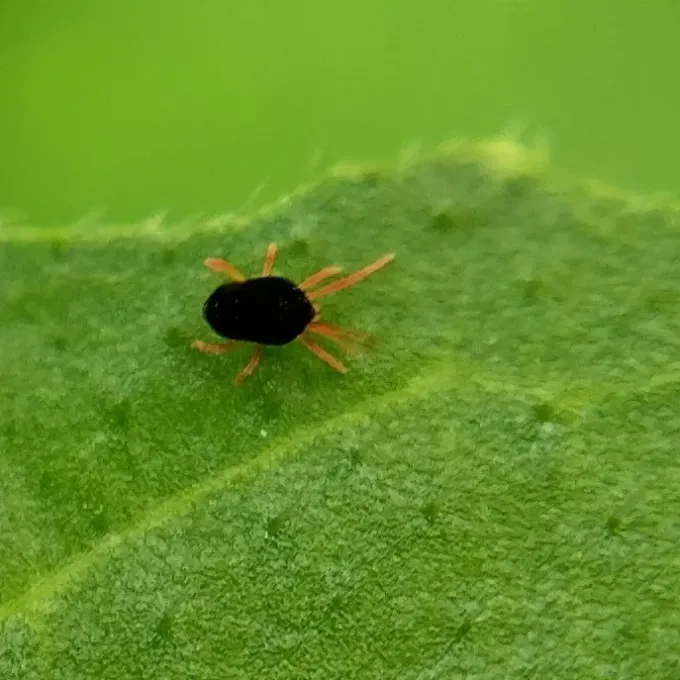
Description
How to identify
The Red-legged earth mite (scientific name: Halotydeus destructor) is a member of the Penthaleidae family and the Trombidiformes order. It is a small arthropod characterized by a velvety black body and bright red legs, which makes it easily recognizable in the field.
Adult mites typically reach a length of about 1 mm. Their body is oval-shaped with a smooth cuticle and four pairs of distinctively bright red legs. A key diagnostic feature is a bright red spot located in the center of the dorsum, which is actually the anal pore.
The lifecycle consists of an egg stage, larva, three nymphal stages, and the adult stage. The species undergoes several generations per year, depending on environmental conditions. Eggs produced at the end of the season are specially adapted to survive harsh conditions, including heat and desiccation.
These mites thrive in cool and moist environments. When temperatures rise and the soil dries out, the mites enter a period of diapause, effectively surviving the summer as resistant eggs in the top layer of the soil until conditions improve.
Spread of the mite is often facilitated by human activities, such as the transport of infested plant material, soil, or agricultural equipment. Wind currents can also carry mites or their eggs over shorter distances, contributing to rapid colonization of new fields.
What it damages
The Red-legged earth mite is a polyphagous pest that attacks a wide range of agricultural crops. Major damage is typically observed in cereals, legumes, and various pasture grasses, particularly during the seedling stage.
Both adults and nymphs cause damage by using their piercing-sucking mouthparts to consume cell sap. This feeding process punctures the epidermis and collapses the plant cells, leading to a significant loss of chlorophyll and vitality.
The most severe impact is seen on young seedlings. A heavy infestation can lead to total crop failure, as the delicate seedlings are unable to survive the persistent feeding pressure, often necessitating replanting of the entire area.
In addition to direct mechanical injury, the feeding process stresses the plants, making them more susceptible to opportunistic fungal infections and other diseases. This leads to stunted growth, reduced biomass, and lower overall yields.
- Winter cereals (wheat, barley).
- Leguminous crops (clover, lucerne, peas).
- Vegetable crops (lettuce, potato, brassicas).
When it appears
The activity of the Red-legged earth mite is highly dependent on climate. They are most active during the cooler and wetter months, typically when temperatures are within the range of 10 to 20 degrees Celsius.
In autumn, following the first significant rainfall, the diapause eggs hatch. This marks the beginning of the new active season, and larvae start feeding immediately on young, emerging crops, which requires vigilant scouting by agronomists.
During the winter months, development continues, though the rate may slow down if temperatures are very low. However, the mites are quite resilient and can persist through most winter conditions as long as moisture is available.
The spring season marks the period of peak reproductive activity, leading to massive increases in population density. This is when the mites cause the most significant economic damage to agricultural production across the fields.
As summer approaches and temperatures rise above 25 degrees Celsius, activity ceases. The adults die off, leaving behind a new batch of resistant eggs in the soil, which will remain dormant until the cycle restarts in the following autumn.
Signs of infestation
The first signs of infestation often appear as fine silvering or white patches on the leaves. This is caused by the mites feeding on the plant cells, which removes the green pigment and leaves behind damaged tissue.
As the infestation progresses, leaf tips may curl, wither, and eventually turn brown. Affected plants appear stunted, display a lack of vigor, and lose their healthy deep green coloration, reflecting the severe stress caused by the mite feeding.
In sunny conditions, mites can often be seen moving actively on the soil surface or the underside of leaves. Their black bodies stand out against the green foliage, making them identifiable upon close inspection of the crop.
Severe infestations manifest as large, scorched-looking patches in the field. If left unmanaged, these patches expand rapidly, causing widespread damage and significant yield loss across the entire agricultural site.
To detect the presence of mites before visible damage appears, agronomists often use the "wet paper" method. By placing a moist white cloth on the soil surface during the early morning, mites will congregate on the fabric, providing a clear count of the pest population density.
Control measures
Cultural control is a cornerstone of management, including deep tillage before planting to bury or destroy egg-laden soil. Maintaining clean fields by controlling weeds is also crucial, as they can act as survival habitats for the mites between crops.
Crop rotation is an effective strategy to break the mite life cycle. By avoiding the cultivation of susceptible crops on the same land for consecutive years, farmers can significantly reduce the potential buildup of mite populations.
Chemical control involves the use of registered acaricides or insecticides. It is essential to apply these treatments at the correct time, specifically when the mites are most active, to ensure maximum efficacy and prevent unnecessary chemical usage.
Application should ideally occur during the early morning or evening when mites are exposed on the plant surface. Good spray coverage is vital to reach the mites, as they often hide in crevices or under the foliage to avoid desiccation.
Biological control, including the use of predatory mites or other natural enemies, can be integrated into broader management systems. While often used in organic production, these strategies require careful timing and management to provide sustainable control levels.
Taxonomy
- Latin name
- Halotydeus
- Order
- Mites
- Family
- Penthaleidae
- EPPO code
- HALOSP
Discussion
No discussions yet — be the first.