
Red-legged earth mite
Penthaleus
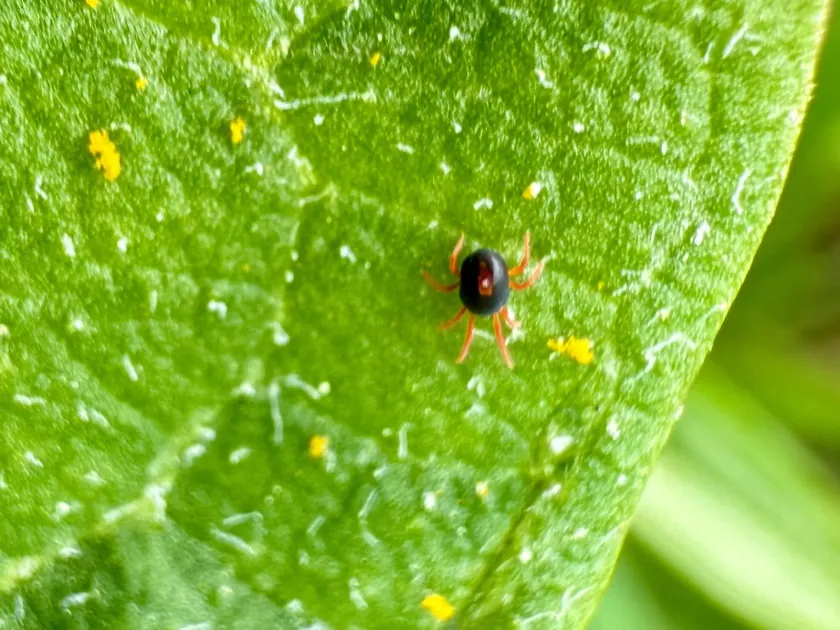
Description
How to identify
The red-legged earth mite (Penthaleus spp.) is a small arthropod belonging to the family Eupodidae within the order Trombidiformes. Adults are recognized by their dark, almost black, rounded bodies and distinctive bright red legs.
A key diagnostic feature is the presence of a conspicuous reddish spot on the dorsal side of the body, which marks the opening of the anal pore, helping distinguish it from similar mites.
These mites are highly active and reproduce primarily through parthenogenesis, allowing populations to expand rapidly during favorable weather conditions such as mild, moist weather.
The life cycle includes two types of eggs: those that develop quickly and those that enter a state of dormancy (diapause) to survive hot, dry summer conditions.
They thrive in cool, moist environments with optimal temperatures ranging from 10°C to 18°C. Temperatures exceeding 25°C typically lead to high mortality or the initiation of diapause.
What it damages
The red-legged earth mite is a polyphagous pest capable of attacking a wide variety of agricultural crops, with winter cereals like wheat, barley, and oats being the most common targets.
Leguminous crops such as clover, lucerne, and peas are also highly susceptible to infestation, often suffering severe leaf damage during the early establishment phases.
Various vegetable crops, particularly brassicas, can be heavily damaged, leading to reduced yield and stunted plant growth if left untreated during critical development stages.
Damage is caused by the mite puncturing the plant epidermis and sucking out the cell contents, which destroys the chlorophyll and causes systemic physiological stress to the plant.
In cases of severe infestation, the cumulative impact of mite feeding can lead to the total loss of seedlings, necessitating costly reseeding efforts for large-scale farmers.
When it appears
The activity of the red-legged earth mite is strongly linked to seasonal climate variations, with peak activity occurring during the cool and moist periods of autumn and spring.
Survival through unfavorable weather is ensured by drought-tolerant eggs that persist in the soil until the return of cool, wet conditions triggers mass hatching.
In spring, as temperatures rise to around 10°C, populations rapidly increase as nymphs emerge from eggs, coinciding with the germination and early growth of many crops.
Summer heat acts as a natural limiting factor for the population, as most active stages of the mite perish when temperatures rise above their physiological tolerance levels.
Understanding the link between rainfall patterns and temperature is essential for predicting outbreaks and timing intervention strategies effectively throughout the growing season.
Signs of infestation
Early signs of infestation manifest as tiny white or silvery spots on the leaves, caused by the localized destruction of leaf cells during the feeding process.
As the infestation progresses, these spots coalesce, giving the foliage a washed-out, dusty, or bleached appearance that is often confused with frost damage or nutrient deficiency.
Heavily infested plants may show signs of curling, wilting, and inhibited growth, which significantly reduces the photosynthetic capacity and overall health of the crop.
Mites can be found on the soil surface or the undersides of leaves during the cooler parts of the day, as they avoid direct, intense sunlight which can be desiccating.
The presence of fine, dark excrement pellets on the surface of the leaves serves as a clear indication of active feeding and the current presence of the mite colony.
Control measures
Effective management begins with integrated pest management (IPM) practices, such as crop rotation, which breaks the pest's cycle by removing host plants from the infested area.
Weed management is critical, as weeds on the perimeters of fields often serve as vital reservoirs that allow the mites to survive and migrate into the main crop.
Chemical control involving acaricides or broad-spectrum insecticides should be applied only when economic thresholds are reached to avoid unnecessary ecological impact.
- Deep tillage to bury crop residues and eggs.
- Adjusting sowing dates to ensure crops reach a less vulnerable stage.
- Using seed treatments to protect young plants during germination.
Timing of chemical application is crucial; treatment should be performed when the mites are most exposed on the leaf surfaces to maximize the contact efficiency of the pesticide.
Taxonomy
- Latin name
- Penthaleus
- Order
- Mites
- Family
- Penthaleidae
- EPPO code
- PENHSP
Discussion
No discussions yet — be the first.