
Red-legged earth mite
Halotydeus destructor
Description
How to identify
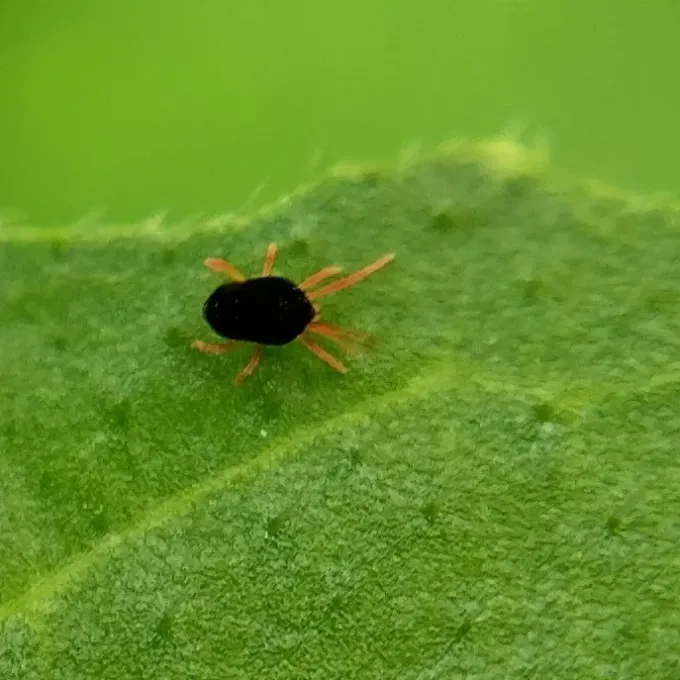
The red-legged earth mite (Halotydeus destructor) is a member of the Penthaleidae family within the Trombidiformes order. It is a distinct, small mite characterized by a velvety black body and bright red legs.
Adult mites typically reach about 1 mm in length and are flightless, relying on crawling to move through the crop canopy and soil surface.
Their life cycle includes egg, larva, three nymph stages, and the adult stage, all of which are sensitive to environmental moisture levels.
These mites possess specialized glands that allow them to produce both active and diapause eggs, the latter being critical for survival during harsh summer conditions.
Identification is easiest in the morning or during overcast days when mites are actively feeding on the upper leaf surfaces.
What it damages
Halotydeus destructor is a highly polyphagous pest, causing significant damage to various crops, including clover, lucerne, cereals, and numerous vegetables.
The mites pierce the plant cells and extract sap, which leads to the collapse of the leaf tissue and a reduction in the plant's overall photosynthetic capacity.
Seedling damage is particularly severe; heavy infestations can lead to complete stand loss, necessitating costly re-sowing of fields.
Pasture productivity is frequently compromised, as mite feeding reduces the available forage mass and impairs the recovery of grazed grass.
Plant vigor is significantly reduced, making the affected crops more susceptible to secondary environmental stresses and disease infections.
When it appears
Mite activity is strictly seasonal, primarily occurring during the cool and moist periods of the autumn and spring seasons.
The first generation typically emerges from oversummering eggs in autumn, provided there is enough moisture to trigger the hatching process.
Spring serves as the period of peak mite density, during which rapid reproduction cycles contribute to the highest level of crop damage.
During the hot and dry summer months, active mites perish, and the species persists solely through its resistant, dormant egg stage in the soil.
Understanding these seasonal patterns is essential for the effective timing of chemical interventions and preventative management practices.
Signs of infestation
The primary symptom of infestation is the development of silvering or whitish spots on the leaves, caused by the destruction of leaf cells.
Leaves often curl and take on a chlorotic appearance, eventually leading to stunted growth or total wilting of the young seedlings.
Close observation of the soil surface or the base of the plants will reveal tiny, fast-moving, black mites, often in clusters.
Necrotic patches frequently spread across the entire leaf surface, reducing the plant's ability to recover from environmental damage.
Heavy feeding can cause the plants to turn gray or brown, with a distinct ragged appearance on the foliage margins.
Control measures
Effective management begins with strict weed control, as weeds provide a sanctuary for mite populations to survive between cropping seasons.
Crop rotation and the use of resistant cultivars, where available, serve as fundamental pillars of an integrated pest management strategy.
- Application of systemic or contact insecticides when thresholds are exceeded.
- Use of insecticide-treated seed to protect vulnerable seedlings during the early growth stages.
- Monitoring population numbers using suction traps or visual assessment tools.
Grazing management can also be used to reduce the amount of surface litter, which in turn limits the habitat available for mite populations.
Biological control agents, such as predatory mites (e.g., Anystis wallacei), are increasingly being used to suppress red-legged earth mite numbers naturally.
Taxonomy
- Latin name
- Halotydeus destructor
- Order
- Mites
- Family
- Penthaleidae
- EPPO code
- HALODE
Discussion
No discussions yet — be the first.