
Poplar spiral gall aphid
Pemphigus spirothecae
Description
How to identify
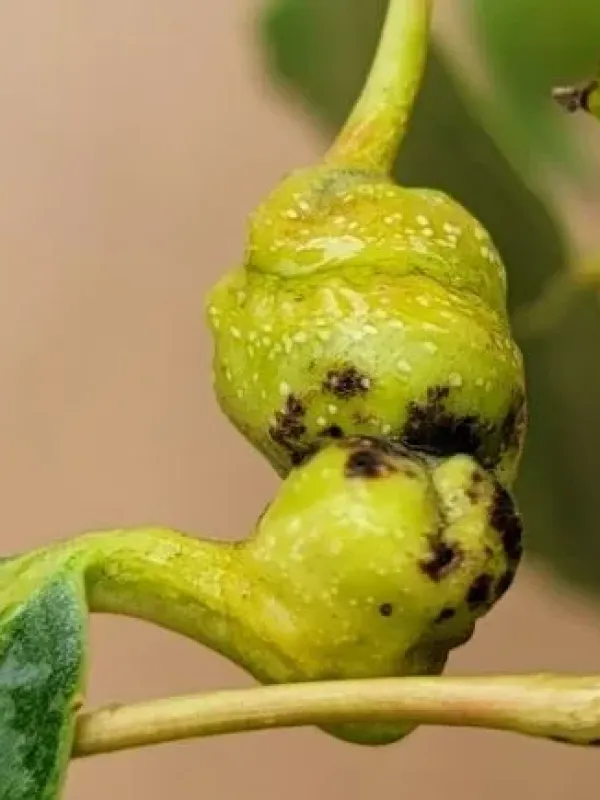
The poplar spiral gall aphid (Pemphigus spirothecae) is a specialized insect from the family Aphididae that creates distinct spiral-shaped galls on the petioles of poplar leaves.
The life cycle of this species is complex and involves host alternation. Females emerge from eggs in spring, settle on petioles, and initiate the formation of a gall, which serves as a secure habitat for the colony.
These aphids are small and often covered with a white, waxy secretion. This substance helps keep them dry and protected within the humid environment of the gall.
The insect possesses a specialized stylet to feed on the plant tissues, simultaneously releasing chemicals that force the plant to grow abnormal tissue around the aphids.
By mid-summer, winged aphids develop within the gall, eventually emerging to migrate to secondary hosts, typically herbaceous plants, to continue their reproductive cycle.
What it damages
The primary hosts for this pest are Populus nigra and its cultivars, including the Lombardy poplar. The damage is restricted to the leaf stalks (petioles).
The formed galls, which are spiral and twisted, significantly disrupt the vascular system of the leaf petiole, hindering the transport of water and nutrients.
Severe infestations lead to stunted leaf growth, chlorosis, and premature leaf drop, which diminishes the ornamental value of urban and parkland poplars.
Long-term infestation can weaken the host tree, making it more susceptible to environmental stress, secondary pests, and various fungal diseases.
Young trees are particularly vulnerable, as heavy gall formation can deform the leaf structure and stunt the growth of new shoots during the critical spring period.
When it appears
The life cycle begins in early spring when overwintering eggs hatch into fundatrices (stem mothers) that move to the emerging leaves.
During the months of May and June, the aphids are actively inside the developing galls. This is the period when the characteristic swellings become most visible on the trees.
In mid-summer, the colony reaches its peak, and winged forms begin to emerge to migrate away from the poplar to secondary host plants.
During autumn, the cycle completes as the sexual generation returns to the poplar trees to mate and lay overwintering eggs in bark crevices.
Consequently, the aphid is essentially hidden within the foliage during most of the summer, leaving only the empty or occupied galls as evidence of their activity.
Signs of infestation
The most obvious sign of infestation is the presence of tightly coiled, spiral galls on the petioles of poplar leaves. These galls often turn green to reddish-brown.
Upon breaking open a gall, one can find a high density of small aphids and their white, waxy secretions inside the hollowed-out chamber.
The leaves affected by these galls are often smaller and may show signs of yellowing or curling compared to healthy, unaffected foliage on the same tree.
The presence of honeydew secreted by the aphids can lead to the growth of sooty mold, appearing as a black, powdery coating on the surface of the leaves.
Affected leaves are prone to premature senescence and abscission, leading to sparse foliage on the tree branches throughout the summer months.
Control measures
Controlling the poplar spiral gall aphid is challenging because the galls protect the aphids from contact insecticides once they are fully formed.
Management must be proactive, focusing on early spring applications of systemic insecticides before the aphids successfully seal themselves within the gall tissue.
Maintaining tree vigor through proper watering and soil fertilization can help the poplar withstand the stress caused by the aphid infestation.
Sanitation practices, such as raking and destroying fallen leaves in the autumn, can reduce the number of overwintering eggs available for the next season.
- Use systemic insecticides targeting the sap-feeding phase in early spring.
- Prune and destroy heavily infested branches in nursery or young tree settings.
- Encourage natural predators like lady beetles and lacewings.
Taxonomy
- Latin name
- Pemphigus spirothecae
- Order
- Hemiptera (bugs, aphids, leafhoppers)
- Family
- Aphididae
- EPPO code
- PEMPSI
Discussion
No discussions yet — be the first.