
Poplar twig gall aphid
Pemphigus populiramulorum
Description
How to identify
The poplar twig gall aphid (Pemphigus populiramulorum) is a member of the family Aphididae, order Hemiptera. This insect is a specialized gall-former that targets specific tree species.
The insects are small and soft-bodied, typical for aphids, but they are uniquely characterized by their ability to induce the host plant to create large, protective structures known as galls.
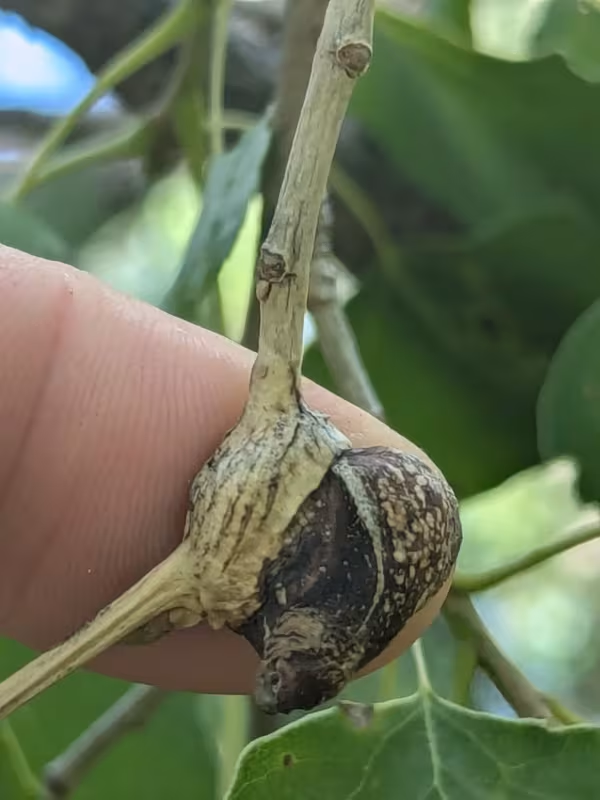
Identification is easiest by observing the presence of round or oval, often woody-textured galls located primarily on the leaf petioles or young twigs of the poplar tree.
This species exhibits a complex heterogynous life cycle, moving between the primary host (poplar) and secondary herbaceous hosts, often involving root-feeding phases.
Winged adults emerge in mid-summer from the galls to disperse and seek secondary hosts, where they continue their reproductive cycle until late autumn.
What it damages
The primary hosts for this aphid are members of the Populus genus, particularly cottonwoods and related poplar varieties found in landscapes and forests.
The aphid feeds on plant sap, which extracts vital resources from the twig, potentially stunting shoot growth and overall tree vigor if infestations are heavy.
While the physiological impact is usually manageable for mature trees, the aesthetic damage caused by large, visible galls is significant in urban park management.
Severe infestations can cause premature yellowing of foliage and early leaf drop, which puts additional stress on the tree during the peak summer months.
Weakened trees may become more susceptible to secondary stressors, including wood-boring insects and opportunistic fungal infections in the bark.
When it appears
The life cycle on poplar begins in early spring when overwintering eggs hatch and the stem mothers initiate feeding on developing buds.
During the spring, the aphid stimulates rapid, localized plant cell growth, which eventually envelopes the colony, creating the characteristic gall structure.
The period from May through July is critical for gall formation and the development of the winged generation, which eventually emerges to leave the poplar.
After migrating from the tree, the aphid spends the remainder of the summer and autumn feeding on the root systems of various herbaceous plants.
As temperatures drop, a return migration to the poplar occurs, where adult aphids lay the overwintering eggs in bark crevices to survive until the next season.
Signs of infestation
The most distinctive sign of infestation is the appearance of spherical or walnut-sized swellings on the leaf stems, which appear during the spring growth phase.
These galls often transition from light green to a brownish or reddish tint as the season progresses, becoming very conspicuous against the tree canopy.
If a gall is dissected during the active growth period, one can observe a dense colony of aphids, typically dusted with white, waxy secretions that protect them.
The presence of dried, brown, and hollow galls in late summer indicates that the aphids have completed their poplar-based cycle and have already migrated.
Sticky honeydew secretions may drip from infested twigs, potentially causing black sooty mold to grow on the leaves and branches beneath the colonies.
Control measures
Chemical control must be applied early in the spring, specifically when the buds begin to break and before the galls have completely formed to enclose the aphids.
Systemic insecticides are the most effective management tool, as they are absorbed into the plant tissue, reaching the aphids feeding within or near the developing galls.
For smaller trees or individual landscaping specimens, pruning out infested twigs during the spring can help reduce the local population density significantly.
Maintaining high tree health through proper irrigation and soil care helps trees tolerate the damage caused by these aphids without long-term negative effects.
Biological management, including the protection of natural predators like lady beetles and lacewings, can help control aphid numbers in natural environments.
Taxonomy
- Latin name
- Pemphigus populiramulorum
- Order
- Hemiptera (bugs, aphids, leafhoppers)
- Family
- Aphididae
- EPPO code
- PEMPPM
Discussion
No discussions yet — be the first.