
Poplar gall aphid
Pemphigus populi
Description
How to identify
The poplar gall aphid is a member of the Aphididae family, known for its complex life cycle that involves distinct primary and secondary host plants during different seasons.
The insect is characterized by the formation of specialized galls on the petioles or leaves of poplar trees, which serve as protective micro-environments for the aphid colonies.
The life cycle begins with overwintering eggs located in the bark crevices of host trees. In the spring, fundatrix larvae emerge and initiate the development of the characteristic galls.
Throughout the summer, the aphid produces generations of winged and wingless individuals, facilitating both local colonization and migration to secondary hosts like herbaceous plants.
This dual-host strategy allows the poplar gall aphid to survive throughout the year, exploiting different resources during the growing season and ensuring survival during the dormant period.
What it damages
The primary damage is caused by the aphid feeding on the sap of the poplar tree, which leads to the formation of structural galls that disrupt the normal flow of nutrients.
Heavy infestations result in leaf distortion, chlorosis, and premature senescence, significantly reducing the photosynthetic efficiency and aesthetic value of the poplar trees.
Besides affecting poplar trees, the aphid also causes damage to the root systems of its secondary host plants, leading to a general decline in the vigor and health of these plants.
Stunted growth of new shoots is a common consequence of sustained annual infestations, as the tree redirects energy towards coping with the physiological stress of the aphid colonies.
Weakened trees are often more susceptible to secondary infections by pathogens and environmental stressors, which can ultimately lead to premature dieback or limb loss.
When it appears
Activity starts in early spring as soon as the poplar buds begin to open, which coincides with the hatching of the fundatrix larvae from the overwintering eggs.
May and June are the peak periods for gall formation, during which the aphid population multiplies rapidly within the protective tissues of the host tree leaves.
Mid-summer is marked by the migration phase, when winged aphids emerge and travel to secondary host plants to continue their reproductive cycle throughout the warmer months.
Autumn brings the return of the aphids to the poplar trees, where they lay the eggs that will remain dormant during the winter, completing the annual developmental cycle.
Weather conditions, particularly spring temperatures, play a critical role in the timing of aphid emergence and the subsequent speed of gall formation on the trees.
Signs of infestation
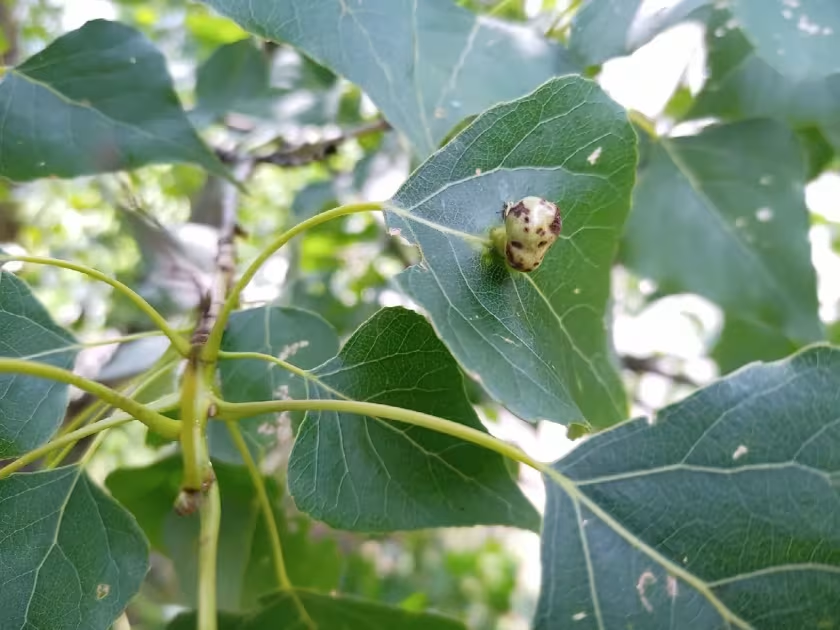
The most visible indicator of infestation is the presence of galls—abnormal swelling or spherical growths occurring on the petioles of the poplar leaves.
Galls often start as light green and may turn reddish or brownish as the aphid colony matures inside, making them highly visible against the green foliage.
Leaves associated with the galls frequently exhibit curling, yellowing, or abnormal shrinkage, and they may drop from the tree earlier than uninfested, healthy foliage.
Large numbers of ants on the tree branches can also be a secondary sign, as they are often attracted to the honeydew excreted by the aphids during their development.
Inspection of a gall typically reveals a dense cluster of aphids, which serves as a definitive confirmation of the presence of the poplar gall aphid.
Control measures
Preventative control involves dormant-season sprays applied to the tree trunks to eliminate overwintering eggs before they can hatch in the spring.
Systemic insecticides are the most effective intervention during the growing season, as they can penetrate the leaf tissues and reach the aphids hidden inside the protective galls.
Manual removal of infested leaves or branches in the late spring or early summer can effectively reduce the local population density if the infestation level is manageable.
In landscaping, choosing resistant poplar clones or cultivars can significantly decrease the likelihood of recurring problems with this specific aphid species.
- Encouraging natural predators such as lady beetles, hoverflies, and lacewings.
- Maintaining tree health through proper irrigation and nutrition to boost resilience.
- Monitoring nursery stock for early signs of gall formation to prevent spread.
Taxonomy
- Latin name
- Pemphigus populi
- Order
- Hemiptera (bugs, aphids, leafhoppers)
- Family
- Aphididae
- EPPO code
- PEMPPP
Discussion
No discussions yet — be the first.