
Poplar gall aphid
Pemphigus immunis
Description
How to identify
The poplar gall aphid (Pemphigus immunis) is a member of the family Aphididae within the order Hemiptera. It is a highly specialized pest characterized by a complex life cycle involving alternation of generations and different host plants.
Adult individuals are typically small, oval-shaped insects measuring about 2-3 mm in length. They are often covered with a white, waxy secretion that acts as a protective barrier against environmental stressors.
The taxonomic classification relies on the morphology of winged migrants, which emerge during the summer. These individuals are responsible for dispersal and locating secondary host plants, such as various grasses or herbs.
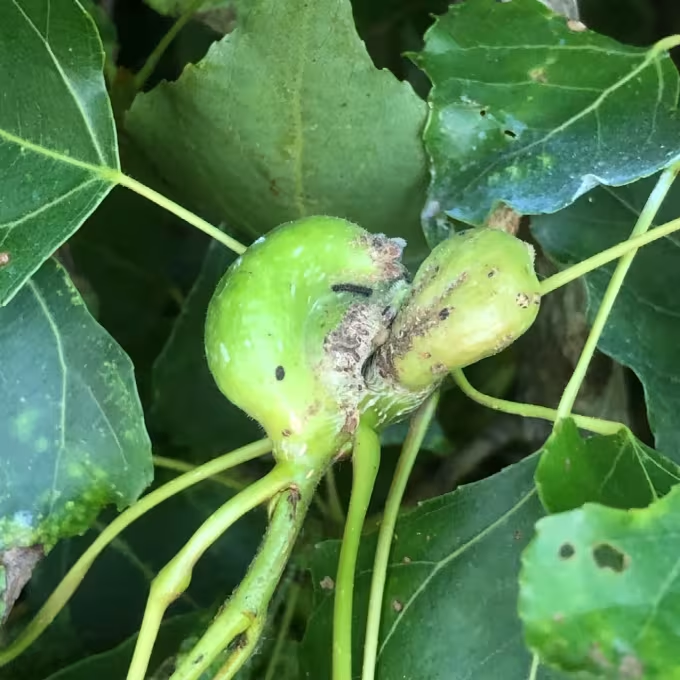
The species is best known for its ability to induce galls on the leaves and petioles of poplar trees (Populus). These galls serve as protected micro-habitats where the aphid population develops and feeds securely.
Identification in the field is usually based on the presence of these distinctive galls. Although the insects are hidden within, the structural abnormalities on the leaf tissue provide clear diagnostic evidence of their presence.
##damage##Poplar trees, particularly the Populus genus, are the primary hosts for this aphid. The feeding activity involves inserting piercing-sucking mouthparts into the plant tissue, which triggers a biological response leading to gall formation.
These galls are not just deformities; they function as metabolic sinks that drain nutrients and water from the host tree. This redirection of resources can negatively impact the tree's annual growth increments and overall health.
Heavy infestations lead to leaf chlorosis, curling, and premature senescence. In young stands or nursery settings, this can severely stunt development and increase susceptibility to secondary pathogens or drought stress.
The visual impact of infested trees is significant, especially in urban landscapes. The presence of numerous galls on the foliage diminishes the aesthetic value of public parks and residential greenery.
Furthermore, the excretion of honeydew by the aphids fosters the growth of sooty mold. This layer of black fungus coats the leaves, interfering with photosynthesis and gas exchange, further weakening the tree's vigor.
##season##The life cycle begins in early spring when stem mothers (fundatrices) hatch from overwintering eggs located in bark crevices. This emergence is perfectly synchronized with the bud burst of the poplar trees.
Throughout late spring and early summer, the aphid population grows rapidly within the developing galls. Multiple generations may occur during this period, allowing the population to reach its peak density.
By mid-summer, winged migrants are produced. They abandon the poplar host and fly to secondary herbaceous hosts, where they continue their reproductive cycle on the roots or leaves of the alternate plant species.
In the autumn, a return migration occurs. Winged sexual forms fly back to the poplar trees to mate. The fertilized females then deposit eggs in sheltered areas of the bark to survive the winter months.
Climate factors such as temperature during the spring play a critical role in the timing of the initial infestation. Warmer springs usually lead to faster gall development and higher early-season aphid pressure.
##signs##The most prominent sign is the development of galls on the petioles or midribs of the leaves. These structures appear as swellings or abnormal growths that vary in shape and color, often appearing greenish or reddish.
A closer inspection of the crown might reveal deformed, curled, or stunted leaves. This chlorotic appearance is a classic sign that the tree is struggling to maintain normal photosynthetic capacity.
The presence of ants on the tree trunk is another indicator. Ants are attracted to the honeydew produced by aphids and will actively protect them from predators, maintaining a symbiotic relationship that sustains the colony.
Sticky, shiny residue on the foliage indicates honeydew secretion. This is often followed by the appearance of dark, sooty mold patches on the leaves or branches below the infestation site.
- Spherical or elongated galls on leaf petioles.
- Curled, yellowed, and malformed leaves.
- Visible trails of ants on the bark of the tree.
- Dark sooty mold residue on leaves.
Chemical control is most effective when applied early in the spring, just as the buds are opening. Systemic insecticides are the preferred choice, as they provide protection before the aphids are enclosed within the protective gall tissue.
In nurseries and young plantations, monitoring for initial symptoms is crucial. Once the galls are fully formed, chemical sprays become significantly less effective because the aphids are physically shielded from contact.
Cultural management involves removing and destroying fallen leaves during the autumn. By eliminating the debris that may harbor overwintering stages, growers can reduce the initial infestation pressure for the following season.
Conservation of natural enemies is essential for long-term suppression. Predators such as ladybird beetles, lacewings, and syrphid fly larvae play a vital role in regulating aphid populations if they are not disrupted by broad-spectrum pesticides.
Maintaining tree vigor through proper irrigation and fertilization can help the host plant better withstand the physiological stress caused by aphid feeding, reducing the overall impact of the pest on tree longevity.
Taxonomy
- Latin name
- Pemphigus immunis
- Order
- Hemiptera (bugs, aphids, leafhoppers)
- Family
- Aphididae
- EPPO code
- PEMPIM
Discussion
No discussions yet — be the first.