
Leopard moth (Zeuzera pyrina)
Parula americana
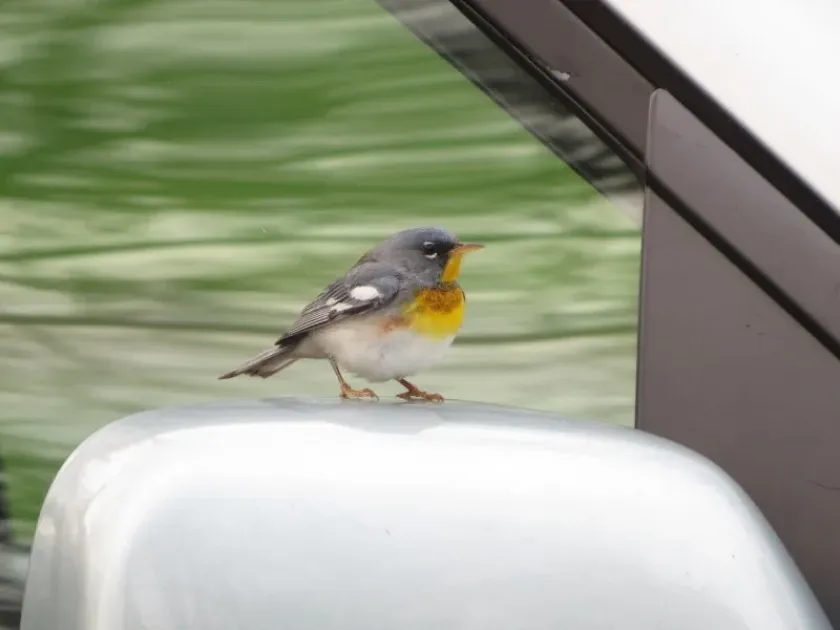
Description
How to identify
The Leopard moth (Zeuzera pyrina) is a significant wood-boring pest belonging to the Cossidae family. Adult moths have a wingspan of up to 70 mm and a striking appearance.
The wings are white and densely covered with numerous dark blue-black spots, resembling the skin of a leopard, which gives the species its common name.
The body is covered in thick hair, and the insects are primarily nocturnal. Their flight patterns are erratic, and they are attracted to artificial light sources during the night.
Larvae are yellow-white with dark, glossy spots and a black head. As they grow, they become quite large, often reaching 60 mm in length.
The life cycle is complex, often taking two to three years to complete depending on the climate, which makes the management of this pest a long-term challenge.
What it damages
This pest is highly polyphagous, attacking a wide variety of deciduous trees, including popular orchard species like apple, pear, and stone fruits.
Larvae burrow into the shoots, branches, and trunks of trees. These galleries disrupt the flow of water and nutrients, leading to branch dieback and overall tree weakening.
Young trees are particularly vulnerable, as a single larva can potentially girdle and kill a young sapling by boring through the main stem.
Branches weakened by larval activity are highly susceptible to wind damage and may snap, causing significant loss of fruit yield and structural integrity.
Extensive infestations lead to the formation of secondary wounds, which become entry points for fungal pathogens, further complicating the health status of the tree.
When it appears
Adult moths typically emerge from June to August. They remain inactive during the day, hiding in bark crevices or foliage, and become active at twilight.
Females lay hundreds of eggs, depositing them singly or in small clusters in bark crevices or near leaf buds on healthy trees.
Upon hatching, young larvae immediately bore into fresh, green shoots. As they increase in size, they move into larger, woodier parts of the tree.
Larvae overwinter inside the galleries they have carved out. This protective environment ensures their survival through cold winters and unfavourable weather conditions.
Pupation takes place within the branch or trunk in the spring. Before the adult moth emerges, the pupa pushes itself halfway out of the exit hole.
Signs of infestation
The most reliable sign of an infestation is the presence of brown, sawdust-like frass (excrement) expelled from small holes in the bark.
Branch wilting is a clear indication that a larva has compromised the vascular system of the shoot. These branches often turn yellow and dry out during the summer.
Sap bleeding or gumming on the bark surface is a frequent reaction of the tree to internal damage caused by the tunneling larvae.
If you perform a cross-section of a damaged branch, you will clearly see the longitudinal tunnels that the larvae have excavated.
- Sudden wilting of branch tips in mid-summer
- Sawdust-like debris at branch crotches
- Small, round entry holes on the trunk or bark
- Premature leaf drop and branch death
Control measures
Pruning and destroying infested branches as soon as symptoms appear is the most effective cultural method to stop the spread of larvae.
For valuable trees, a wire can be inserted into the entry holes to mechanically kill the larvae. This is labor-intensive but highly effective for small infestations.
Systemic insecticides can be applied during the period when young larvae are moving from eggs to the wood, providing a chemical barrier against entry.
Pheromone traps are used to monitor moth populations, allowing growers to time their insecticide applications precisely to coincide with peak adult flight.
Maintaining optimal tree health through proper irrigation and balanced fertilization helps trees seal wounds and resist the secondary effects of borer damage.
Taxonomy
- Latin name
- Parula americana
- Family
- Parulidae
- EPPO code
- PRULAM
Discussion
No discussions yet — be the first.