
Citrus whitefly
Paraleyrodes minei
Description
How to identify
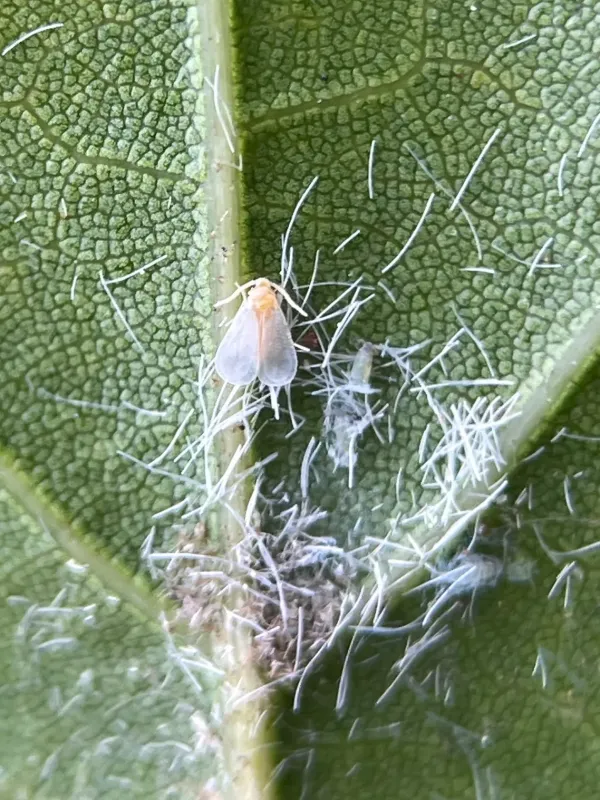
The citrus whitefly (Paraleyrodes minei) belongs to the order Hemiptera and the family Aleyrodidae. Adults are small insects characterized by white wings with distinct dark spots, a key identification feature.
The lifecycle includes the egg stage, four larval instars (nymphs), and the adult stage. Females typically lay eggs on the underside of leaves, often in circular patterns.
While the first instar larvae are mobile, they quickly settle to feed on plant sap, eventually secreting protective waxy filaments that cover their bodies during later stages.
The rate of development is heavily dependent on ambient temperature, with warmer conditions leading to faster lifecycle completion and overlapping generations.
Accurate identification is critical as this species can be mistaken for other common whiteflies; observation of the specific wing markings under magnification is recommended.
What it damages
Paraleyrodes minei primarily attacks citrus crops, including lemons, oranges, and mandarins, affecting both young shoots and mature foliage in orchards and nurseries.
The pest may occasionally be found on various ornamental plants, which can act as alternative hosts and facilitate the spread of the insect between fields.
Feeding by larvae and adults drains plant nutrients, leading to reduced vigor, stunted growth, and a significant decline in the overall quality of citrus production.
The production of honeydew promotes the growth of sooty mold, which covers the leaf surface, effectively blocking photosynthesis and reducing the market value of the fruit.
Severe infestations can lead to heavy defoliation, which weakens the tree structure and may cause significant yield losses in commercial orchards.
Signs of infestation
The most visible symptom is the appearance of white, cotton-like wax deposits on the underside of the leaves, where the larval colonies are established.
A tell-tale sign of an active infestation is the sudden emergence of a white cloud of small insects when the foliage of a citrus tree is shaken.
The presence of a sticky, glistening substance known as honeydew on the leaves and branches indicates that the whitefly population is currently feeding.
Leaves may exhibit yellow chlorotic spots at the site of feeding, followed by curling or distortion as the insect's saliva affects the plant tissue.
Premature leaf drop, often accompanied by a black coating of sooty mold, serves as a late-stage warning of high pest density requiring immediate action.
Control measures
Effective management requires an Integrated Pest Management (IPM) approach that combines monitoring, biological control agents, and judicious chemical applications.
Biological control involves releasing natural predators or parasitoids, such as specific wasps that target whitefly nymphs, to keep populations below the economic threshold.
Chemical control programs should rotate between different insecticide classes (e.g., neonicotinoids, insect growth regulators) to avoid the development of resistance.
Monitoring with yellow sticky traps provides essential data on population density, allowing growers to time their insecticide applications for maximum efficacy.
Cultural practices, such as maintaining proper spacing and pruning trees to ensure good aeration, create a less favorable environment for the whitefly to thrive.
Taxonomy
- Latin name
- Paraleyrodes minei
- Order
- Hemiptera (bugs, aphids, leafhoppers)
- Family
- Aleyrodidae
- EPPO code
- PARYMI
Discussion
No discussions yet — be the first.