
Japanese citrus whitefly
Parabemisia myricae
Description
How to identify
The Japanese citrus whitefly (Parabemisia myricae) belongs to the order Hemiptera and the family Aleyrodidae. Adult insects are very small, typically around 1 mm in length, and are covered with a fine white waxy powder.
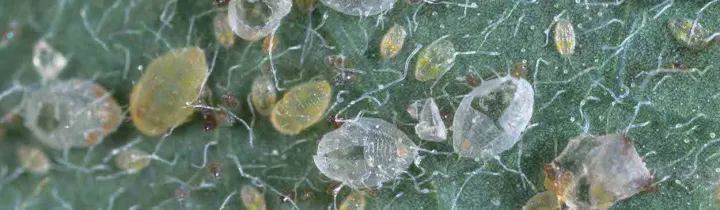
The biological cycle consists of an egg stage, three nymphal stages, and a pupal stage. Nymphs are oval-shaped and flattened, often appearing translucent or pale yellow, making them cryptic on the underside of leaves.
Adult whiteflies are highly active fliers and are attracted to young, developing foliage to feed and lay eggs. This behavior ensures that the next generation has immediate access to nutrient-rich plant sap.
Development from egg to adult is temperature-dependent and can be completed in as little as 15-20 days during warm summer months. This rapid turnover leads to overlapping generations and significant population explosions.
Field identification requires close inspection of young leaves using a hand lens. You should specifically target the abaxial (bottom) side of leaves near the terminal shoots where whitefly aggregations are most frequent.
What it damages
Primary hosts for this species are citrus trees, including lemons, oranges, and mandarins. The pest can also infest various alternative host plants, contributing to its widespread distribution in subtropical regions.
Damage is caused by both adults and nymphs piercing the leaf surface to suck sap. This feeding drains the plant of essential nutrients, leading to stunted shoot growth and loss of tree vigor.
The whitefly excretes honeydew, a sugary byproduct that coats the leaves. This serves as a primary substrate for the colonization of sooty mold, which creates a thick black layer over the canopy.
The presence of sooty mold effectively shades the leaves, inhibiting photosynthesis and leading to premature leaf drop. Consequently, the tree's health declines, and the quality of the fruit is severely degraded.
In cases of severe infestation, the cumulative damage results in significant economic loss for producers. Deformed fruit and reduced yields make trees unattractive and non-productive for subsequent harvest seasons.
Signs of infestation
A tell-tale sign is the presence of white, flying adults that disperse in clouds when branches are disturbed. This is usually the first indication that a population is becoming well-established.
Sticky honeydew residues on leaves and fruit surfaces, which eventually turn black due to sooty mold growth, clearly indicate the presence of sap-sucking pests in the canopy.
Leaves often exhibit chlorosis, curling, and abnormal deformation. Terminal shoots might cease to grow, resulting in a bushy, stunted appearance of the branch tips.
An increase in ant activity within the tree canopy is a strong indicator of whitefly presence. Ants are attracted to the honeydew and often protect the whitefly nymphs from natural predators.
Visual inspection of the underside of leaves reveals numerous immobile, scale-like nymphs. These look like small, flat, translucent patches that are firmly attached to the leaf epidermis.
Control measures
Biological control using parasitoid wasps, such as species from the genus Eretmocerus, is highly effective in managing populations. These natural enemies can significantly reduce whitefly densities in orchard environments.
Yellow sticky traps are recommended for monitoring populations and capturing mobile adults. Placing these traps strategically throughout the canopy helps detect infestation early before it reaches economic thresholds.
Chemical control involves the use of systemic insecticides that are absorbed by the plant. These chemicals disrupt the feeding process of the whitefly and are generally most effective when applied during nymphal development stages.
Cultural practices include the removal of infested shoots and thinning of the canopy to increase airflow. Proper irrigation and fertilization are also essential to help trees recover from the stress of feeding damage.
Oils, such as horticultural mineral oils, can be applied to coat the nymphs and cause mortality through suffocation. This method is environmentally friendly and often integrated into broader Integrated Pest Management (IPM) programs.
Taxonomy
- Latin name
- Parabemisia myricae
- Order
- Hemiptera (bugs, aphids, leafhoppers)
- Family
- Aleyrodidae
- EPPO code
- PRABMY
Discussion
No discussions yet — be the first.