
Depressed flour beetle
Palorus subdepressus
Description
How to identify
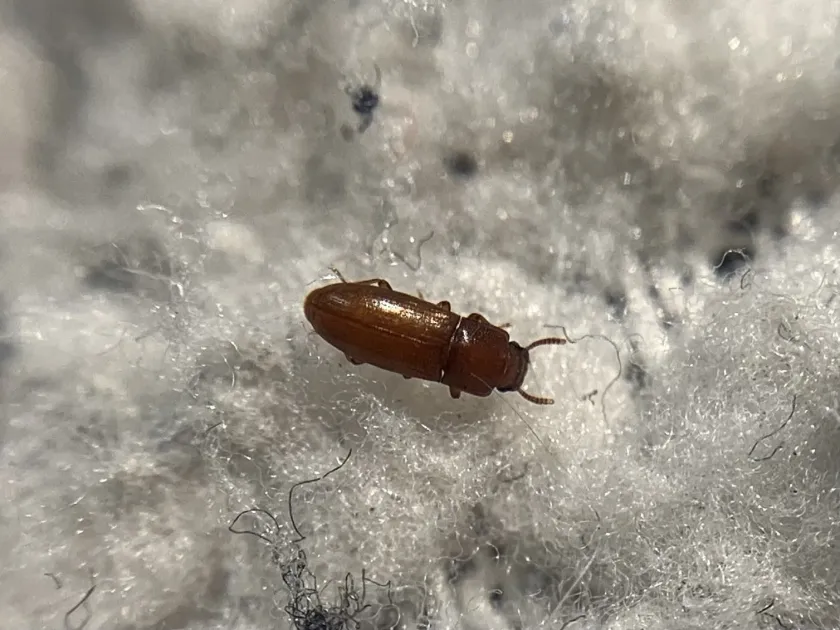
The Depressed flour beetle (Palorus subdepressus) is a small, flattened beetle belonging to the Tenebrionidae family. Adults are roughly 3 mm long and reddish-brown in color, well-adapted to living in confined spaces.
The larvae are cylindrical and creamy-white, capable of burrowing deep into grain masses and processed flour products. They are highly mobile and elusive.
Due to their small size and light-avoiding behavior, these beetles often dwell in the crevices of storage bins, beneath floorboards, and within conveyor machinery.
The morphological characteristics, such as the shape of the pronotum and specific sensory organs, allow entomologists to distinguish this species from other flour beetles.
These insects are notoriously hardy and can survive in environments that would be unfavorable for other species of stored-product pests.
##damage##This beetle is a serious threat to wheat, barley, rye, flour, bran, and various oilseeds. It also frequently infests dried fruits and stored spices in industrial facilities.
The larvae feed primarily on the germ of the grain kernel, causing a drastic reduction in germination rate, which is devastating for seed storage facilities.
Infestation by Palorus subdepressus leads to the contamination of goods with excrement, larval skins, and metabolic waste, significantly lowering the market value of the crop.
By breaking the grain integrity, the beetles introduce fungi and bacteria, which accelerates the spoilage of the entire stored batch.
The pests often congregate in large numbers, causing local heating of the grain mass and facilitating further development of secondary pests and mold.
When it appears
In temperature-controlled warehouses, the Depressed flour beetle can reproduce throughout the entire year, with optimal development occurring at 25–30°C.
The life cycle involves egg, larva, pupa, and adult stages. The total time for one generation depends heavily on temperature and the moisture content of the substrate.
Females lay eggs directly into the flour or broken grain, ensuring that larvae are surrounded by a constant food source from the moment of hatching.
During winter months in unheated storage areas, adult beetles may remain inactive in deep, protected layers of grain, surviving until spring.
Rapid population growth is often observed when grain is stored at moisture levels above 13%, which significantly speeds up the metabolic rate of the insects.
Signs of infestation
The presence of fine flour-like dust on the surface of grain bags or bins is a primary indicator that the beetles are active within the product.
A foul, musty odor emanating from the storage facility often points to a high infestation density and the subsequent degradation of the stored material.
Inspectors often find clumping of flour or grain, which is caused by the sticky excreta of the beetles and the webbing of secondary organisms associated with them.
- Increased temperature within the stored grain (hot spots).
- Visual presence of small reddish-brown beetles on bin walls.
- Detection of larvae during mechanical sieving of grain samples.
- Reduced flowability of grain in vertical storage units.
Routine monitoring using pheromone traps and regular sampling is essential for early detection before the population reaches economic injury levels.
Control measures
The first line of defense is strict sanitation: removing spilled grain and flour dust from all areas, especially in hard-to-reach spots under machinery.
Before stocking new grain, all storage containers must be cleaned and treated with appropriate contact insecticides to eliminate any remaining population.
Maintaining the moisture content of the grain below 12% is one of the most effective non-chemical ways to prevent the successful development of larvae.
Fumigation with authorized chemicals is necessary in cases of severe infestation to penetrate the cracks and crevices where these beetles typically hide.
Active aeration and cooling of the grain mass can inhibit the beetle's biological activity, serving as an important part of an Integrated Pest Management (IPM) program.
Taxonomy
- Latin name
- Palorus subdepressus
- Order
- Coleoptera (beetles)
- Family
- Tenebrionidae
- EPPO code
- PALSSU
Discussion
No discussions yet — be the first.