
Depressed flour beetle
Palorus ficicola
Description
How to identify
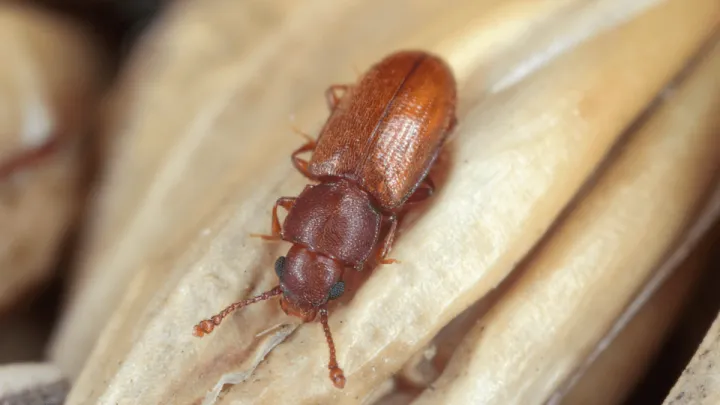
The depressed flour beetle (Palorus ficicola) is a small beetle belonging to the Tenebrionidae family. It typically measures between 2 to 2.5 mm in length, possessing an elongated and flattened body shape.
The name of the beetle comes from its club-shaped antennae. Its body is reddish-brown and covered with fine punctures, and its pronotum features characteristic angular edges that distinguish it from similar species.
The larvae are approximately 3–4 mm long and have a cylindrical, whitish-yellow body. They possess three pairs of thoracic legs and two distinct pointed appendages at the end of the abdomen.
These beetles thrive in warm, humid conditions, with an optimal temperature range of 25–30 °C. Under these favourable circumstances, the life cycle from egg to adult takes approximately 4–6 weeks.
The depressed flour beetle prefers a secretive lifestyle, often hiding in dark, inaccessible cracks and crevices in storage facilities, which makes detecting an infestation early on quite challenging.
What it damages
This pest is a common inhabitant of food storage facilities and specialises in feeding on dry plant-based products, including cereals, flour, bran, legumes, and oilseed products.
Both adults and larvae inflict damage by boring into individual grains. They consume the germ and endosperm, effectively destroying the nutritional value and germination potential of the stored product.
Beyond the direct consumption of grain, these beetles promote the growth of moulds and bacteria. Their activity causes the grain mass to heat up, a condition known as "hot spots," leading to significant spoilage.
The species is frequently found in flour mills, bakeries, and feed processing plants. They can also infest dried fruits, nuts, and compound animal feeds, contaminating them with excrement and cast-off larval skins.
The greatest economic impact occurs during long-term storage in poorly maintained facilities where old grain remnants serve as a permanent reservoir for the pest population.
Signs of infestation
The primary indicators of infestation include tiny boreholes in grains and the accumulation of a fine powdery substance (frass). The grain often develops an unpleasant, musty odour due to insect secretions.
During inspections, clusters of beetles may be found in corners, under flooring, or within cracks in the walls. They are often concentrated in areas where dust and spilled grain accumulate.
A localised increase in temperature within the grain silo or pile, often accompanied by signs of mould, is a common signal that a significant population of larvae is active deep within the grain mass.
Sieving grain samples through fine-mesh screens is an effective diagnostic method to identify the presence of both adult beetles and the smaller, less visible larvae.
The presence of shed larval skins scattered within the grain is a clear sign that the population is growing rapidly and that immediate pest control intervention is necessary.
Control measures
The most effective management strategy is prevention. This includes thorough sanitation, such as removing all old grain, dust, and debris from storage areas before bringing in a new harvest to eliminate breeding sites.
Maintaining low moisture levels is crucial, as this beetle prefers moist environments. Regular ventilation of storage areas helps to dry out the grain and makes the environment less suitable for the pest.
In cases where an infestation has already occurred, empty storage areas should undergo professional wet or aerosol disinfestation using approved contact insecticides.
For grain that is already stored in bulk, fumigation is the standard solution. This process involves using specialised gases that penetrate every crevice and the interstitial spaces between grains to kill pests at all life stages.
After any chemical treatment, it is vital to adhere strictly to the waiting periods required by safety regulations before the grain can be cleared for human consumption or animal feed production.
Taxonomy
- Latin name
- Palorus ficicola
- Order
- Coleoptera (beetles)
- Family
- Tenebrionidae
- EPPO code
- PALSFI
Discussion
No discussions yet — be the first.