
Depressed flour beetle
Palorus
Description
How to identify
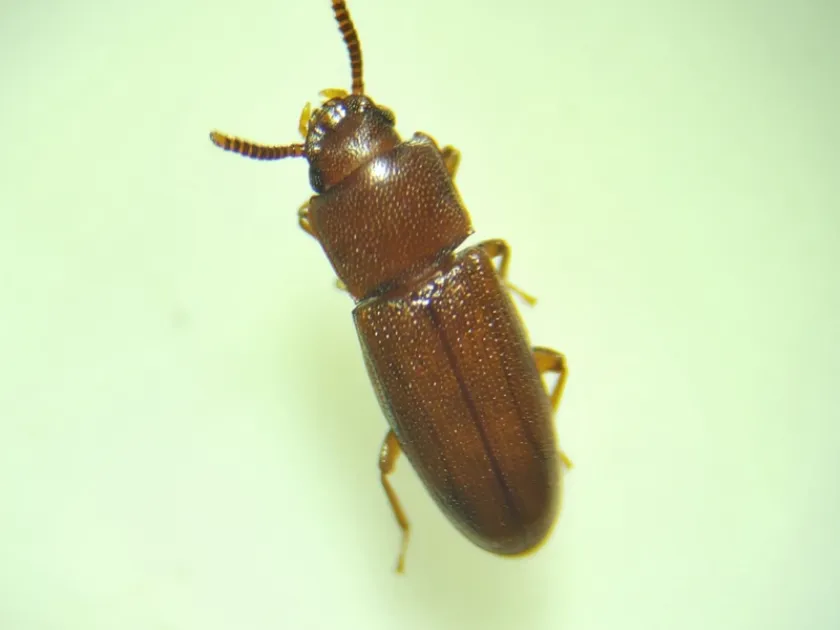
The depressed flour beetle (genus Palorus) belongs to the family Tenebrionidae, the darkling beetles. These insects are very small, typically measuring between 2.5 and 3 mm in length, with a flattened reddish-brown body.
Their extremely flat body shape is an evolutionary adaptation that allows them to crawl into incredibly narrow cracks in warehouse structures, milling machinery, and packaging materials.
The larvae of Palorus are yellowish-white and tend to hide deep within the bulk of the food source, making detection difficult during the early stages of an infestation.
Their life cycle consists of egg, larva, pupa, and adult stages. Under optimal warehouse conditions, they can complete their development cycle rapidly, leading to multiple generations per year.
They are known for their resilience and ability to survive in environments with limited resources, often hiding in dust accumulation in areas that are hard to clean.
What it damages
The depressed flour beetle primarily infests processed grain products such as flour, bran, semolina, crackers, pasta, and various animal feed mixtures found in storage facilities.
The damage is caused by both adults and larvae feeding on the product, which leads to significant weight loss and, more importantly, severe contamination of the entire batch.
Infested products become contaminated with excrement, shed larval skins, and insect remains, giving the material a distinct, unpleasant, and musty odor.
The presence of these beetles often increases the local moisture content of the stored product, creating hot spots that favor the growth of molds and fungi, causing secondary damage.
Once established, these pests are notoriously difficult to eradicate due to their ability to inhabit hidden structural crevices and mechanical parts of processing equipment.
When it appears
As Palorus is primarily a stored-product pest, its activity is largely independent of outdoor seasonal changes, provided that the storage facility maintains stable conditions.
The ideal conditions for rapid population growth are temperatures between 22°C and 30°C, which allow for continuous breeding cycles throughout the year.
While their activity slows down significantly at temperatures below 10°C, they do not die but enter a state of dormancy, waiting for the return of warmer conditions.
In unheated warehouses, the most significant population spikes are observed during the spring and summer months as the internal temperature of the grain mass rises.
Effective management requires consistent monitoring regardless of the time of year, as even a small overwintering population can quickly explode once conditions improve.
Signs of infestation
Visible signs of an infestation include the presence of tiny holes in food packaging and the accumulation of fine "flour dust" near corners or floor cracks.
Adult beetles may be spotted during routine inspections, especially around grain elevators, conveyors, and areas where spilled product has been left for extended periods.
A persistent, musty, or slightly sweet, pungent odor emanating from a stored batch of flour or cereal is a strong indicator of a deep-seated infestation.
Glue traps or pheromone-based monitoring systems are highly recommended tools for detecting the presence of the beetle early in the infestation cycle.
Clumped particles of flour or grain held together by insect debris indicate that a colony is actively feeding and developing within that specific batch.
Control measures
The primary control strategy is strict sanitation; removing dust, spilled grain, and debris from all warehouse corners is essential to eliminate hiding spots for the beetles.
Chemical control measures include the surface treatment of warehouse walls and equipment with contact insecticides, alongside professional fumigation of silos using phosphine.
Maintaining low moisture levels in stored grain is crucial, as keeping the moisture content below 14% significantly reduces the likelihood of beetle development.
Using sealed and pest-proof containers is an effective preventive measure for protecting goods during storage and transit from infested facilities.
- Implement a rigorous sampling and laboratory testing program for incoming and stored grain.
- Seal all structural cracks and crevices in the warehouse floor and walls.
- Immediately isolate and treat any batch found to be infested to prevent spread.
- Use professional monitoring traps to track population trends throughout the year.
Taxonomy
- Latin name
- Palorus
- Order
- Coleoptera (beetles)
- Family
- Tenebrionidae
- EPPO code
- PALSSP
Discussion
No discussions yet — be the first.