
Poplar-spruce gall aphid
Pachypappa tremulae
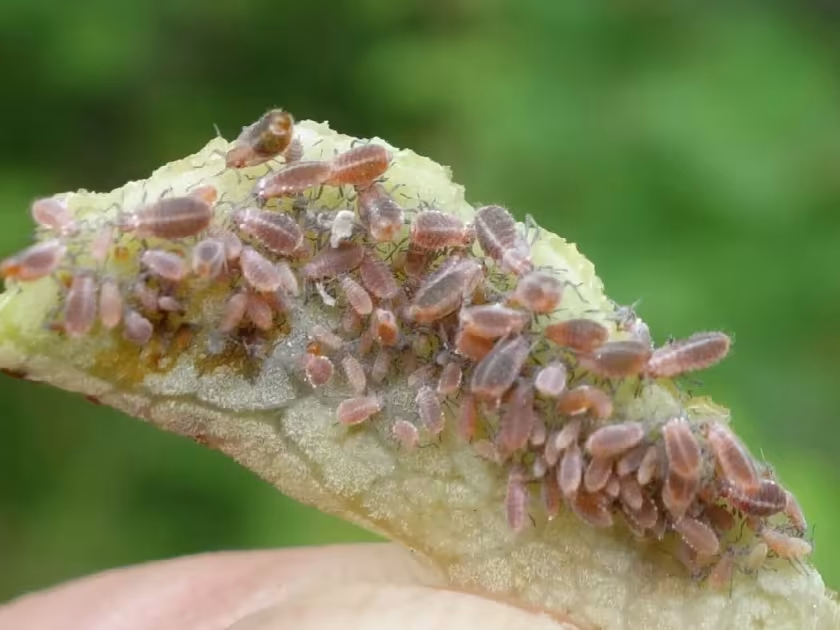
Description
How to identify
The poplar-spruce gall aphid (Pachypappa tremulae) belongs to the order Hemiptera and the family Aphididae. It is a specialized insect with a complex heteroecious life cycle.
Adult aphids often produce a characteristic waxy, woolly secretion that acts as a protective layer, shielding them from environmental stress and predators.
This species exhibits significant morphological plasticity, with different forms adapted to thrive on either spruce or poplar trees during different phases of their lifecycle.
The population reproduces through both sexual and asexual (parthenogenetic) cycles, allowing for rapid expansion in numbers under favorable climatic conditions.
Accurate identification requires observing both the host plants and the specific types of deformations or galls created during the infestation process.
What it damages
This aphid is a migratory pest, causing significant damage to both its primary host, spruce (Picea), and its secondary host, poplar or aspen (Populus).
On spruce, the aphid feeds on developing buds and young needles, which can lead to severe stunting and deformation of the tree's terminal growth.
On poplars, the insect induces the formation of galls — abnormal tissue growths on the leaves — which provide a protected environment for the aphid colonies to feed.
Heavy infestations result in early leaf senescence, reduced photosynthetic activity, and a general decline in the vitality of the affected trees.
Young nursery stock is particularly vulnerable, as damage to the growing tips can cause structural issues, leading to crooked trunks and poor tree development.
When it appears
The life cycle begins in early spring when overwintering larvae emerge to feed on the sprouting buds of spruce trees.
As the season progresses, winged forms migrate to poplars or aspens, where they establish new colonies and initiate the development of leaf galls.
Summer is a period of peak activity inside the galls, where the insects are relatively shielded from contact insecticides, making management more challenging.
During autumn, winged sexual forms return to spruce trees to lay eggs, which will remain dormant and overwinter until the following spring.
Warm and early springs facilitate faster larval emergence, potentially leading to higher aphid density and more severe damage to host plants.
Signs of infestation
The earliest symptom on spruce is the yellowing and twisting of needles on infested shoots, often accompanied by weakened bud development.
On poplars and aspens, the primary indicator is the presence of distinctive leaf galls, often filled with white, waxy, woolly filaments.
A heavy presence of white waxy residue on the underside of leaves or at the base of buds is a clear sign of an active aphid colony.
General loss of vigor and premature leaf drop during mid-summer are common indicators of a long-term infestation affecting the tree's health.
- Twisted and yellowed needles on spruce.
- Development of galls on poplar/aspen leaves.
- Presence of waxy woolly secretions.
- Premature yellowing and leaf loss.
Control measures
Effective management begins with silvicultural practices, such as ensuring spatial separation between spruce and poplar plantations to disrupt the migration cycle.
In nurseries and ornamental landscapes, systemic insecticides can be used to control aphids, as these chemicals are translocated within the plant tissues.
Applications should be timed to coincide with the migratory phases of the aphid, when the insects are most exposed to chemical control methods.
Biological control can be enhanced by supporting local populations of natural enemies, such as lady beetles, lacewings, and hoverflies.
Manual removal and destruction of infested leaves and branches can be effective for small-scale infestations if done before the winged adults emerge.
Taxonomy
- Latin name
- Pachypappa tremulae
- Order
- Hemiptera (bugs, aphids, leafhoppers)
- Family
- Aphididae
- EPPO code
- ASIPTR
Discussion
No discussions yet — be the first.