
Poplar gall aphid
Pachypappa populi
Description
How to identify
The poplar gall aphid (Pachypappa populi) belongs to the order Hemiptera and the family Aphididae. This pest features a complex life cycle, often involving host alternation, which makes its identification challenging throughout different seasons.
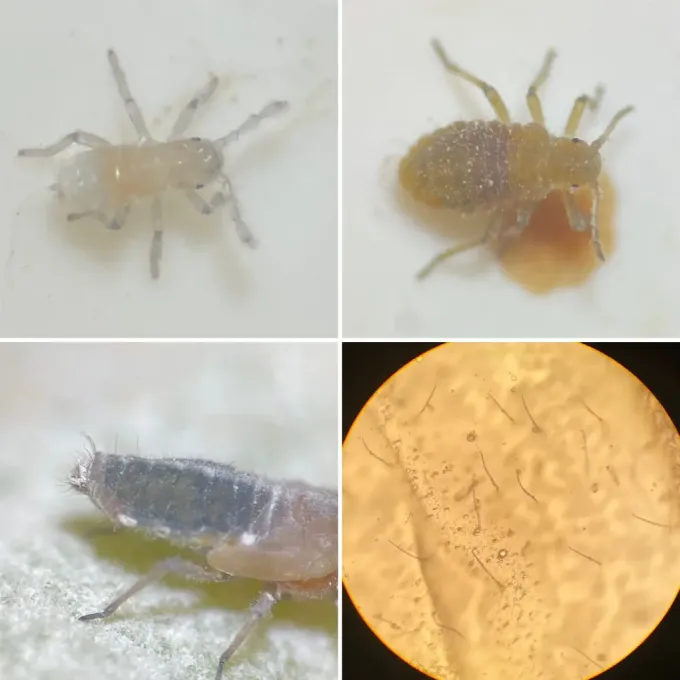
Adult aphids are small with soft bodies, typically colored in greenish or yellowish shades. Winged forms possess transparent wings with a distinct venation pattern, which aids specialists in precise species identification under microscopic examination.
Aphid nymphs are highly active in their early stages, quickly finding feeding sites on young plant tissues. Gradually, by influencing the leaf's physiology, they induce specific morphological changes that result in the formation of galls.
Systematically, this species is closely associated with members of the Populus genus. Detecting the aphid at early stages is difficult due to its camouflage coloration and the secluded lifestyle of insects inside curled leaves.
Pest identification is primarily possible through the results of its activity—the formation of swellings, which serve as secure refuges for colonies against external factors and predators.
What it damages
The primary targets for this species are various poplar trees (Populus), particularly aspen and balsam poplar. The pest selects the most delicate, actively growing apical shoots and young leaves.
During the sap-feeding process, the aphid injects specific enzymes into plant tissues, stimulating the pathological proliferation of plant cells. This results in the formation of characteristic leaf galls.
Mass reproduction of aphids leads to significant weakening of the trees. Affected leaves turn yellow prematurely, become deformed, and dry out, reducing the total photosynthetic surface area of the crown.
In young poplar saplings, damage to the tops can cause growth stunting and trunk curvature. This is critical for nurseries and shelterbelts, where the aesthetic and economic value of the trees depends directly on their correct form.
Trees weakened by aphids become more susceptible to secondary infections and infestations by other pests, such as wood borers or fungal diseases, which together lead to the degradation of the stands.
When it appears
The life cycle of Pachypappa populi is closely linked to the vegetation period of the host plant. In early spring, foundresses emerge from overwintered eggs and colonize budding leaves.
During the summer, the pest reaches its peak activity, with numerous aphid generations developing inside the galls. During this time, the colonies are maximally protected within the plant tissues.
By mid-to-late summer, winged migrant individuals appear. They leave the primary host to fly to secondary host plants, where the reproductive cycle continues.
In the autumn, a reverse migration occurs, during which fertilized females return to the poplars to lay overwintering eggs in bark crevices or near the buds.
Thus, the primary damage occurs during the spring-summer period, when the colony actively feeds on plant sap, coinciding with the active growth of poplar shoots.
Signs of infestation
The main sign of infestation is the presence of large, often sack-like or curled galls on poplar leaves. These can be bright green, yellowish, or reddish depending on their maturity level.
Opening a gall reveals clusters of numerous aphids, often surrounded by a whitish waxy coating secreted by the insects for protection.
The presence of large numbers of ants on the trunks and branches of the poplar often indirectly indicates the presence of aphid colonies, as ants feed on the sweet excretions (honeydew) produced by aphids.
Gradual drying and shedding of deformed leaves in the peak of summer is also a clear symptom of serious pest infestation.
If the tree's crown looks untidy and the leaves are covered with a sticky substance, it indicates the active life cycle of a large insect population.
Control measures
Agrotechnical methods include regular inspection and removal of affected leaves with galls if the tree is small. This helps significantly reduce the population density in the spring.
Biological control involves conserving natural enemies of aphids in the garden, such as ladybugs, lacewings, and hoverflies, which effectively feed on aphid colonies.
If chemical control is necessary, systemic insecticides should be used. They should be applied before gall formation, as the preparation may not penetrate deep into the dense plant structures later.
To prevent pest overwintering, it is recommended to conduct autumn cleaning of the bark to remove old scales where insects lay eggs and treat the trees with specialized products.
- Crown monitoring in early spring.
- Timely pruning of heavily infested branches.
- Application of systemic preparations (e.g., acetamiprid-based).
- Encouraging the presence of entomophages in forest stands.
Taxonomy
- Latin name
- Pachypappa populi
- Order
- Hemiptera (bugs, aphids, leafhoppers)
- Family
- Aphididae
- EPPO code
- PACAPO
Discussion
No discussions yet — be the first.