
Hazel leaf miner
Ornix avellanella
Description
How to identify
The hazel leaf miner (Parornix avellanella), often associated with the family Gracillariidae, is a small moth species. Its wingspan typically ranges between 10 and 12 millimeters, making it a subtle but significant pest in hazelnut and filbert plantations.
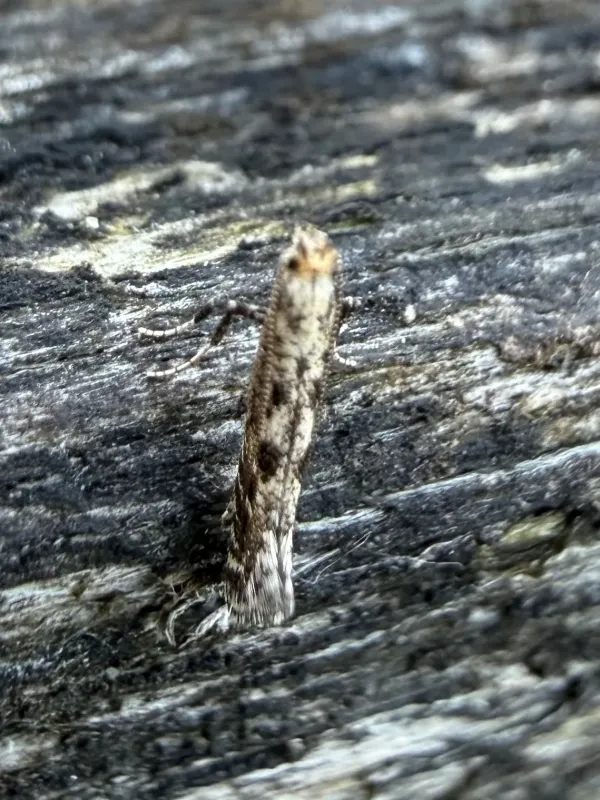
The forewings of the moth exhibit a brownish-gray coloration with distinct white patterns and stripes along the anterior edge. The hindwings possess a delicate, fringed structure typical of small leaf-mining moths.
The larvae are highly mobile and present a greenish to yellowish appearance with a darker head capsule. They lead a secretive lifestyle, feeding within the leaf tissues, which makes early detection a challenge for farm managers.
Pupation occurs within a tightly rolled or folded leaf, where the larva spins a silk cocoon. The pupa darkens in color as it matures, transitioning from light brown to a dark brownish tone before the adult moth emerges.
Adult moths are primarily crepuscular or nocturnal. During the day, they remain stationary in the dense foliage, relying on their camouflage to blend into the bark or leaf surfaces of the host plant.
What it damages
The primary host plant for this species is the common hazel (Corylus avellana). The larvae consume the inner tissues of the leaves, which causes localized necrosis and significantly reduces the photosynthetic capacity of the plant.
As the larvae grow, they create larger mines and eventually roll the leaves into tubes or cones, reinforced with silk. This damage restricts the surface area available for photosynthesis, impacting the overall vitality of the shrub.
In cases of severe infestation, the cumulative loss of leaf tissue leads to premature leaf drop. This interrupts the plant's ability to store energy for the subsequent year, resulting in weaker growth and lower nut production.
Young hazelnut saplings are particularly susceptible to this pest. Repeated foliage damage in the early developmental stages can significantly stunt growth and lead to the decline of the plant's structural health.
Long-term infestation can also make the hazel bushes more vulnerable to secondary infections and winter stress, as the plant lacks the vigor required to heal effectively after intense pest pressure.
When it appears
The first generation of adults typically emerges in the spring, coinciding with the bud burst and the development of the first young leaves. Eggs are then deposited on the underside of the leaves, where the larvae begin their development.
A second generation usually peaks during mid-summer. This period is often when the most visible damage occurs, as the increasing population size leads to a higher number of rolled leaves across the canopy.
The species generally completes two generations per year in temperate climates. However, prolonged periods of warmth during the summer may facilitate a partial third generation, further complicating control efforts.
Winter is spent in the pupal stage, usually tucked away within the leaf litter beneath the trees or deep within the crevices of the host plant's bark, awaiting the return of warmer temperatures.
Effective scouting should begin as soon as the trees break dormancy. Monitoring for early signs of leaf mining allows for timely intervention before the larval populations become established within protected leaf rolls.
Signs of infestation
Initial signs of infestation appear as small, clear patches or 'windows' on the leaves, where the larvae have mined the tissue. As the larva matures, it pulls the edges of the leaf together to form a protective roll.
The presence of fine silk webbing holding the leaf folds together is a key indicator of larval activity. Inspecting the tips of the shoots often reveals these characteristic rolls, which are home to the developing larvae.
Small, dark fecal pellets are frequently visible inside the leaf rolls, providing clear evidence of ongoing feeding. These deposits are a useful diagnostic feature for confirming the presence of the pest.
Affected sections of the leaf eventually dry out, turn brown, and become brittle. When many leaves are infested, the tree canopy may appear discolored or scorched, signaling a significant loss of foliage.
Unfolding a suspicious leaf usually reveals the larva itself, which may demonstrate a quick, twitching movement when disturbed. This simple physical check is the most direct way to assess the status of an infestation.
Control measures
Sanitation is a critical first step in managing the hazel leaf miner. Collecting and destroying fallen leaves in the autumn removes the primary overwintering sites, significantly reducing the population for the following spring.
For small-scale orchards or nursery settings, manual removal and destruction of infested leaf rolls can be an effective and non-toxic method to keep pest populations at low, manageable levels.
If chemical intervention becomes necessary, systemic or contact insecticides should be applied during the early stages of larval development, before the larvae successfully enclose themselves within the leaf folds.
Biological control, including the use of Bacillus thuringiensis or other entomopathogenic agents, provides an effective alternative that minimizes impact on beneficial insect populations in the orchard.
Maintaining optimal tree health through balanced fertilization and adequate irrigation is essential. A vigorous, well-nourished tree is far more resilient to leaf miner damage and recovers much faster than an stressed one.
Taxonomy
- Latin name
- Ornix avellanella
- Order
- Lepidoptera (butterflies)
- Family
- Gracillariidae
- EPPO code
- ORNXAV
Discussion
No discussions yet — be the first.