
Tropical fowl mite
Ornithonyssus bursa
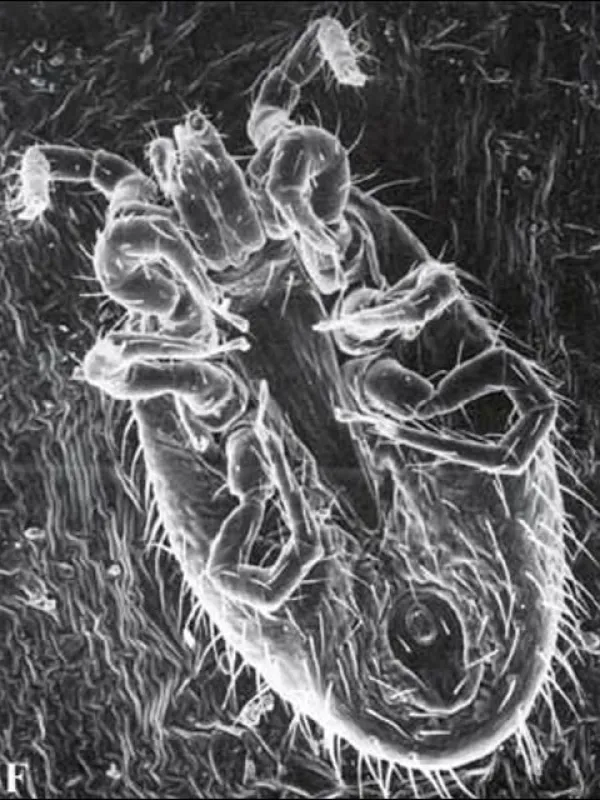
Description
How to identify
The tropical fowl mite (Ornithonyssus bursa) is a small blood-feeding ectoparasite belonging to the order Mesostigmata and the family Macronyssidae.
Adult mites are tiny, roughly 1 mm in length, and vary in color from pale brown to dark red, depending on their last blood meal. They are characterized by eight legs and a robust mouthpart designed for piercing the host skin.
A key biological feature of Ornithonyssus bursa is its preference for remaining on the bird's body throughout its entire life cycle, rather than living primarily in the environment.
The life cycle is rapid, consisting of egg, larva, protonymph, deutonymph, and adult stages. Favorable tropical conditions allow them to multiply exponentially in a short period.
Proper identification is crucial, as their presence is often mistaken for other common poultry pests, leading to ineffective treatment choices if the species is misidentified.
What it damages
Tropical fowl mites primarily infest domestic and wild birds, causing significant distress to chickens, turkeys, and pigeons in agricultural settings.
The infestation results in severe skin irritation, anemia, and reduced production efficiency, as the birds expend significant energy dealing with constant itching and irritation.
While the mite is not a primary crop pest, its presence in agricultural facilities can contaminate storage areas and equipment, posing risks to farm staff and other livestock.
The economic impact on poultry farming includes loss of body weight, decreased egg production, and potential transmission of secondary pathogens through skin wounds.
High levels of infestation can lead to mortality in chicks and young birds, which are less resilient to the heavy blood loss caused by large mite populations.
Signs of infestation
The first signs of infestation include behavioral changes: birds become restless, start pecking their own feathers, and show overall signs of discomfort.
Physical inspection reveals inflamed skin, sores, and crusty lesions, particularly in areas with high mite density like the vent, under the wings, and on the breast.
Mite presence is often spotted by examining nest boxes, perches, and roosts where these parasites cluster, appearing as small, fast-moving dark specks.
Egg quality often declines during an infestation, and small blood spots on the surface of eggs are a major indicator of high mite activity in the nesting area.
A persistent, stale, or musty odor in the poultry house often accompanies massive infestations, signaling an urgent need for sanitation and pest control.
Control measures
Control strategies must start with deep cleaning of the facility, ensuring that all organic debris, old nesting materials, and dust are thoroughly removed.
Chemical control involving approved acaricides is the primary method. It is essential to treat both the physical environment and the birds, following safety guidelines to prevent residues in eggs or meat.
Integrated Pest Management (IPM) practices, such as maintaining optimal humidity and ventilation, can create a less favorable environment for mite reproduction.
Implementing strict quarantine protocols for any new birds entering the flock is essential to prevent the introduction of Ornithonyssus bursa.
Consistent monitoring using physical traps allows for early detection, enabling farmers to intervene before the mite population reaches a critical threshold.
Taxonomy
- Latin name
- Ornithonyssus bursa
- Order
- Mites
- Family
- Macronyssidae
- EPPO code
- ORNTBU
Discussion
No discussions yet — be the first.