
Poultry mite
Ornithonyssus
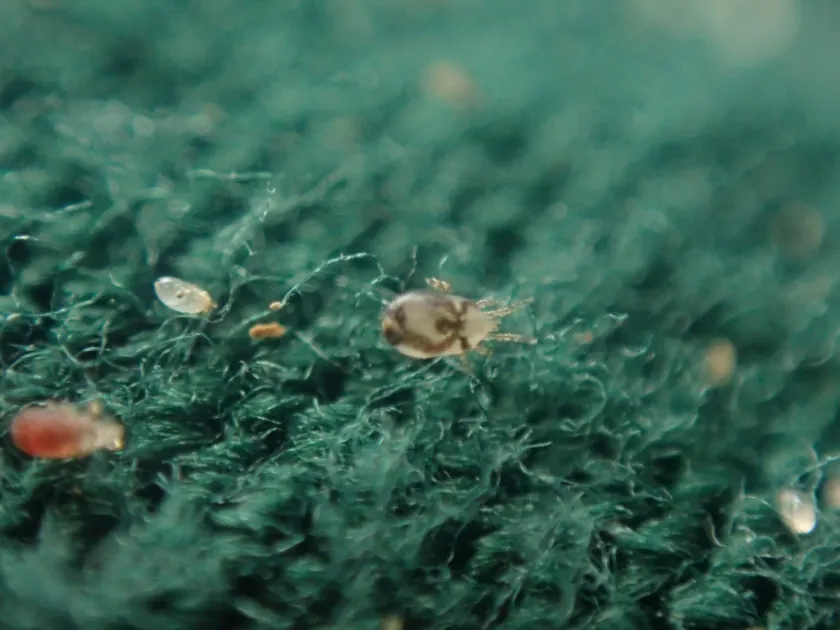
Description
How to identify
The genus Ornithonyssus belongs to the family Macronyssidae, order Mesostigmata. These are parasitic mites primarily associated with birds, yet they are frequently found in greenhouses as occasional wanderers.
These mites are small, ranging from 0.5 to 1 mm in length. Their coloration varies from pale white to dark red, depending on their last feeding on a warm-blooded host.
They possess long, bristly legs that allow for rapid, agile movement across surfaces. This high mobility enables them to colonize various structures within a farm or greenhouse environment.
Their life cycle includes egg, larva, protonymph, and deutonymph stages. The transition from egg to adult is exceptionally fast, allowing populations to explode in warm, humid conditions.
Unlike spider mites, Ornithonyssus species lack the specialized mouthparts needed for plant tissue penetration, which is a key diagnostic feature for growers.
What it damages
Poultry mites do not cause direct damage to plant tissues. They do not consume chlorophyll, sap, or plant cells, meaning they do not affect plant photosynthesis or growth rates.
The primary damage is economic and operational. Their presence makes greenhouses unsuitable for work, as their bites cause severe itching and allergic reactions in human staff.
They can also contaminate harvested vegetables with organic debris or excrement, lowering the aesthetic and sanitary quality of the produce being brought to market.
By moving across greenhouse surfaces, they act as mechanical vectors for various bacteria, potentially spreading diseases between plants even if they do not feed on them.
Infestations often lead to the abandonment of certain greenhouse zones due to the nuisance they cause to the personnel tending the crops.
When it appears
The activity of poultry mites is strictly tied to temperature and humidity. They thrive in environments where conditions mimic the nest of a bird.
In greenhouses, they remain active throughout the year as long as the temperature is consistently above 20°C. Seasonal fluctuations in outdoor populations do not apply if they are housed indoors.
Their appearance on plants is often correlated with the nesting season of birds that may enter the greenhouse or the seasonal movement of small rodents.
During peak summer months, population densities can reach massive levels, increasing the likelihood of migration from nesting areas to greenhouse crops.
Winter does not provide a natural control method if the greenhouse is heated, allowing these parasites to survive and reproduce continuously.
Signs of infestation
Identification is primarily based on seeing small, active mites scurrying on leaf surfaces or stems, particularly in low-light conditions.
There is a distinct lack of classic plant-damage symptoms, such as yellow stippling, webbing, or leaf curling, which are characteristic of typical plant-feeding mites.
Mites are frequently found on the undersides of leaves, in crevices of greenhouse frames, and near bird nesting sites on or near the building structure.
The most common sign of infestation is not on the plant itself, but on the workers, who may notice the mites crawling on their skin or clothing.
If you suspect an infestation, inspect the facility for bird nests, rodent burrows, or dust buildup in storage areas where the mites tend to cluster.
Control measures
Effective management requires focusing on the facility rather than the plants. The goal is to eliminate the reservoir host: the birds and rodents.
Sanitation is paramount. Regularly cleaning structural components, removing bird nests, and sealing entry points to the greenhouse are essential steps.
- Remove all bird nesting materials from the greenhouse exterior.
- Implement a robust rodent control program.
- Apply specialized acaricides to facility surfaces where mites congregate.
- Ensure workers wear protective clothing to avoid bites during crop care.
While chemical acaricides can reduce the population, they must be used as part of a comprehensive integrated pest management (IPM) strategy focused on exclusion and sanitation.
Taxonomy
- Latin name
- Ornithonyssus
- Order
- Mites
- Family
- Macronyssidae
- EPPO code
- ORNTSP
Discussion
No discussions yet — be the first.