
Tropical rat mite
Ornithonyssus bacoti
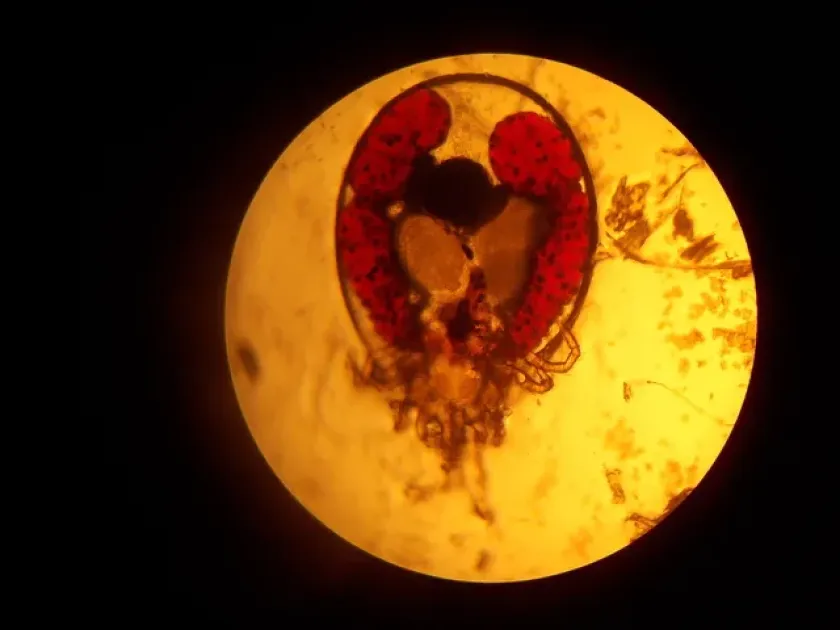
Description
How to identify
The tropical rat mite (Ornithonyssus bacoti) belongs to the order Parasitiformes, family Macronyssidae. It is a tiny blood-feeding parasite, typically measuring 0.5 to 1 mm in length.
Adults exhibit a brownish-red color, turning bright red after a blood meal. They are highly active and mobile, capable of searching for hosts over significant distances within indoor environments.
The life cycle involves egg, larva, protonymph, deutonymph, and adult stages. Development can be completed in as little as 10–12 days under optimal temperature and humidity conditions.
Females lay eggs in wall crevices, rodent nests, or debris. While larvae do not feed, nymphs and adults are active parasites that require blood meals to progress to subsequent stages.
Adult mites are resilient and can survive for several weeks without a host, making them a persistent issue in infested facilities.
What it damages
This mite is a primary ectoparasite of the brown rat and the house mouse, commonly found in agricultural structures and storage facilities.
Although it does not damage plants directly, its presence in warehouses and storage sites disrupts operations and poses serious health risks to agricultural workers.
In the absence of their preferred rodent hosts, these mites frequently migrate and infest livestock, poultry, and humans, causing significant discomfort and skin reactions.
The economic damage is primarily indirect, as the presence of the mite leads to the need for costly sanitation and pest control protocols within agricultural businesses.
Failure to address the mite population can lead to severe operational downtime and the potential spread of pathogens associated with rodent-mite complexes.
Signs of infestation
The most reliable sign of an infestation is the presence of rodents in storage areas, as the mites are obligate parasites that follow their hosts' movements.
Observation of small, rapidly moving dots on floors or walls near nesting sites often confirms the presence of an active population.
Human encounters with these mites often result in pruritic (itchy) dermatitis, typically appearing as localized clusters of bites on the arms or legs after visiting infested sites.
Infestations are often noticed during cleaning or structural repairs, when the disturbance of rodent habitats forces mites to forage for new hosts.
Discovery of mites within empty cages or near feed stockpiles is a clear indicator of a widespread infestation within the facility.
Control measures
The primary control strategy is the aggressive elimination of rodent populations, as removing the host is essential for curbing the mite life cycle.
Sanitation is critical; cleaning storage areas, removing debris, and sealing structural crevices prevents mites from finding safe harbor for egg-laying.
Application of professional-grade acaricides, particularly pyrethroids, is necessary to treat surfaces and voids where mite populations are concentrated.
Integrated pest management (IPM) should be adopted, focusing on long-term habitat modification to prevent re-infestation by rodents and their associated parasites.
- Targeted acaricide treatments for floors and walls.
- Stringent rodent proofing and exclusion.
- Regular cleaning and removal of nesting material.
- Personal protective equipment for warehouse staff.
Taxonomy
- Latin name
- Ornithonyssus bacoti
- Order
- Mites
- Family
- Macronyssidae
- EPPO code
- ORNTBA
Discussion
No discussions yet — be the first.