
Citrus whitefly
Orchamoplatus citri
Description
How to identify
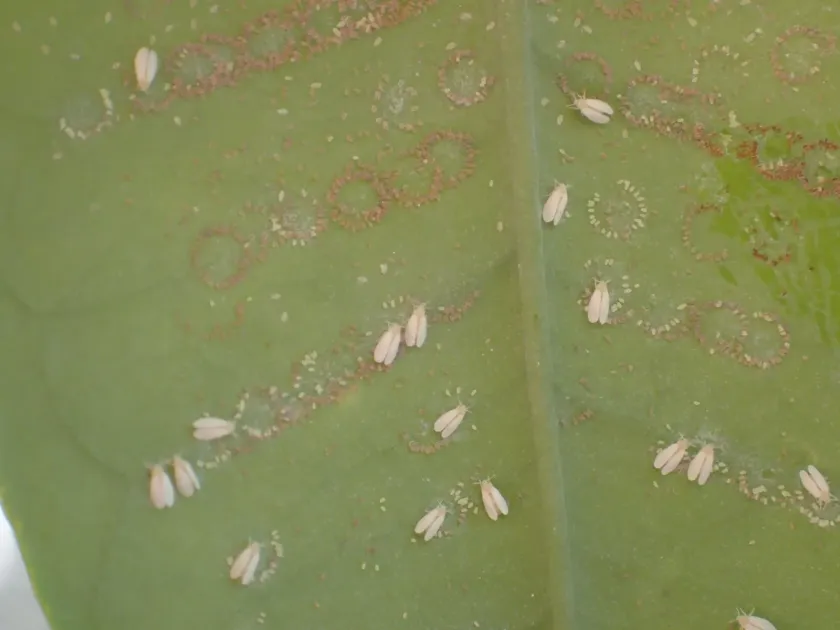
The citrus whitefly Orchamoplatus citri is a hemipteran insect belonging to the family Aleyrodidae. Adult insects are minute, typically measuring 1-1.5 mm in length, and are covered in a white, powdery wax that gives them their name.
The lifecycle consists of the egg stage, four nymphal instars, and the adult stage. The nymphs are particularly damaging as they transition from a mobile crawler stage to a sedentary feeding stage on the underside of leaves.
The pupal stage is diagnostic; the cases are often flat with waxy fringes or specific morphological markers that distinguish Orchamoplatus citri from other common whitefly species found in greenhouses.
These pests reproduce rapidly under warm conditions, with multiple overlapping generations possible throughout the year, especially in protected cultivation environments.
Understanding the biology of these insects is crucial for pest management programs, as the sedentary nymphs are more resilient to contact-based insecticides than the mobile adults.
What it damages
This pest primarily targets citrus varieties, including lemon, orange, and lime trees. It can also infest various ornamental plants, causing significant economic losses for commercial nurseries.
Nymphs and adults feed on phloem sap, which depletes the plant's nutrient reserves. This sap-sucking activity causes chlorosis, leaf curling, and severe stunting of new growth.
A major indirect impact is the excretion of honeydew, a sticky, sugary substance that coats the leaves and branches. This serves as a primary substrate for the colonization of sooty mold fungus.
The accumulation of sooty mold blocks sunlight, significantly reducing the photosynthetic capacity of the plant and degrading the cosmetic quality of both the foliage and the fruit.
In severe infestations, the cumulative stress from nutritional depletion and secondary fungal growth can lead to leaf drop, twig dieback, and the eventual decline of the plant.
Signs of infestation
A cloud of small white insects flying up from the canopy when a branch is disturbed is the most obvious sign of an active infestation.
The appearance of yellow, irregular spots or general chlorotic patches on the upper leaf surface indicates localized feeding pressure from nymphs on the underside.
Leaves will often feel sticky to the touch due to the presence of honeydew, which is frequently accompanied by a black, powdery coating known as sooty mold.
Increased ant activity around the plant is often observed, as ants are drawn to the honeydew excreted by the whitefly colonies.
Careful inspection of the abaxial (underside) surface of the leaves will reveal the nymphs, which look like small, flat, semi-translucent discs attached to the leaf veins.
Control measures
Yellow sticky traps are an essential tool for monitoring population levels and can provide a level of suppression by capturing adult insects in flight.
Chemical control measures should focus on systemic insecticides that translocate through the plant tissues to reach the sedentary nymphs effectively.
Biological control, utilizing parasitoid wasps or predatory mites, has proven to be a highly effective long-term strategy for managing populations in both orchards and greenhouses.
Good sanitation practices, including the removal of heavily infested leaves and the management of weeds near the crop, help reduce overall infestation pressure.
Pruning the canopy to improve air circulation and light penetration is a recommended cultural practice that makes the environment less hospitable to whitefly colonization.
Taxonomy
- Latin name
- Orchamoplatus citri
- Order
- Hemiptera (bugs, aphids, leafhoppers)
- Family
- Aleyrodidae
- EPPO code
- ORCMCI
Discussion
No discussions yet — be the first.