
Olios argelasius
Olios argelasius
Description
How to identify
Olios argelasius is a species of spider belonging to the family Sparassidae, commonly referred to as huntsman spiders.
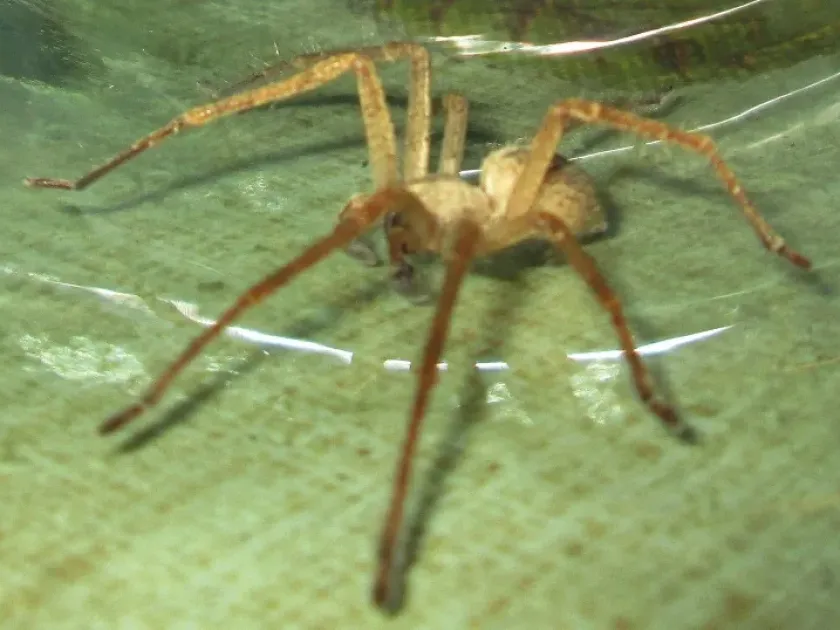
These spiders are distinguished by their significant size, with adults often reaching a leg span of 10 to 12 centimeters.
The body coloration ranges from light brown to yellowish-gray, providing an excellent camouflage against tree bark and rocky surfaces.
They possess a flattened body structure, allowing them to hide efficiently in narrow crevices during the daylight hours.
Their eyesight is well-developed, facilitating active hunting, as they do not rely on webs to capture their prey.
What it damages
Olios argelasius is not a plant pest; it does not feed on plant tissues, foliage, or fruits, making it harmless to crops.
Instead, these spiders are active predators that feed on various insects, including many agricultural pests found in orchards and vineyards.
By consuming caterpillars, beetles, and other invertebrates, they provide a valuable biological control service for gardeners and farmers.
The presence of this species should be viewed as an indicator of a healthy, diverse ecosystem rather than a threat to agricultural productivity.
No agricultural damage is attributed to this species, and their activity helps reduce the need for chemical pesticide interventions.
When it appears
The active season for Olios argelasius typically begins in late spring when temperatures consistently remain above freezing.
Peak activity occurs throughout the summer months, aligning with the breeding and foraging period of the adult population.
As temperatures begin to drop in late autumn, the spiders seek sheltered locations to overwinter, often utilizing crevices or buildings.
Their life cycle is well-adapted to Mediterranean-type climates, allowing them to remain active for the majority of the year.
Winter survival is achieved through diapause, where the spiders remain inactive until the return of warmer spring conditions.
Signs of infestation
Signs of presence are primarily limited to sighting the spiders themselves, especially when they move during the night.
Because they are wandering hunters, they do not create webs on plants, which distinguishes them from various plant-damaging mites.
Exuviae, or discarded exoskeletons after molting, can sometimes be found near their hiding spots in tree bark or stone wall crevices.
Observations of the spiders are often accidental, occurring when they are disturbed from their daytime resting places in sheds or thick foliage.
The absolute lack of plant damage, such as leaf discoloration or necrotic spots, serves as evidence that they are not feeding on the vegetation.
Control measures
Control measures are generally unnecessary and often counterproductive, given the spider's role as a beneficial predator in the garden.
To discourage their presence near living areas, homeowners should clear debris, prune dead branches, and seal potential entry points into buildings.
Avoid the use of non-selective insecticides, as these will kill beneficial predators and likely lead to an increase in actual plant-eating pests.
Manual relocation is the best approach if a spider is found in an inconvenient location, rather than resorting to chemical extermination.
Encouraging natural predators contributes to a balanced, sustainable gardening practice that reduces the need for artificial interventions.
Taxonomy
- Latin name
- Olios argelasius
- Family
- Sparassidae
- EPPO code
- OLISAR
Discussion
No discussions yet — be the first.