
Huntsman spiders
Heteropoda
Description
How to identify
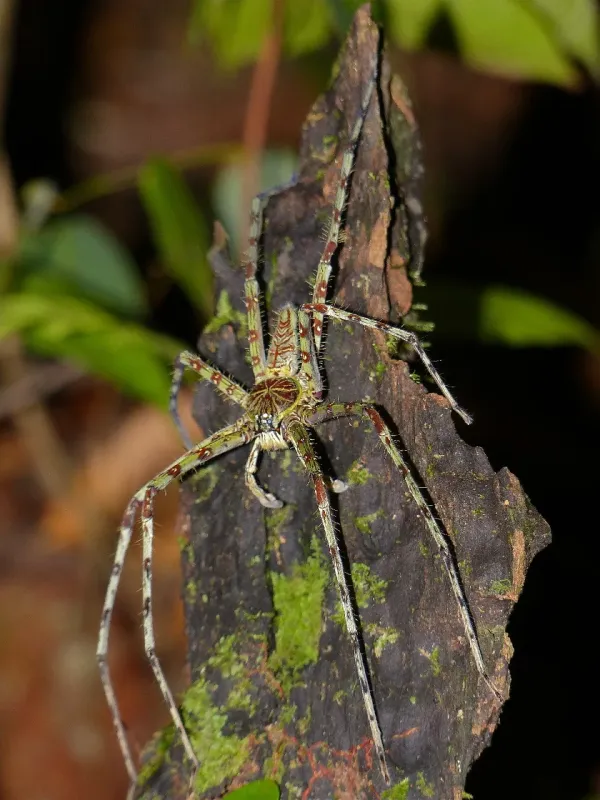
Huntsman spiders, belonging to the family Sparassidae, are large, long-legged spiders known for their sideways, crab-like walking gait.
They are easily recognized by their flattened bodies, which allow them to squeeze into narrow spaces such as loose bark, crevices, and building gaps.
Unlike many other spider species, they do not build webs to capture prey; instead, they rely on speed and surprise to hunt down their targets.
Their coloration is typically brown or gray with mottled patterns, providing excellent camouflage against tree trunks and wooden surfaces.
In an agricultural context, identifying them is simple: if you see a large, fast-moving spider with long, sprawling legs and no web, it is likely a Huntsman.
What it damages
Huntsman spiders are not plant pests; they are predatory arthropods that feed strictly on other insects and invertebrates.
They do not consume plant sap, foliage, or roots, meaning they have no negative impact on the health or development of crops.
Instead, they act as beneficial biological control agents by managing populations of cockroaches, crickets, and other potential garden pests.
In greenhouses, their presence is often viewed as a natural way to reduce the population of harmful insects hiding in structural crevices.
There is zero economic damage associated with these spiders, and any perception of them as pests is strictly due to their large and intimidating appearance.
When it appears
Huntsman spiders are primarily active during warmer months, as their metabolic processes are highly dependent on environmental temperatures.
They thrive in tropical and subtropical climates where their activity remains consistent throughout the year, supporting stable pest control.
During colder seasons, they seek shelter in protected areas, which can include barns, sheds, or the walls of houses, where they hibernate.
They are primarily nocturnal, venturing out from their hideouts at night to actively search for food sources near crops or structures.
Their seasonal life cycle is aligned with the availability of prey, which increases significantly during the prime growing seasons for various plants.
Signs of infestation
The most common sign of their presence is finding their cast-off exoskeletons (molts) tucked into quiet corners or under wooden debris.
The absence of sticky or tangled webs in areas where large spiders are seen is the most reliable indicator that you are dealing with Huntsman spiders.
You may also observe their rapid movement across walls or tree bark, often triggered by the vibrations of footsteps or artificial light.
In agricultural fields, their nests (which are actually retreats made of silk for egg-laying) can sometimes be found under loose bark or thick foliage.
Since they do not damage plant tissues, the lack of holes, yellowing, or structural defects on your leaves confirms that they are not the cause of any observed plant issues.
Control measures
There is no need to implement control measures against Huntsman spiders as they do not harm crops and are considered beneficial to the ecosystem.
If their presence is unwelcome in a workplace or greenhouse, simply block their access by sealing cracks and removing debris that serves as hiding spots.
Avoid broad-spectrum pesticides, as these will kill off these beneficial predators and potentially lead to an increase in actual crop-damaging pests.
Physical relocation is the recommended method if individual spiders pose a disturbance to personnel working in the vicinity.
- Remove accumulated wood or debris around agricultural structures.
- Seal structural gaps in greenhouses to prevent spiders from entering.
- Promote biological diversity to allow natural predators to flourish.
- Educate staff about the non-pest status of these spiders to prevent unnecessary panic.
Taxonomy
- Latin name
- Heteropoda
- Family
- Sparassidae
- EPPO code
- HTEPSP
Discussion
No discussions yet — be the first.