
Rhododendron whitefly
Odontaleyrodes rhododendri
Description
How to identify
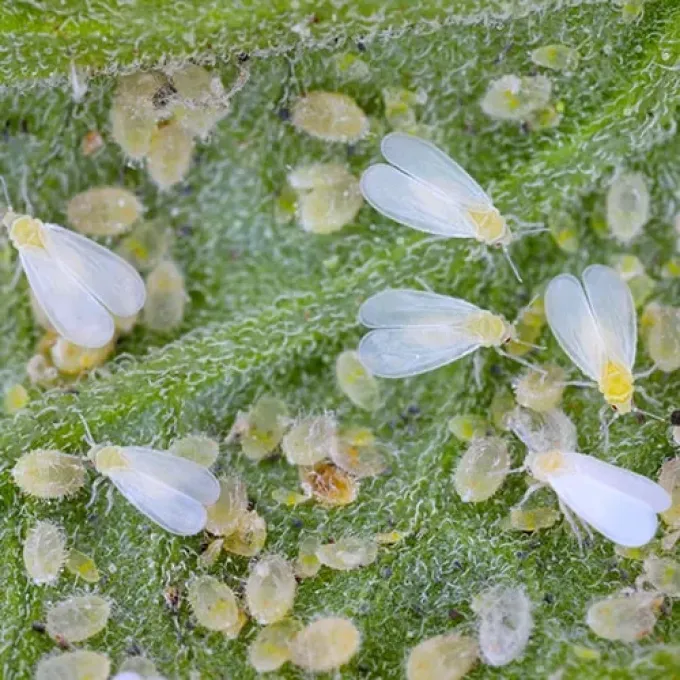
The rhododendron whitefly (Odontaleyrodes rhododendri) is a small insect belonging to the Aleyrodidae family. Adult insects are tiny, white-winged flies that resemble small moths and typically measure around 2-3 mm in length.
The bodies and wings of adults are covered in a fine, powdery wax secretion, which serves as protection against external environmental stresses. This wax gives them their characteristic bright white appearance.
Larvae are oval-shaped, flattened, and often appear translucent or pale yellow. They are sedentary, sticking firmly to the underside of leaves, where they remain throughout their development until reaching the pupal stage.
This species thrives in temperate climates and is often found in sheltered garden areas with high humidity. They prefer environments where air circulation is limited, allowing them to establish stable colonies.
Their life cycle includes several nymphal stages. In warm conditions, multiple generations can occur per season, enabling the pest population to expand rapidly if left unchecked by the gardener.
What it damages
The primary host for this pest is the genus Rhododendron. The insects are highly specialized and primarily target the foliage of evergreen rhododendron species found in gardens and landscapes.
They feed by piercing the plant tissue and sucking out sap. This feeding behavior drains the plant of essential nutrients and moisture, directly impacting the vigor and health of the shrub.
As they feed, they excrete honeydew, a sticky substance that coats the leaves. This honeydew serves as a substrate for sooty mold, a type of fungus that turns the leaves black and interferes with photosynthesis.
Severe infestations lead to stunted growth, yellowing of the leaves, and overall decline. If the population is large enough, it can cause significant leaf drop, which leaves the plant vulnerable to winter damage.
The aesthetic damage is profound, as the combination of yellowing leaves, sticky residue, and black mold makes the rhododendron look neglected and unhealthy, reducing its landscape value.
Signs of infestation
A classic sign of an infestation is a cloud of small white insects flying up when you shake the foliage. This is most noticeable on warm, calm days when adults are actively moving.
Upon inspecting the underside of the leaves, you will likely see small, flat, scale-like objects. These are the larvae of the whitefly, often grouped closely along the leaf veins.
Sticky residue on the leaf surface is another key indicator. This honeydew creates a shiny appearance on the foliage and may attract other insects, such as ants, to the plant.
The presence of sooty mold is a major warning sign. This black, powdery fungus grows on the honeydew, effectively suffocating the leaf and blocking the light needed for healthy growth.
Yellowing, curling, or dry leaf margins are symptoms of advanced infestation. As the whiteflies continue to suck nutrients, the leaves lose their ability to support the plant, leading to gradual wilting.
Control measures
Monitoring is essential. Early detection by inspecting the underside of leaves allows for quick intervention before the population reaches critical levels and becomes difficult to manage.
For chemical control, use systemic insecticides that move through the plant sap. It is crucial to ensure thorough coverage of the underside of the leaves where the larvae are actively feeding.
Biological controls include the introduction of natural predators such as ladybugs or specific parasitoid wasps. These can significantly reduce whitefly populations without the use of harsh chemicals.
Cultural practices, such as proper pruning, improve air circulation within the shrub. This makes the environment less favorable for whiteflies and can help prevent the buildup of severe infestations.
If sooty mold is present, it can be gently washed off with a soapy water solution once the whitefly population has been suppressed, allowing the leaves to recover their functional capacity.
Taxonomy
- Latin name
- Odontaleyrodes rhododendri
- Order
- Hemiptera (bugs, aphids, leafhoppers)
- Family
- Aleyrodidae
- EPPO code
- PEALRH
Discussion
No discussions yet — be the first.