
Northern rat flea
Nosopsyllus
Description
How to identify
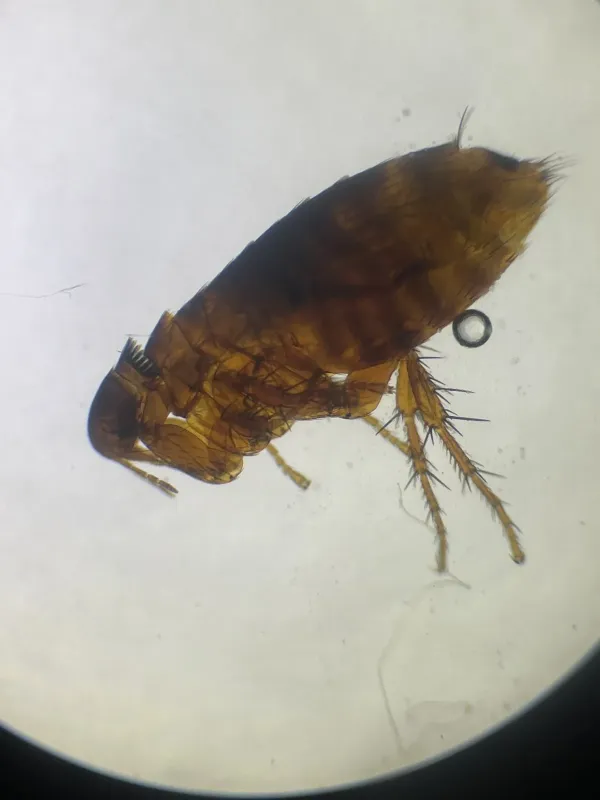
The Northern rat flea (Nosopsyllus fasciatus) belongs to the order Siphonaptera, family Ceratophyllidae. This is an ectoparasite adapted to living in rodent nests and agricultural storage buildings.
The adult insect has a laterally compressed body measuring 2 to 4 millimeters in length, colored brown or dark mahogany, allowing it to move easily through a host's fur.
The head of the insect is equipped with developed eyes and a piercing-sucking mouthpart, which is specialized exclusively for feeding on the blood of warm-blooded animals.
The hind legs of the imago are significantly more powerful than the others, providing the ability to jump long distances in search of a new food source.
The flea larvae are worm-like, legless, and eyeless; they inhabit organic debris in rodent dwellings, feeding on the excrement of adult fleas and other organic matter.
What it damages
Although this species is not an agricultural pest in the traditional sense, it causes significant damage in agricultural enterprises, grain storage facilities, and warehouses.
The primary harm consists of mass attacks on livestock, personnel, and pets, leading to reduced livestock productivity due to stress and discomfort.
These insects serve as specific vectors for dangerous zoonotic diseases, including plague and murine typhus, posing a threat to the epidemiological safety of the farm.
The presence of fleas in storage facilities necessitates expensive sanitary measures and limits the ability to effectively process and store grain products.
During mass reproduction, these parasites can transfer to other animal species, disrupting sanitary protocols on farms and in surrounding buildings.
When it appears
The reproduction of these insects depends directly on the temperature and humidity of their habitats, allowing the life cycle to continue year-round in heated warehouses.
The peak of activity and population density typically occurs during the warm season, coinciding with the increased migratory activity of rodents — the primary hosts.
Optimal conditions for rapid completion of the life cycle (from egg to imago) include temperatures of 20–25 degrees Celsius and high relative humidity.
In dry and cold conditions, larval development slows down or stalls, but eggs and pupae can remain viable for extended periods.
The highest risk of infestation occurs during seasonal migration periods when rodents move from fields into buildings as autumn temperatures drop.
Signs of infestation
The primary sign of a flea infestation is the detection of live individuals on floors, in animal bedding, or on the hosts themselves during inspection.
The appearance of specific itchy, red bite marks on workers or animals serves as a clear indication of a high parasite population.
The presence of characteristic black excrement containing undigested blood in dust and debris near rodent burrows confirms active colony reproduction.
Behavioral abnormalities in animals, such as persistent scratching and nervousness, are an indirect but very reliable indicator of indoor infestation.
Finding pupal cocoons in floor cracks, baseboards, or dust accumulations confirms that the population has successfully adapted to the facility.
Control measures
The main control method is comprehensive deratization aimed at eliminating primary hosts—rats and mice—within storage and production areas.
Regular wet cleaning of storage facilities is crucial to remove organic debris where flea larvae develop, followed by insecticide application in cracks and crevices.
To eliminate adult insects, pyrethroid-based insecticides are applied to floor surfaces and walls up to a height of 1–1.5 meters.
Maintaining sanitary buffers around warehouses, keeping adjacent areas clean, and preventing the accumulation of waste that attracts rodents is recommended.
- Use of animal-safe repellents.
- Installation of barriers against rodent intrusion.
- Regular population monitoring using glue traps.
- Use of disinfectant agents after rodent extermination.
Taxonomy
- Latin name
- Nosopsyllus
- Family
- Ceratophyllidae
- EPPO code
- NOSOSP
Discussion
No discussions yet — be the first.