
Onion aphid
Neotoxoptera formosana
Description
How to identify
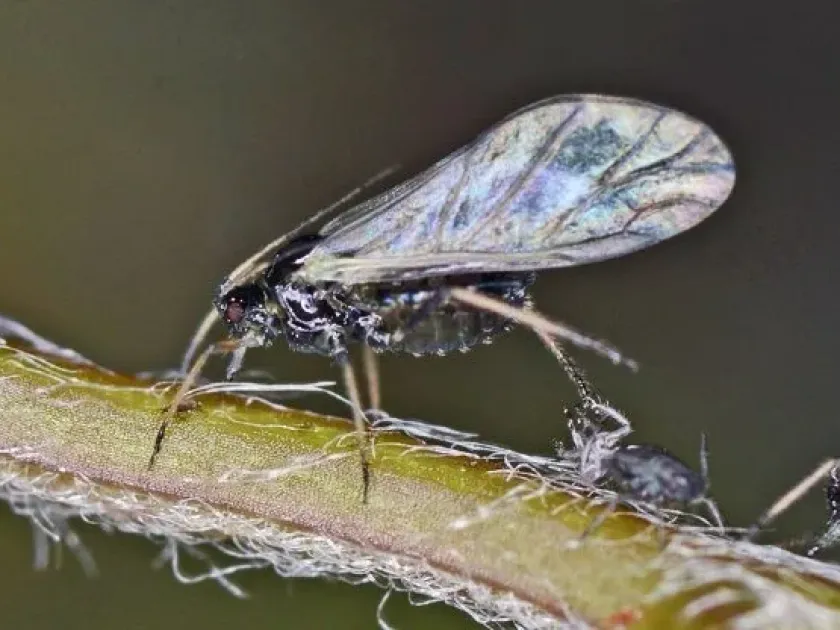
The onion aphid (Neotoxoptera formosana) is a small insect belonging to the order Hemiptera and the family Aphididae. Unlike many common green aphids, these insects are typically dark brown or reddish-brown in color.
Adults often have darkened wing veins, which is a key diagnostic feature for identification. The body is oval-shaped, measuring about 1.5 to 2 mm in length, with relatively long antennae and distinct cornicles.
The life cycle involves both wingless and winged forms. The winged adults are primarily responsible for colonizing new host plants, allowing the pest to spread rapidly across fields.
These aphids are most commonly found on the underside of tubular leaves or deep within the leaf sheaths near the bulb base, making them difficult to detect during early infestation stages.
Reproduction is largely parthenogenetic, allowing for exponential population growth in favorable conditions, which can lead to rapid colonization of onion patches.
What it damages
Onion aphids primarily feed on plants in the Amaryllidaceae family, including onions, leeks, garlic, and shallots. They pierce plant tissues and suck out the sap.
The extraction of nutrients causes significant wilting, yellowing, and deformation of the leaves, which hinders the plant's overall development and photosynthesis.
Beyond direct feeding damage, they act as vectors for several viral diseases, such as the onion yellow dwarf virus, which can cause severe stunting and crop loss.
Heavy infestations result in small, underdeveloped bulbs that are not suitable for commercial storage or long-term consumption.
The accumulation of honeydew secreted by the aphids provides a medium for sooty mold growth, which further blocks light and degrades the plant's health and appearance.
When it appears
Infestations typically begin in the spring, shortly after crop emergence or transplanting, when weather conditions become conducive to insect development.
Populations tend to peak during periods of moderate temperatures and adequate humidity, which allow the aphids to thrive and reproduce most effectively.
In mid-summer, extreme heat may temporarily reduce their activity; however, the population often persists in shaded or well-irrigated environments.
During the autumn, the aphids migrate towards perennial hosts or volunteer crops, where they prepare for overwintering before moving back to new crops the next season.
Within greenhouses or tunnels, the onion aphid can maintain an active lifecycle year-round if temperatures are maintained and host plants remain available.
Signs of infestation
Early symptoms include the curling, twisting, and yellowing of onion leaves, followed by general wilting as the plant loses vital nutrients.
Close inspection of the leaves reveals clusters of dark-colored aphids and a sticky substance known as honeydew on the leaf surfaces.
The presence of ants is a common indicator of aphid activity, as ants actively tend to the aphids to feed on the sugary excretions produced by the pests.
Advanced damage is often accompanied by necrotic spots on leaves and the growth of a black, soot-like substance, indicating secondary fungal infections.
Affected plants often show weakened root systems, making them pull out of the ground easily compared to healthy, well-rooted onions.
Control measures
Cultural practices such as crop rotation are vital, as they disrupt the lifecycle of the aphids and reduce the build-up of local populations over time.
Sanitation is key; removing weeds that serve as alternative hosts and eliminating crop debris after harvest significantly reduces the overwintering success of the pest.
- Use biological control agents such as predatory beetles, lacewings, or entomopathogenic fungi like Beauveria bassiana.
- Apply systemic insecticides during high-pressure infestations, ensuring adherence to pre-harvest intervals for safety.
- Use physical barriers like insect-proof netting in small-scale gardening to prevent winged aphids from landing.
- Regularly inspect crops to catch infestations early when localized spot treatments are still effective.
Monitoring using yellow sticky traps is an effective way to detect the arrival of winged adults, signaling the need for increased vigilance and timely intervention.
Integrated Pest Management (IPM) strategies, which combine cultural, biological, and chemical methods, provide the most sustainable long-term control against onion aphid outbreaks.
Taxonomy
- Latin name
- Neotoxoptera formosana
- Order
- Hemiptera (bugs, aphids, leafhoppers)
- Family
- Aphididae
- EPPO code
- NEOTFO
Discussion
No discussions yet — be the first.