
Neomyia
Neomyia
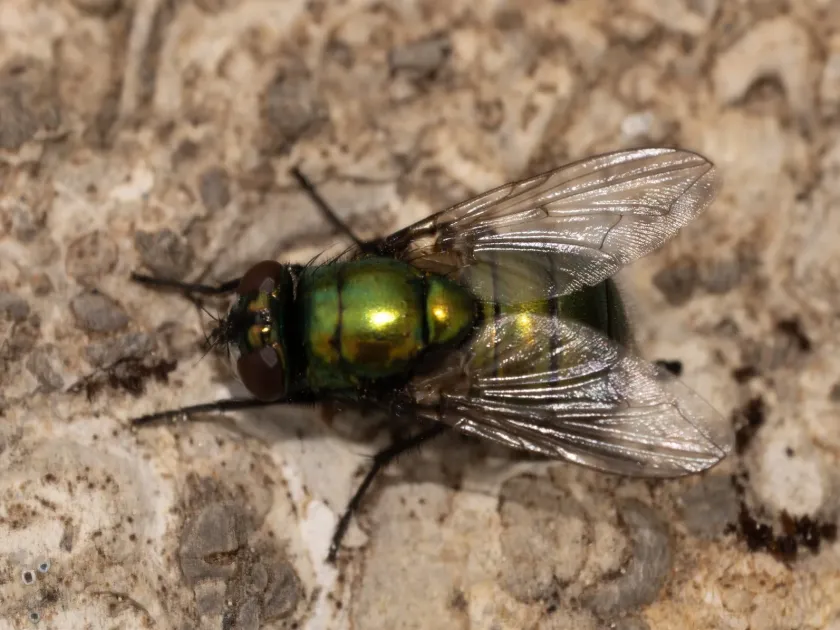
Description
How to identify
The genus Neomyia belongs to the order Diptera and the family Muscidae. These insects are easily recognized by their distinct metallic sheen, which can be green or blue.
Adult flies possess well-developed wings and a complex proboscis designed for consuming liquid food, such as floral nectar and plant exudates.
The larvae are typically maggot-like, cone-shaped, and lack appendages, adapted for burrowing through organic matter or decaying plant tissues.
Identification often requires careful examination of wing venation and thoracic bristles, as many Muscidae species share similar external features.
These flies are globally distributed and often interact with both agricultural fields and natural ecosystems where they serve various ecological roles.
What it damages
While Neomyia flies are not primary pests in the traditional sense, they act as vectors for phytopathogenic bacteria and fungal spores.
Adults often visit flowers to feed, inadvertently damaging delicate petal tissues, which creates entry points for secondary infections.
Larvae may inhabit decaying plant stems or fruits, further degrading tissues that have already been weakened by other environmental or biological factors.
In greenhouses, these flies can cause significant issues by spreading pathogens across crops, leading to decreased yields and poor produce quality.
Their presence on crops is often associated with the breakdown of plant organic matter, leading to localized rotting and plant tissue necrosis.
When it appears
The activity of Neomyia is strongly correlated with temperature; they are most active during the warmer months of the late spring and summer.
They undergo a complete life cycle, and the rate of development is directly proportional to the ambient temperature and local humidity levels.
Overwintering typically occurs in the pupal stage, buried deep within the soil or protected by layers of decomposing plant debris.
Generations overlap throughout the season, allowing for rapid population growth when conditions are favorable for their development.
Peak fly activity often coincides with the flowering periods of many crops, which attract the adults with their nectar resources.
Signs of infestation
Signs of infestation include the appearance of small, dark necrotic spots on leaves and flowers where the flies have been feeding.
Premature wilting of flowers or a significant drop in fruit set can be indicative of adult fly activity damaging sensitive plant structures.
Small dark fecal specks left on the surface of leaves or flowers are reliable indicators of adult fly activity in the vicinity.
The development of an unpleasant, fermenting odor around plant tissues indicates that bacteria introduced by flies are causing tissue decay.
Field scouting for flying adults during dawn or dusk is an effective way to assess the presence and density of the pest population.
Control measures
Good agricultural practices are the first line of defense, including the thorough removal of crop residues to eliminate breeding grounds.
Tilling the soil after harvest helps to disturb and bury pupae, significantly reducing the survival rate of the overwintering generation.
In protected cultivation environments, yellow sticky traps are highly effective for monitoring and controlling the adult fly population.
Chemical control should be applied sparingly, following integrated pest management (IPM) guidelines, and used only when populations reach economic thresholds.
Biological control, such as promoting natural predators and parasitoids that target the larval stage, can provide a sustainable way to manage the population.
Taxonomy
- Latin name
- Neomyia
- Order
- Diptera (flies)
- Family
- Muscidae
- EPPO code
- NMYISP
Discussion
No discussions yet — be the first.