
Sugarcane whitefly
Neomaskellia bergii
Description
How to identify
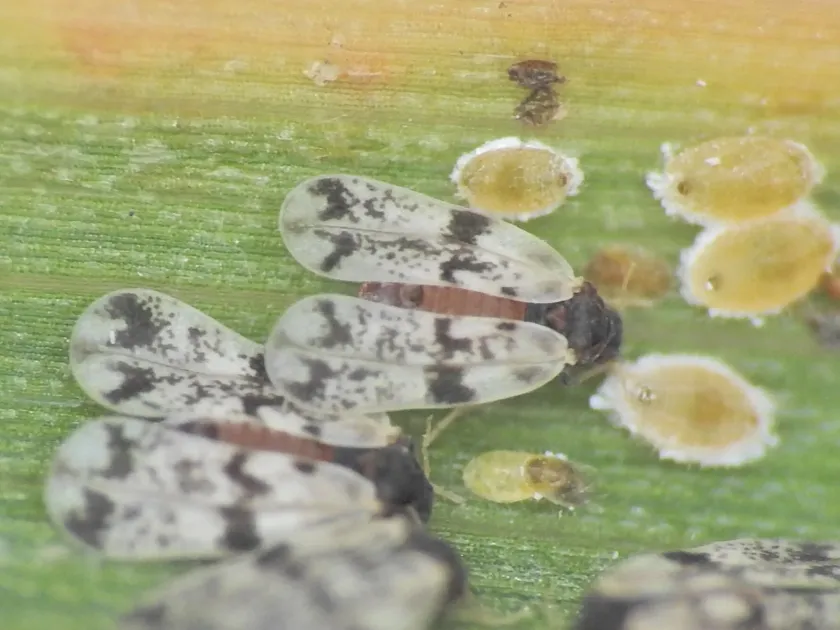
The sugarcane whitefly (Neomaskellia bergii) belongs to the Hemiptera order and the Aleyrodidae family. Adult insects are characterized by white wings, often featuring distinct dark spots or bands, which distinguishes them from related species.
The body of the adult is tiny and covered with a white waxy secretion. This coating serves as a protective barrier against moisture and environmental stressors. The eyes are divided into two parts, a key taxonomic feature used by specialists for identification.
Nymphs (larvae) are oval and flattened in shape. They remain sedentary on the underside of leaves, firmly attached to the plant surface. Their appearance can sometimes resemble tiny, translucent scales or dust-like deposits.
The life cycle encompasses egg, several nymphal stages, and adult. Development is highly sensitive to ambient temperature, with warmer conditions significantly accelerating the maturation process and increasing population density.
This species is well-adapted to tropical and subtropical climates. In these environments, it is capable of producing multiple successive generations, leading to rapid colonization of suitable host plants throughout the year.
What it damages
The primary host for this pest is sugarcane. The insect feeds by extracting plant sap through the phloem, which directly impacts the plant's metabolic health and overall development capacity.
The whitefly also affects various other crops including corn, sorghum, and several wild grasses. This ability to utilize alternative hosts allows the pest to persist and spread effectively within the agro-ecosystem.
Continuous feeding by the insects leads to severe chlorosis and stunted growth of the plants. Weakened plants exhibit lower biomass production and a significant decrease in overall yield quality, which is critical for sugarcane producers.
Infestation often leads to the accumulation of honeydew on the leaves. This substance attracts secondary invaders such as sooty mold, which creates a black film that blocks sunlight and severely inhibits photosynthesis.
High infestation levels can cause premature leaf senescence and death. The physiological stress caused by the whitefly makes the crop more susceptible to other secondary infections and environmental challenges.
Signs of infestation
The most immediate sign of an infestation is the sudden flight of small white insects when the plant is disturbed or shaken. They typically flutter and then quickly return to settle on the undersides of leaves.
The presence of sedentary colonies of nymphs on the underside of the leaves is a clear indicator. They appear as flat, static, scale-like structures often arranged neatly along the central leaf veins.
Visual symptoms on the foliage include generalized yellowing and curling. As feeding continues, necrotic spots may develop, followed by significant chlorosis, leading to a loss of the plant's healthy green color.
A sticky honeydew residue is a common symptom of high populations. This sticky surface eventually darkens as it becomes covered with a black sooty mold fungus, which is highly visible on the foliage and stalks.
The overall reduction in crop vigor and uneven development patches across the field are classic indicators of an established whitefly colony. Such damage patterns warrant immediate inspection and intervention.
Control measures
Biological control methods involve the utilization of natural enemies such as parasitoid wasps and predatory bugs. Promoting these populations within the field helps maintain the whitefly at a non-damaging threshold.
Good agricultural practices are essential, including the removal of weeds that serve as alternative hosts during the off-season. Proper field hygiene prevents the build-up of initial populations before the main crop season.
Chemical intervention usually involves systemic insecticides that are absorbed into the plant's vascular system. These are effective against sap-sucking insects and should be used according to integrated pest management principles.
Monitoring the field with yellow sticky traps is a standard proactive measure. These traps allow farmers to detect the arrival of adults and determine the best timing for insecticide application or biological intervention.
- Sanitation of fields after the harvest period
- Application of neonicotinoid-based insecticides when necessary
- Use of bio-insecticides containing entomopathogenic fungi
- Regular scouting and field monitoring programs
Taxonomy
- Latin name
- Neomaskellia bergii
- Order
- Hemiptera (bugs, aphids, leafhoppers)
- Family
- Aleyrodidae
- EPPO code
- NEOMBE
Discussion
No discussions yet — be the first.