
Nectarosiphon
Nectarosiphon
Description
How to identify
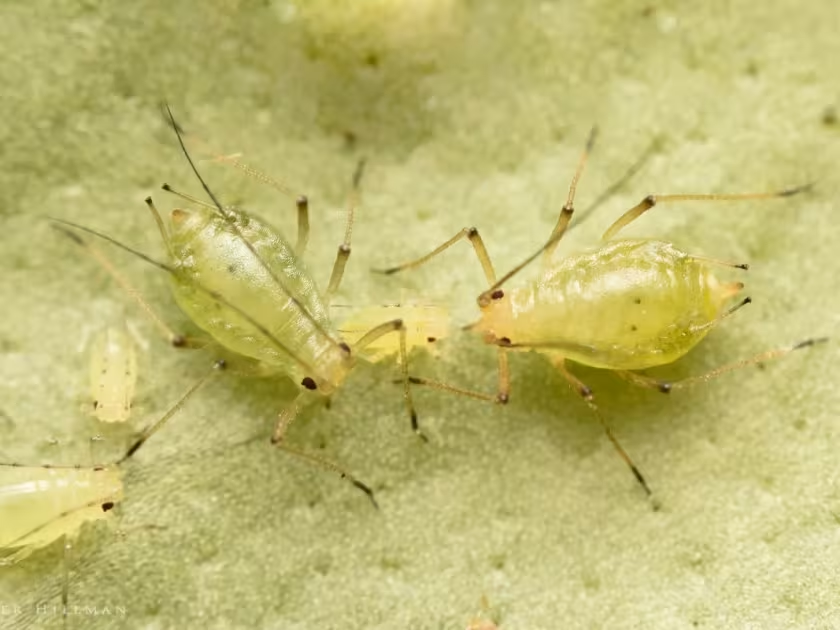
Nectarosiphon belongs to the family Aphididae (true aphids) within the order Hemiptera. These are small, often greenish or yellowish insects, which allows them to camouflage effectively against plant foliage.
Both adults and nymphs possess a piercing-sucking mouthpart. Morphologically, they are distinguished by long siphunculi (tubes) at the tip of the abdomen, through which they secrete defensive substances.
The life cycle involves both parthenogenetic reproduction and sexual reproduction at the end of the season. This reproductive strategy allows the population to explode in density very quickly.
These insects prefer to colonize the undersides of leaves and apical shoots, where tissues are tender. Colonies often contain both apterous (wingless) and alate (winged) forms for migration.
Precise identification often requires microscopic examination of the wing venation and the shape of the siphunculi. Distinguishing them from other aphid species based on host preference is essential for accurate scouting.
What it damages
Nectarosiphon affects a wide range of agricultural and ornamental plants, particularly those in the Solanaceae and Rosaceae families. The damage is primarily caused by intensive sap-feeding.
As the pest feeds on the phloem, the plant's overall health and physiological development are compromised. This leads to stunted growth and weakened plant immunity.
During feeding, the aphid injects specific enzymes into plant tissues, which causes structural damage and leads to the deformation of young shoots and buds.
A major threat is the transmission of various phytoviruses. Nectarosiphon acts as an active vector for these pathogens, which can result in severe yield losses and degraded crop quality.
The secretion of honeydew promotes the growth of sooty mold, which covers the foliage, blocks photosynthesis, and further degrades the plant's ability to produce energy.
When it appears
The active development of Nectarosiphon begins in early spring as soon as temperatures stabilize above freezing. The first colonizers target buds and emerging leaves.
Population peaks typically occur during the first half of summer, coinciding with the most rapid vegetative growth of crops. Generations can succeed one another every 7–10 days.
In late summer, during periods of extreme heat and drought, reproduction may slow down, or winged individuals may migrate to secondary hosts to survive.
Autumn marks the transition to sexual reproduction, followed by the laying of overwintering eggs on perennial plants or trees, ensuring survival through the cold season.
Regular monitoring starting from the leaf-unfolding stage is critical. Early detection is the most effective way to prevent large-scale infestations.
Signs of infestation
Primary signs of infestation include curling, yellowing, and premature leaf drop. The deformation of shoot tips is a classic symptom of significant aphid pressure.
- Presence of a sticky, shiny layer (honeydew) on foliage.
- High ant activity, as ants feed on the aphid honeydew.
- Chlorotic spots visible on the surface of leaves.
- Noticeable stunting and twisting of young growth.
- Black fungal growth (sooty mold) covering leaves and stems.
Control measures
Integrated management begins with good horticultural practices: controlling weeds that act as alternate hosts and avoiding excessive nitrogen fertilization that promotes succulent, vulnerable growth.
Biological control is highly effective by fostering natural enemies, including lady beetles, lacewings, and parasitic wasps (Aphidiidae), which can keep populations below economic thresholds.
When the economic threshold is exceeded, chemical intervention with systemic insecticides is recommended. Systemic products provide the most thorough coverage inside plant tissues.
Applications should be timed for the evening to minimize impact on pollinators. It is essential to rotate chemical classes to avoid the development of insecticide resistance.
In greenhouses, biological control agents or yellow sticky traps serve as effective tools for both monitoring and managing population levels throughout the growing season.
Taxonomy
- Latin name
- Nectarosiphon
- Order
- Hemiptera (bugs, aphids, leafhoppers)
- Family
- Aphididae
- EPPO code
- NECSSP
Discussion
No discussions yet — be the first.