
Peach aphid
Myzus varians
Description
How to identify
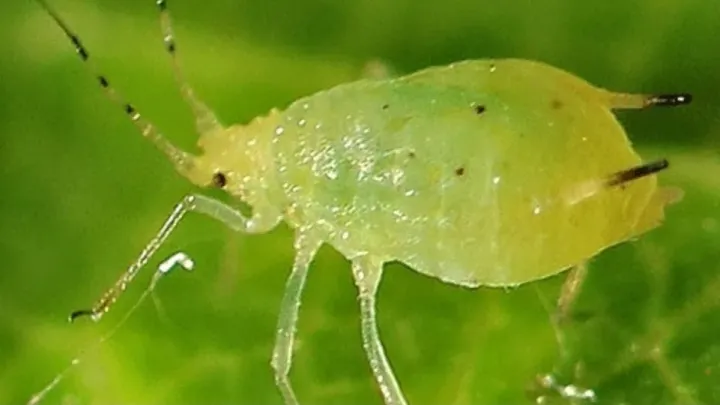
The peach aphid (Myzus varians) belongs to the order Hemiptera and the family Aphididae. It is a small sap-sucking insect that typically measures around 1.5 to 2 millimeters in length.
These insects exhibit a spindle-shaped body and range in color from pale green to yellowish-green, providing excellent camouflage against young foliage.
The life cycle involves overwintering as eggs on the bark of host trees. In the spring, founder nymphs emerge and begin establishing colonies on the underside of young leaves.
The aphid undergoes several generations during a single growing season. Winged forms can migrate to neighboring plants or alternative hosts, facilitating the rapid spread of the infestation throughout the orchard.
Proper identification usually involves examining the curled leaves at the tips of shoots, where these insects congregate in dense, protected clusters.
What it damages
The primary host for this species is the peach tree. The aphids concentrate their feeding on the most succulent tissues, such as new shoots and flower buds, during the period of active growth.
By piercing the plant's epidermis and extracting phloem sap, the aphids drain the tree's energy. This leads to the physiological weakening of the plant and poor nutrient distribution.
A major indirect threat is the transmission of plant viruses. Aphids act as vectors for various pathogens, which can cause permanent damage to the structural integrity and health of the fruit trees.
The feeding process results in severe leaf deformation. Leaves typically curl inward, becoming stunted and losing their ability to undergo effective photosynthesis.
In terms of yield, the damage manifests as decreased fruit size, poor fruit quality, and premature drop of both blossoms and fruitlets, significantly impacting commercial output.
Signs of infestation
Curled and distorted shoot tips are the most visible indication of a peach aphid infestation. These leaf rolls serve as shelter for the growing aphid population.
The secretion of honeydew is a diagnostic sign. This sticky, sugar-rich substance covers the foliage, creating a glistening appearance on the leaves and stems.
Sooty mold growth on the honeydew is a common follow-up sign. The leaves turn black and appear dusty, which prevents the tree from capturing sunlight properly.
The presence of ants is a clear biological marker. Ants are often found patrolling the branches because they "farm" the aphids to consume their sweet honeydew secretions.
General tree decline, such as yellowing leaves or wilting shoots, indicates that the population of aphids has reached a level that the host plant can no longer tolerate.
Control measures
Effective management begins with sound horticultural practices. Pruning out infested shoots and removing root suckers in the early spring can significantly reduce the overwintering population.
Encouraging beneficial predators is a cornerstone of integrated pest management. Lady beetles, lacewings, and hoverflies are natural enemies that can keep aphid populations below damaging thresholds.
Chemical control should be employed only when necessary. Systemic insecticides are most effective when applied during the pre-bloom stage to ensure the protection of developing buds and young leaves.
Dormant oils applied before bud break are a highly effective, low-toxicity method to smother overwintering aphid eggs on the bark of the trees.
- Regular orchard scouting for early signs of leaf curling.
- Using sticky bands on trunks to deter ants from tending aphid colonies.
- Avoid excessive nitrogen fertilization to limit the growth of soft, attractive succulent shoots.
- Rotating insecticide modes of action to prevent the development of pest resistance.
- Ensuring proper spacing and airflow in the orchard to minimize favorable conditions for outbreaks.
Taxonomy
- Latin name
- Myzus varians
- Order
- Hemiptera (bugs, aphids, leafhoppers)
- Family
- Aphididae
- EPPO code
- MYZUVA
Discussion
No discussions yet — be the first.