
Daylily aphid
Myzus hemerocallis
Description
How to identify
The daylily aphid (Myzus hemerocallis) is a member of the Aphididae family, belonging to the order Hemiptera. This aphid species is highly host-specific, feeding almost exclusively on Hemerocallis plants.
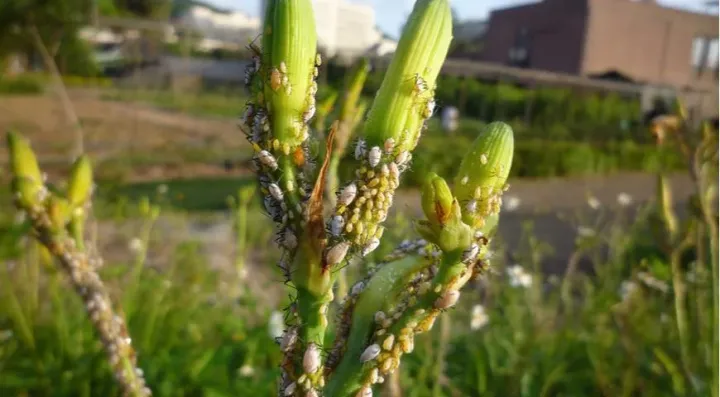
These insects are tiny, usually measuring between 1.5 and 2 mm in length. Their coloration ranges from pale yellow to orange-brown, which allows them to blend in perfectly with the stems and flower buds of the daylily.
They live in dense colonies, typically clustering in large numbers on the most succulent parts of the plant. Both winged and wingless forms exist, facilitating rapid spread throughout a garden.
The reproduction cycle is primarily parthenogenetic, meaning females can produce offspring without mating, allowing populations to explode in size within just a few days.
These aphids overwinter as eggs, typically tucked into the base of the daylily crowns or within dead foliage, remaining dormant until the spring temperatures rise.
What it damages
Daylily aphids feed by piercing plant tissues with their specialized mouthparts to extract sap. By doing so, they deprive the plant of vital nutrients and water.
They show a strong preference for tender new growth, specifically targeting young leaves and, most critically, the developing flower buds of the daylily plant.
This feeding activity causes significant stress to the plant, which often manifests as stunted growth, leaf curling, and overall weakening of the daylily's immune system.
Flower buds are particularly vulnerable; feeding by aphids often results in deformed flowers that may fail to open properly or may wither and drop prematurely.
Furthermore, because these aphids act as potential vectors for plant viruses, a heavy infestation poses a long-term threat to the health and vitality of the entire daylily bed.
When it appears
Activity begins in early spring, synchronized with the onset of the daylily's growing season. As soon as the first green shoots appear, the overwintered aphids emerge.
The population reaches its peak during the bud development and early flowering stage, as the concentration of sugary sap is highest in these tissues at that time.
While their growth rate may slow during extreme heat, they remain active throughout the summer months, with multiple generations overlapping during the peak season.
As autumn progresses and daylilies enter dormancy, the aphid population declines, with individuals producing eggs for the next generation before the cold sets in.
Gardeners should begin monitoring for these pests as soon as outdoor temperatures reach approximately 12–15°C, focusing inspections on the tips of the flower stalks.
Signs of infestation
The most obvious sign of an infestation is the visual presence of dense clusters of yellow or orange-colored insects on the flower stalks and buds.
Sticky residue, often called "honeydew," on the leaves is a classic indicator. This substance is an excretion of the aphids and often leads to the growth of black sooty mold.
Visible curling, yellowing, or twisting of the foliage is another common symptom that the plant is under attack by a colony of aphids.
Frequent activity of ants on the daylily stems is a strong secondary signal. Ants are attracted to the honeydew and will actively defend the aphid colonies from predators.
Failure of buds to bloom or buds that appear misshapen is a clear sign that the aphids have been feeding on the developing flower parts for an extended period.
Control measures
Early intervention is key. A light infestation can often be managed by manually removing the aphids or washing the plants with a strong stream of water.
In cases of heavy infestation, systemic insecticides containing ingredients like imidacloprid or acetamiprid are highly effective at controlling the population.
Natural biological control should be encouraged by creating a garden environment that supports predatory insects like ladybugs, lacewings, and syrphid flies.
Proper garden sanitation, including the removal of dead leaf litter and spent flower stalks, can significantly reduce the overwintering sites for aphid eggs.
- Apply horticultural oils or insecticidal soaps for eco-friendly management.
- Avoid over-fertilizing with nitrogen, which can lead to succulent growth that attracts aphids.
- Inspect new daylily additions carefully to prevent introducing aphids to your garden.
Taxonomy
- Latin name
- Myzus hemerocallis
- Order
- Hemiptera (bugs, aphids, leafhoppers)
- Family
- Aphididae
- EPPO code
- MYZUHE
Discussion
No discussions yet — be the first.