
Myzus certus aphid
Myzus certus
Description
How to identify
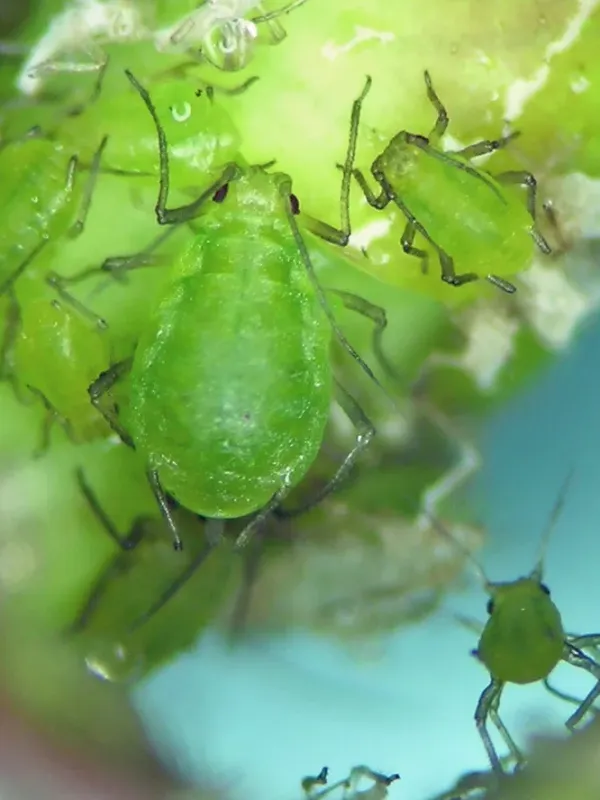
Myzus certus is a species of aphid belonging to the family Aphididae, order Hemiptera. It exhibits a typical pear-shaped body, with adult specimens measuring up to 2.5 mm in length.
The coloration of the adults can vary from yellowish-green to brown or even reddish, depending on the host plant species and environmental conditions during development.
A distinctive morphological feature is the presence of long, club-shaped siphunculi that are slightly curved outwards, which is a key diagnostic characteristic for this species.
The antennae are typically longer than the body length. The frontal view of the head reveals a distinctly concave shape between the antennal bases, characteristic of the Myzus genus.
Larvae are morphologically similar to adults but smaller and lighter in color. Accurate identification often requires microscopic examination of the sensorium structure on the antennae.
What it damages
This pest primarily infests crops from the Solanaceae and Fabaceae families, including potatoes. They typically congregate on the underside of leaves and on tender young shoots.
By feeding on phloem sap, the aphid drains the plant's resources, causing stunted growth, leaf curling, and a significant reduction in overall yield and crop quality.
Beyond direct feeding damage, Myzus certus acts as an important vector for various phytopathogenic viruses, which can cause severe disease outbreaks in crop fields.
The honeydew excreted by aphids facilitates the growth of sooty mold, which covers the leaf surface and blocks photosynthesis, further stressing the infested plants.
Severe infestations lead to the deformation of shoot tips, which drastically diminishes the aesthetic value of vegetable produce and impacts commercial profitability.
When it appears
The life cycle begins in spring when nymphs hatch from overwintering eggs deposited on primary host plants. Early generations often live in dense colonies.
During the summer, the aphid migrates to secondary herbaceous host plants. Throughout the season, it can produce multiple parthenogenetic generations, enabling rapid population growth.
Peak population levels for Myzus certus usually occur in the second half of summer, benefiting from stable, warm, and dry weather conditions that accelerate reproductive rates.
As autumn approaches, sexual morphs appear to produce overwintering eggs, which are laid in bark crevices or on plant debris to survive until the next growing season.
The speed of generation turnover is highly sensitive to ambient temperature and moisture, meaning that prolonged drought can trigger massive pest outbreaks.
Signs of infestation
The first visual sign of infestation is the curling and distortion of young leaves at the shoot tips. Close inspection of the underside of leaves reveals colonies of small insects.
The presence of a sticky honeydew residue on leaves is a definitive symptom. This residue soon becomes a substrate for black sooty mold fungus.
Plants show signs of yellowing and premature wilting. In heavy infestations, the growth tips become severely deformed and appear discolored.
- Curling and distortion of young foliage.
- Sticky honeydew secretions on plant surfaces.
- Increased ant activity, as ants tend the aphid colonies for honeydew.
- Chlorosis and premature yellowing of leaf veins.
Stunted growth of internodes and general plant weakening make the crops more susceptible to other diseases and environmental stress factors.
Control measures
Agricultural control includes rigorous weed management, as many weeds act as intermediate hosts, and strict crop rotation to disrupt the aphid's life cycle.
Biological control relies on promoting natural predators such as lady beetles, lacewings, and hoverflies, which can effectively keep aphid populations below economic damage thresholds.
When infestation levels pose a significant risk, systemic insecticides are applied. It is essential to rotate chemical classes to prevent the development of resistant populations.
Application of contact insecticides is most effective during the early stages of colonization, before the leaves have curled and protected the aphid colonies.
Continuous monitoring of the field throughout the growing season is crucial for detecting early signs of infestation and applying localized treatments before the problem spreads.
Taxonomy
- Latin name
- Myzus certus
- Order
- Hemiptera (bugs, aphids, leafhoppers)
- Family
- Aphididae
- EPPO code
- MYZUCR
Discussion
No discussions yet — be the first.