
Shallot aphid
Myzus ascalonicus
Description
How to identify
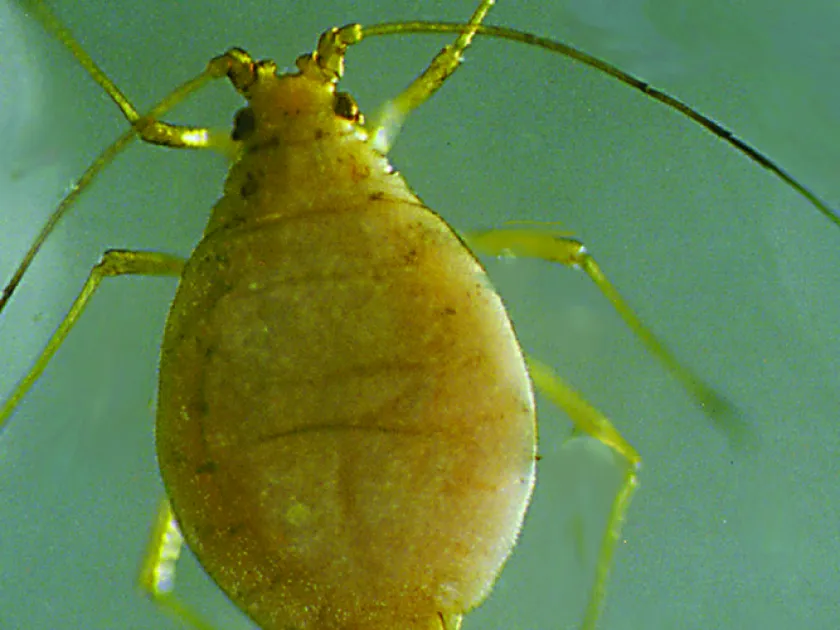
The shallot aphid (Myzus ascalonicus) is a significant horticultural pest belonging to the Aphididae family. Adults are small, measuring roughly 1.5 to 2.5 mm in length.
They exhibit a pale yellow, greenish, or grayish coloration. The body is typically oval-shaped, often covered by a fine layer of wax, which gives them a slightly dull appearance.
These insects can exist as wingless forms, which reproduce rapidly on the host, or winged forms, which are responsible for colonizing new host plants during the season.
They are characterized by their tendency to cluster in high densities, particularly at the base of the leaves or hidden within the hollow structures of onion and shallot foliage.
This species is highly adapted to cool weather conditions, distinguishing it from many other aphid types that prefer higher temperatures for peak population growth.
What it damages
The shallot aphid is a polyphagous insect that primarily attacks Allium crops, including bulb onions, garlic, shallots, and various ornamental bulbs like tulips.
By sucking the sap from the plant, they drain essential nutrients. This feeding process causes severe leaf distortion, curling, and stunting, which impacts the plant's overall development.
A critical aspect of their damage is the transmission of viruses. They are vectors for several persistent and non-persistent viruses that cause yellowing and necrosis in onions.
The physiological stress caused by heavy infestations leads to poor bulb formation, reduced yields, and significantly increased susceptibility to secondary rot infections.
In greenhouses, where temperatures are stable, these aphids can cause complete crop failure if left unmanaged, as they reproduce continuously under protected conditions.
When it appears
Activity begins early in the season, as the shallot aphid is uniquely adapted to thrive in cool, moist conditions that occur in early spring.
Population density increases rapidly through parthenogenesis, where females give birth to live nymphs without the need for mating, allowing for exponential growth.
As temperatures rise significantly during the peak of summer, their activity may decrease, but they often survive in sheltered areas or on alternative host plants.
In autumn, as conditions cool down again, they migrate back to wintering hosts or enter protected structures like greenhouses to survive the cold months.
Multiple generations occur throughout the growing season, necessitating ongoing vigilance and multiple control interventions if the pest load remains high.
Signs of infestation
The most visible symptom is the yellowing, wilting, and twisting of the leaf tips, which often creates an overall unkempt appearance in the onion patch.
Closer inspection of the base of the plant or between the leaf blades will reveal colonies of the aphids, often appearing as a grayish or greenish mass on the foliage.
The presence of honeydew is a diagnostic sign; this sticky excretion coats the leaves and encourages the growth of black sooty mold, which impairs photosynthesis.
A significant increase in ant activity around the plants is a reliable indicator that an aphid colony is present and is being "farmed" by the ants for their honeydew.
If the plants appear stunted compared to adjacent rows and the foliage feels limp, it is almost certainly a result of intense aphid feeding pressure on the tissues.
Control measures
Effective cultural control includes the removal of weeds from garden borders, as these act as reservoirs for the aphids during the periods between vegetable crops.
Regular monitoring of the undersides of leaves and the central growing point allows for early detection before the population reaches an uncontrollable level.
Chemical control can be implemented using systemic insecticides that penetrate the leaf tissue, as contact sprays are often ineffective against aphids hidden inside the foliage.
Biological control involves maintaining a favorable habitat for natural predators such as ladybirds, lacewings, and hoverfly larvae, which can naturally regulate aphid numbers.
In home gardens, horticultural soaps or neem-based oils can be applied to suppress populations, provided the spray is applied thoroughly to reach the hidden colony sites.
Taxonomy
- Latin name
- Myzus ascalonicus
- Order
- Hemiptera (bugs, aphids, leafhoppers)
- Family
- Aphididae
- EPPO code
- MYZUAS
Discussion
No discussions yet — be the first.