
Ross's Turaco
Musophaga rossae
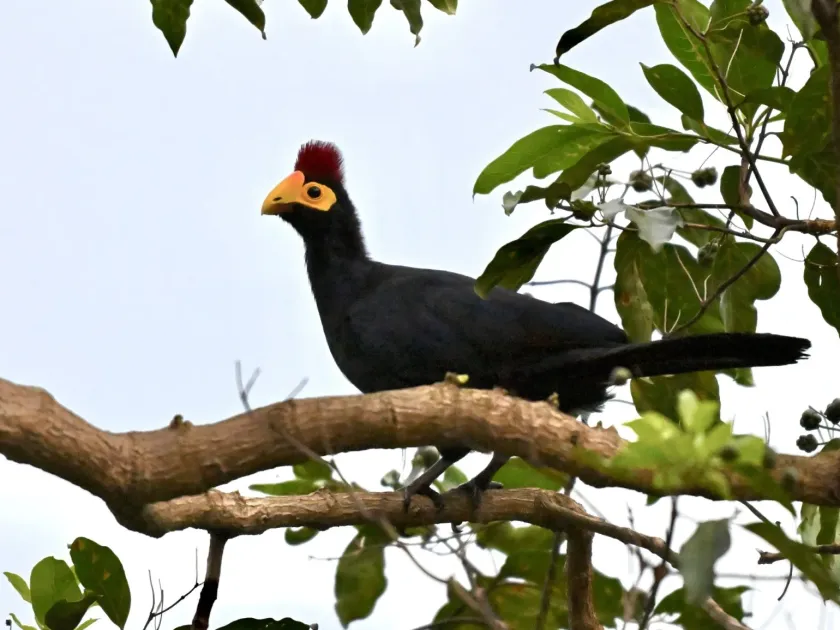
Description
How to identify
Ross's Turaco (Musophaga rossae) is a large, distinctive bird species belonging to the family Musophagidae, within the order Musophagiformes.
The species is easily identified by its vibrant blue plumage with a metallic sheen and a prominent red crest that adorns the top of its head.
Its powerful, brightly colored beak is highly specialized for cracking open fruits and processing fibrous plant materials found in their forest habitats.
Adult individuals typically measure between 40 and 50 centimeters in length, making them conspicuous residents of canopy-dense environments.
They are primarily arboreal birds, known for their ability to move quickly through tree branches while remaining relatively stationary within their home range.
What it damages
The primary agricultural impact of Ross's Turaco is the consumption and destruction of fruit crops in Central and Eastern Africa.
Commonly targeted crops include bananas, papayas, and various other orchard fruits that are grown in proximity to forest zones.
The birds cause significant economic loss by not only eating ripe fruits but also by damaging buds and tender shoots during the flowering stage.
Due to their feeding patterns, small-scale plantations can experience severe yield losses when a flock decides to concentrate their efforts on a single orchard.
Beyond crop loss, the physical weight of large flocks resting in fruit trees can lead to branch breakage and long-term damage to the plant structure.
When it appears
The foraging activity of Ross's Turaco is intrinsically linked to the fruiting phenology of both wild and cultivated plants in their habitat.
The intensity of crop raiding increases significantly during the ripening season when fruit sugar content and availability reach their peak.
During dry seasons, these birds may migrate locally toward irrigated farmlands, seeking consistent water and food sources that are otherwise scarce.
Their presence on agricultural land is highly seasonal, dictated by the availability of food sources across their broader home range.
Farmers usually observe increased activity in the weeks preceding harvest, which necessitates timely mitigation strategies to protect the ripening fruits.
Signs of infestation
The most reliable sign of Ross's Turaco activity is the presence of deep, ragged holes in fruit skins, caused by their robust and sharp beaks.
Ground-level debris, consisting of partially eaten and discarded fruit fragments, serves as clear evidence of their presence in the canopy above.
Loud, guttural vocalizations are typical of these birds and often serve as an auditory warning to farmers before visual contact is made.
Accumulation of avian waste on branches and leaves in the orchard provides further confirmation that the trees are being used as a primary feeding site.
Structural damage, such as bent or broken small branches, often indicates heavy activity by these birds during the peak fruiting season.
Control measures
Effective management of Ross's Turaco involves non-lethal deterrent methods to protect crops while maintaining ecological balance.
Physical barriers such as protective netting are the most effective solution for individual high-value trees or small plantation plots.
Visual deterrents, including reflective materials and predator-mimicking decoys, can be used to discourage the birds from settling in the orchard.
Maintaining a clean harvest schedule is crucial, as overripe fruits left on branches act as a significant attractor for these foraging flocks.
Integrated bird management programs often rely on a combination of these tactics to ensure that crops remain safe from significant bird-related damage.
Taxonomy
- Latin name
- Musophaga rossae
- Family
- Musophagidae
- EPPO code
- MUSORO
Discussion
No discussions yet — be the first.