
Australian bush fly
Musca vetustissima
Description
How to identify
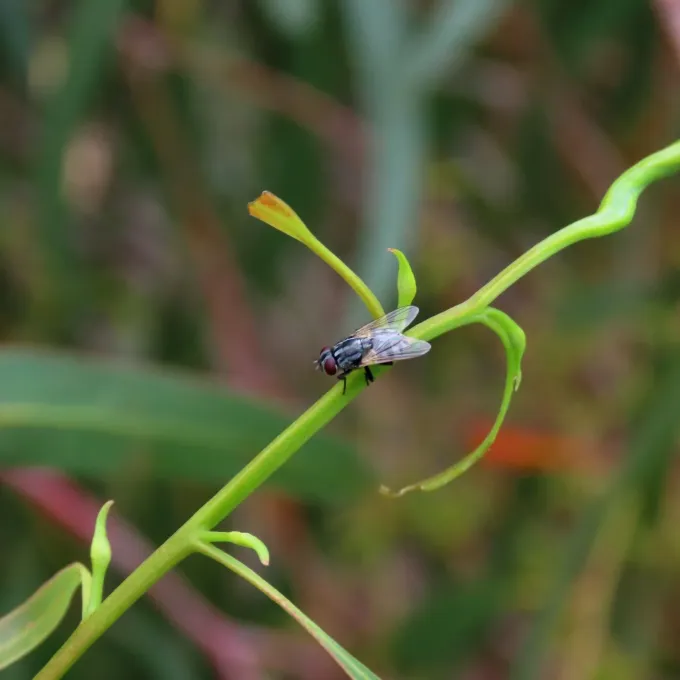
The Australian bush fly (Musca vetustissima) is a species of filth fly belonging to the family Muscidae, known for its persistent behavior around mammals.
Adult flies are typically 5–7 mm long, characterized by a grey thorax with four dark longitudinal stripes and a yellowish or pale abdomen.
They possess large compound eyes and a sponging-type mouthpart, which is evolved to lap up fluids from skin and mucous membranes.
Morphologically, they are easily confused with other house fly species, but their specific attraction to live animals differentiates them in field conditions.
Their larvae are legless maggots that develop in the dung of large herbivores, which serves as both their primary food source and breeding ground.
What it damages
While not a plant pest, the Australian bush fly is a major nuisance for the livestock industry, causing severe stress to grazing animals.
The flies feed on secretions from the eyes, nose, and mouth of cattle, horses, and sheep, leading to chronic irritation and secondary infections.
Constant harassment by swarms of flies disrupts feeding behavior, as animals spend significant time attempting to shake off the insects rather than grazing.
This disruption leads to reduced weight gain in calves and decreased milk production in dairy cattle due to constant movement and metabolic stress.
Furthermore, these flies can serve as mechanical vectors for various bacteria and pathogens, which can transmit diseases between animals in a herd.
When it appears
The activity of Musca vetustissima is heavily dependent on temperature, with populations surging during the warmer months of the year.
Development from egg to adult is rapid in favorable conditions, typically taking only a few weeks to complete a full life cycle.
High temperatures combined with moisture accelerate the breeding process, leading to peak infestation levels during the mid-summer period.
As autumn approaches and temperatures drop, fly activity gradually declines, and the population prepares for overwintering.
In cooler regions, the species overwinters in the pupal stage within the soil or as dormant adults in sheltered, warmer locations.
Signs of infestation
The most obvious sign of an infestation is the aggressive behavior of livestock, which frequently flick tails and shake their heads.
Visible clusters of flies around the eyes and nostrils of animals indicate a high level of population pressure in the area.
Livestock may bunch together in tight groups to reduce the exposed surface area available for flies to land on, a common defensive posture.
Tear staining and crusting around the eyes of the animals are clear physiological symptoms of continuous feeding by the flies.
Presence of fresh dung pats on the pasture with signs of maggot activity confirms that the area is being used for breeding.
Control measures
Effective control requires a multi-faceted strategy that focuses on disrupting the breeding cycle and protecting individual animals.
Sanitation of grazing areas, particularly the prompt management and disposal of dung, is critical to limiting the available breeding sites.
The application of insecticidal ear tags and pour-on solutions directly on the livestock provides significant relief from persistent fly attacks.
- Regular application of insecticide sprays in barns and shelters.
- Biological control measures, such as the introduction of dung beetles to disturb breeding sites.
- Use of traps with specific attractants to reduce fly numbers in intensive farming areas.
Implementing an integrated pest management (IPM) plan that combines chemical treatment with pasture rotation is the most sustainable approach.
Taxonomy
- Latin name
- Musca vetustissima
- Order
- Diptera (flies)
- Family
- Muscidae
- EPPO code
- MUSCVE
Discussion
No discussions yet — be the first.