
Face fly
Musca autumnalis
Description
How to identify
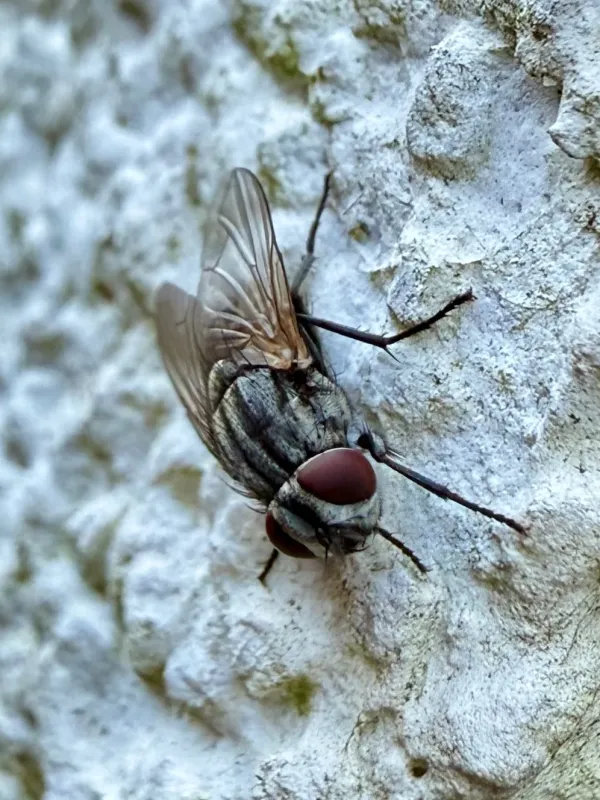
The face fly (Musca autumnalis) is a fly belonging to the family Muscidae. It closely resembles the common house fly but is slightly larger and has distinct longitudinal stripes on its thorax, making it identifiable upon close inspection.
Adults are known for their specific feeding habits. While males feed on plant sugars and nectar, females require protein, which they obtain from the secretions of the eyes, nostrils, and mouth of cattle and horses.
The life cycle of this species is highly specialized. Eggs are laid exclusively in fresh bovine manure, which serves as the required substrate for the larval stage to complete its development under favorable temperature conditions.
Adult flies overwinter in secluded places such as attics, barns, and wall voids. They emerge in early spring to begin their annual cycle, with populations peaking in the late summer and autumn months.
Due to their mobility, face flies can travel significant distances between pastures, ensuring that livestock herds are under constant pressure throughout the grazing season in many temperate regions.
What it damages
Face flies are significant economic pests in the livestock industry. They cause severe annoyance to cattle by clustering around their faces, which prevents the animals from grazing efficiently.
The primary concern is the transmission of pathogens. The flies act as mechanical vectors for Moraxella bovis, the bacterium responsible for infectious bovine keratoconjunctivitis, commonly known as pinkeye.
The constant irritation caused by thousands of flies leads to behavioral changes in livestock. Cattle spend more energy swatting at flies and less time grazing, which directly results in reduced weight gain and decreased milk production.
In addition to physiological stress, the open sores around the eyes caused by feeding flies can attract other secondary parasites, further compromising the health and welfare of the animal.
The economic impact of face fly infestations is widely recognized by cattle producers. Without effective management, the prevalence of eye infections and the overall decline in herd performance can lead to substantial financial losses.
Control measures
Effective control of face flies requires an integrated pest management (IPM) approach. The most important step is manure management, as removing fresh manure piles significantly reduces the breeding sites available to the flies.
Direct protection of cattle is achieved through the use of insecticidal ear tags, pour-on treatments, and insecticide-impregnated backrubbers. These methods provide a barrier against fly landings on the animals' sensitive areas.
Environmental control in barns is equally important. Installing screen meshes on windows and using high-efficiency fly traps can help reduce the overwintering population and diminish the intensity of the early spring flight.
Feed-through additives that contain insect growth regulators are another option. These additives pass through the animal's digestive system into the manure, preventing the larvae from successfully maturing into adults.
- Frequent removal and proper composting of manure.
- Application of long-acting topical insecticides.
- Use of insecticidal ear tags on calves and adults.
- Installation of screens in livestock housing.
- Monitoring fly activity to time control efforts.
Taxonomy
- Latin name
- Musca autumnalis
- Order
- Diptera (flies)
- Family
- Muscidae
- EPPO code
- MUSCAU
Discussion
No discussions yet — be the first.