
House fly
Musca
Description
How to identify
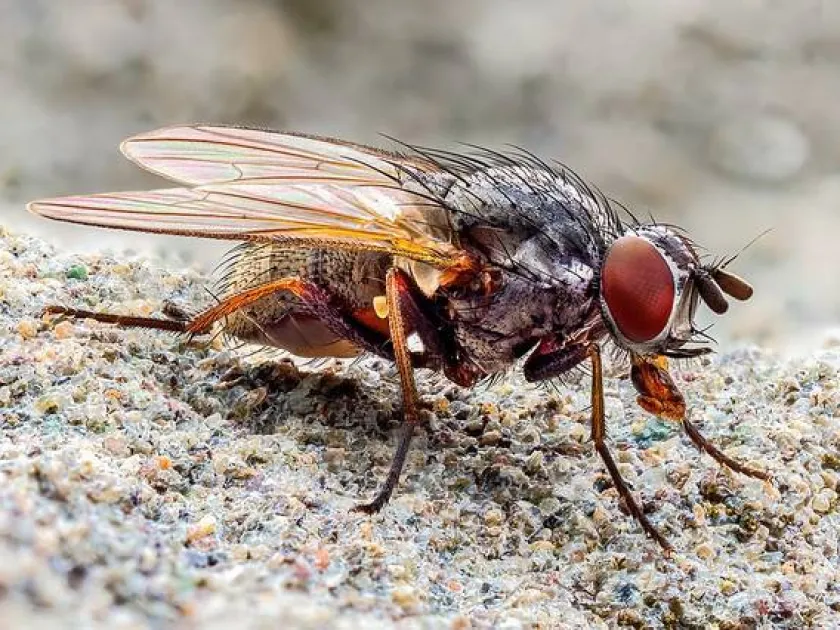
The house fly (Musca domestica) belongs to the order Diptera and the family Muscidae. This synanthropic species is closely linked to human environments and agricultural activities.
The adult insect is 6–8 mm long, with a grayish body featuring four dark longitudinal stripes on the thorax. The mouthparts are of the sponging-sucking type, adapted for liquid food.
The life cycle consists of four distinct stages: egg, larva, pupa, and adult. Development is rapid, particularly in warm temperatures and where organic waste is present.
The larva is a white, legless maggot reaching up to 12 mm in length, which thrives in decaying organic matter, manure, or damp soil.
Optimal conditions for reproduction include temperatures above +20 °C and access to rotting plant residues that serve as a breeding site.
What it damages
Although the house fly is not a direct primary phytophagous pest, it causes indirect damage to vegetable crops, particularly within greenhouse environments.
The primary harm involves the mechanical transmission of pathogens, fungal spores, and parasites onto the surface of leaves and fruit.
By damaging plant tissues while feeding or contaminating them with excrement, flies create entry points for secondary bacterial and fungal infections.
In seedbeds, house flies may affect delicate seedlings that are already weakened by substrate decay, as the organic odor attracts the flies.
Contamination of harvested produce with fly excrement makes the vegetables unfit for market or consumption due to significant sanitary risks.
Signs of infestation
A primary visual indicator of fly presence is the accumulation of dark "specks" on leaves, stems, and fruit, which are dried fecal deposits.
The presence of numerous adults within a greenhouse or conservatory usually indicates the existence of breeding hotspots, such as piles of raw manure or compost.
Finding larvae in the top layer of the growing medium is a clear sign of poor horticultural hygiene and the use of improperly composted organic matter.
The development of localized soft rots or bacterial spots where insects frequently congregate is strong evidence of the flies' negative impact on plant health.
Affected plant areas may emit a pungent, decaying odor, which further attracts additional flies to lay eggs.
Control measures
The primary control measure is the strict maintenance of sanitation and hygiene protocols within greenhouses, including the removal of all organic debris.
It is essential to prevent the storage of exposed organic waste and manure near crop production areas to eliminate breeding sites for larvae.
The use of sticky yellow traps and light traps is highly effective in reducing adult population densities during periods of high activity.
Application of authorized insecticides should be restricted to emergency situations and must strictly adhere to pre-harvest interval requirements.
- Regular soil cultivation to ensure the top layer remains dry.
- Installing fine mesh screens on all ventilation openings.
- Treating known fly congregation areas with biological control agents.
Taxonomy
- Latin name
- Musca
- Order
- Diptera (flies)
- Family
- Muscidae
- EPPO code
- MUSCSP
Discussion
No discussions yet — be the first.