
Yellow pecan aphid
Monellia caryella
Description
How to identify
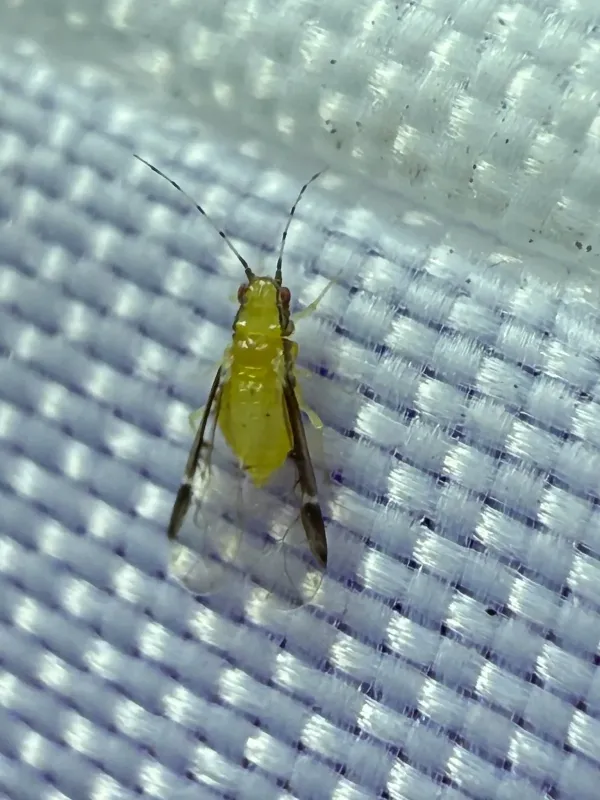
The yellow pecan aphid (Monellia caryella) is a small, pale-yellow insect belonging to the family Aphididae. Adults are approximately 2 mm long and are typically found on the undersides of pecan leaflets.
A key distinguishing feature of this species is the presence of clear wings with noticeable dark, pigmented spots along the anterior margin, which helps in field identification.
Nymphs go through several developmental stages, resembling the adults but smaller in size. They are active feeders throughout their immature lifecycle, which can be completed in just a few days under optimal conditions.
These aphids are highly mobile and tend to scurry rapidly when disturbed, often dropping from the leaves to evade predators or external threats.
The population cycle includes both winged and wingless forms, allowing the insect to colonize new parts of the tree or migrate to adjacent orchards effectively throughout the growing season.
What it damages
The primary host for this pest is the pecan tree (Carya illinoinensis). The aphids feed by sucking phloem sap directly from the leaf tissues, which places a significant physiological stress on the host plant.
Severe infestations lead to premature leaf drop (defoliation) in late summer, which hinders the tree's ability to store necessary carbohydrates for the following season's growth and nut development.
The insects excrete large amounts of honeydew, a sugary substance that coats the leaves and serves as a medium for the growth of sooty mold, which blocks sunlight and inhibits photosynthesis.
Economic damage occurs primarily through reduced nut quality, lower kernel weight, and decreased overall orchard productivity over successive years of infestation.
Furthermore, chronic nutrient depletion caused by heavy aphid populations makes the trees more susceptible to environmental stressors and other opportunistic diseases.
When it appears
The infestation cycle typically begins in early spring, as temperatures rise and overwintering eggs on the tree bark hatch into the first generation of nymphs.
Populations tend to increase rapidly during the mid-summer months, particularly when hot and dry weather conditions prevail, which accelerate the reproductive rate.
The peak of aphid activity often occurs in late summer and early autumn before the onset of cooler temperatures, when the insects transition to producing overwintering eggs.
Continuous monitoring is required during these peak periods, as the aphid's ability to reproduce parthenogenetically allows them to build up large colonies within a very short timeframe.
Effective management in the earlier stages of the season is crucial to prevent the exponential population growth that often happens by mid-summer.
Signs of infestation
Identifying an infestation is often possible by observing both the direct presence of the aphids and the indirect damage symptoms on the foliage.
- Yellow or chlorotic spots appearing on the leaflets where feeding occurred.
- Visible, sticky honeydew deposits on the upper surface of leaves below the aphid colonies.
- The development of black sooty mold on leaf surfaces due to honeydew accumulation.
- The presence of cast-off white skins (exuviae) left behind after aphid molting.
- Increased ant activity on the tree trunks, as ants are often attracted to the honeydew.
Control measures
Integrated Pest Management (IPM) strategies for the yellow pecan aphid focus on conserving natural predators such as lady beetles, green lacewings, and parasitic wasps.
Monitoring using yellow sticky traps is a standard practice to track population density and determine if chemical intervention is necessary based on economic thresholds.
If chemical control is required, systemic or contact insecticides may be applied, ensuring they are used according to safety guidelines to protect beneficial pollinators and natural enemies.
Proper orchard management, including correct pruning and irrigation, helps maintain tree vigor and reduces the susceptibility of the canopy to pest colonization.
Rotating insecticides with different modes of action is essential to manage resistance and ensure the long-term effectiveness of chemical control programs.
Taxonomy
- Latin name
- Monellia caryella
- Order
- Hemiptera (bugs, aphids, leafhoppers)
- Family
- Aphididae
- EPPO code
- MONLCA
Discussion
No discussions yet — be the first.