
Yellow walnut aphid
Monellia
Description
How to identify
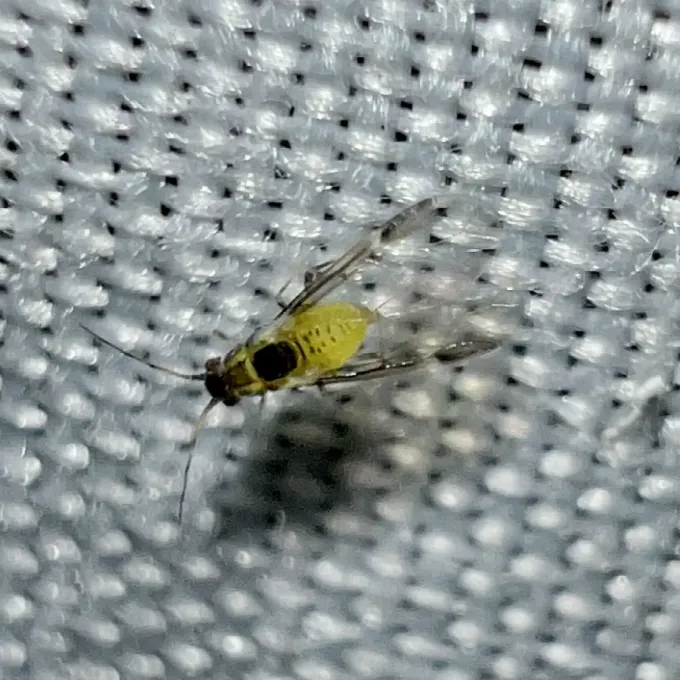
The Yellow walnut aphid (Monellia spp.) is a small sap-sucking insect belonging to the family Aphididae that specifically targets walnut trees.
Adults are typically pale yellow, measuring about 1.5 to 2 mm in length, and possess distinct wings that they hold roof-like over their backs when resting.
These aphids are highly active and mobile, often scattering quickly across the leaf surface when the branch is disturbed, which makes detection a bit challenging.
The life cycle is characterized by rapid parthenogenesis during the spring and summer months, allowing for exponential population growth in short periods.
Overwintering occurs in the egg stage, with eggs deposited in bark crevices or near buds to withstand cold winter temperatures.
What it damages
The primary host for this pest is the English walnut (Juglans regia), though it can inhabit various other species within the Juglans genus.
Damage is caused by the aphids extracting phloem sap from the undersides of leaves, which weakens the tree and disrupts essential physiological processes.
As a byproduct of feeding, the aphids excrete a sugary substance known as honeydew, which accumulates on the foliage and branches below.
This honeydew serves as a perfect substrate for sooty mold fungus, which creates a dark layer on the leaves, significantly reducing their photosynthetic efficiency.
In cases of heavy infestation, trees may suffer from premature leaf drop, reduced nut size, and decreased overall vigor and winter hardiness.
When it appears
The activity of the yellow walnut aphid begins in early spring, coinciding with bud break and the initial emergence of new, succulent leaf tissue.
Population peaks typically occur during the warmer months of summer, when temperature and humidity levels favor rapid reproductive cycles.
As autumn approaches and temperatures drop, the aphid shifts its lifecycle towards producing overwintering eggs to ensure the species' survival.
Multiple overlapping generations occur throughout the growing season, meaning that without intervention, infestations can persist from late spring until fall.
Environmental monitoring is crucial during these peak periods to determine if pest thresholds have been crossed and if action is required.
Signs of infestation
Early symptoms include yellow stippling or spotting on the foliage where the aphids have been feeding on the underside of the leaf.
The presence of a sticky, glistening residue (honeydew) on the leaves or the ground beneath the tree is a classic indicator of an aphid colony.
A black, soot-like covering on the leaves indicates the secondary growth of sooty mold, which is a strong sign of long-term aphid presence.
Distorted, curling, or prematurely yellowing leaves are common physiological responses to severe feeding stress caused by the insect.
Direct visual inspection of the lower leaf surfaces will reveal the pale, yellow-bodied insects, often positioned along the main veins of the leaf.
Control measures
Orchard management should prioritize the maintenance of healthy trees through balanced fertilization and proper irrigation to avoid excessive soft growth.
Cultural controls include pruning to open up the canopy, which improves light penetration and airflow, making the environment less hospitable to aphids.
Encouraging biological control agents like lady beetles, lacewings, and hoverflies is highly effective in naturally suppressing aphid populations.
When monitoring indicates that economic thresholds are exceeded, targeted applications of systemic or contact insecticides may be necessary to save the crop.
Always time chemical treatments correctly, focusing on the early stages of infestation to prevent the buildup of large, hard-to-control colonies.
Taxonomy
- Latin name
- Monellia
- Order
- Hemiptera (bugs, aphids, leafhoppers)
- Family
- Aphididae
- EPPO code
- MONLSP
Discussion
No discussions yet — be the first.