
Spruce needle aphid
Mindarus japonicus
Description
How to identify
The spruce needle aphid (Mindarus japonicus) belongs to the family Aphididae. These small insects are typically pale green or yellowish and are often covered in a white, waxy secretion that protects them from drying out.
The life cycle is closely synchronized with the growth of spruce buds in spring. Females can be both winged and wingless, allowing the population to spread rapidly across the canopy of a single tree or to adjacent ones.
They are highly specialized, feeding exclusively on the soft, succulent tissues of young spruce shoots that have recently emerged during the spring flush.
Due to their small size and camouflage capabilities, they are often difficult to spot during the early stages of an infestation without close inspection of the base of the needles.
The colonies produce large amounts of honeydew, which serves as a secondary indicator of their presence within the dense foliage of the host tree.
What it damages
The primary hosts of Mindarus japonicus are species of the genus Picea. They are a significant nuisance for both ornamental landscapes and commercial conifer nurseries.
Feeding occurs on current-year growth. By sucking the sap from these developing needles, the aphids disrupt the normal hormonal balance of the shoot, leading to severe twisting and curling of the needles.
Heavy infestations can lead to stunted growth and premature needle drop. This significantly impacts the aesthetic value of the tree and can cause long-term stress, especially in younger saplings.
Furthermore, the extraction of sap causes the shoots to become brittle and discolored, which detracts from the uniform, lush appearance expected of healthy spruce trees.
While the direct damage is significant, the indirect damage caused by the secondary colonization of sooty mold fungus on the aphid’s excrement can further reduce the tree's photosynthetic capacity.
Signs of infestation
A classic sign of infestation is the deformation of the new growth, which often curls into a hook shape. This is accompanied by the yellowing and subsequent browning of the needles.
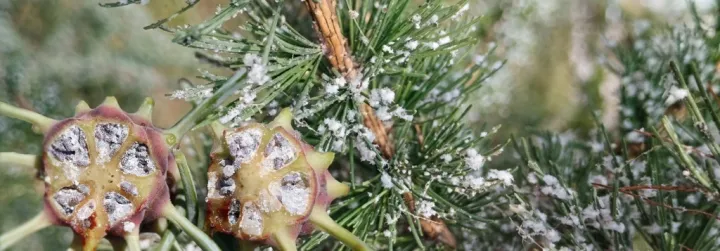
The presence of white, cotton-like wax at the base of the needles is a diagnostic feature. This substance is secreted by the aphids and remains visible even after the insects have moved or been killed.
Sticky honeydew on the needles and branches is a clear warning sign. This substance often attracts ants, which will farm the aphids for their sugary secretions.
Sooty mold, appearing as black soot on the foliage, thrives on the honeydew produced by the aphids and can be seen on heavily infested trees.
- Curled, deformed new shoots.
- White waxy tufts at the base of needles.
- Sticky, sweet-smelling honeydew deposits.
- Presence of ants on new growth.
- Premature defoliation of current-year shoots.
Control measures
Chemical control is most effective when applied early in the spring, just as the buds begin to open and the aphids start their feeding activity on the young needles.
Systemic insecticides are generally preferred as they are absorbed by the tree and provide longer-lasting protection against the aphids, which are often hidden deep within the foliage.
Integrated pest management strategies include encouraging natural predators such as lady beetles, lacewings, and hoverflies, which are highly effective at suppressing aphid populations.
Horticultural oils can be used to disrupt the waxy coating of the aphids, leading to their death, although these must be applied carefully to avoid phytotoxicity on young, tender growth.
Regular monitoring of young spruce trees during the spring growth phase is essential for early detection, allowing for spot treatments rather than widespread pesticide application.
Taxonomy
- Latin name
- Mindarus japonicus
- Order
- Hemiptera (bugs, aphids, leafhoppers)
- Family
- Aphididae
- EPPO code
- MINDJA
Discussion
No discussions yet — be the first.