
Spruce aphid
Mindarus
Description
How to identify
The spruce aphid (Mindarus abietinus) is a small insect belonging to the family Mindaridae. These pests are primarily found on spruce and fir species throughout temperate regions.
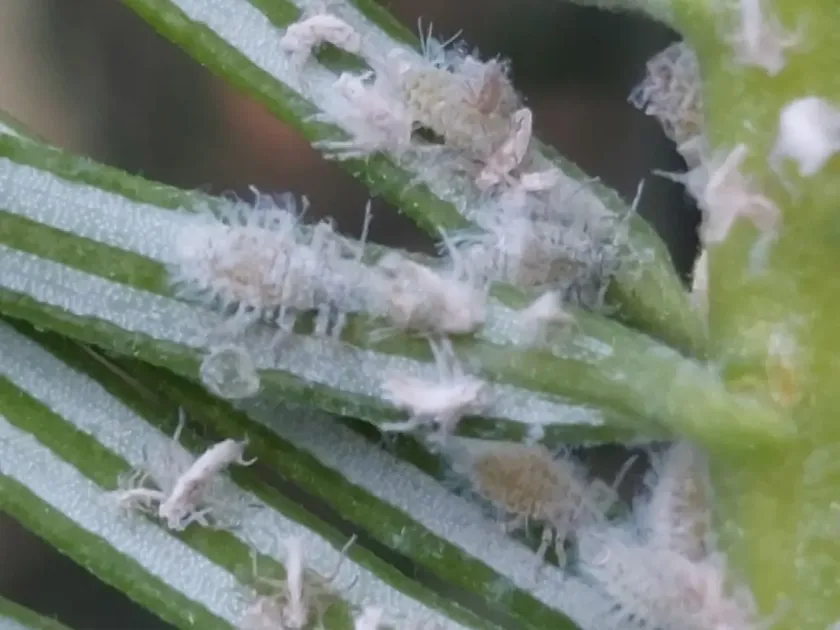
Adult aphids are typically pale green or grayish, often covered with a white waxy substance that makes them resemble bits of cotton or dust. Their small size makes detection difficult.
The life cycle is complex, involving both winged and wingless forms. The winged individuals allow the pest to spread to adjacent trees when the population density becomes too high.
They overwinter as eggs, which are deposited in small crevices, near buds, or under the bark of the host tree. These eggs hatch as soon as spring temperatures begin to rise.
Because they live on the undersides of needles, they often go unnoticed until significant damage has already been caused to the tree's new growth.
What it damages
The primary hosts are spruce (Picea) and fir (Abies). The aphid specifically targets new, tender shoots, extracting sap directly from the phloem.
Feeding causes the young needles to curl, twist, and eventually turn yellow or brown. This significantly reduces the aesthetic value of ornamental trees.
Persistent feeding on shoots leads to stunted growth and, in severe cases, branch dieback. This weakens the tree, making it susceptible to secondary infections.
The honeydew excreted by the aphids encourages the growth of sooty mold, which covers the needles and further interferes with photosynthesis, weakening the tree's health.
Young trees in nurseries are at the highest risk, as the loss of new growth can severely impact their development and marketability over several seasons.
When it appears
The activity of Mindarus abietinus is synchronized with the host tree's bud break. Hatching occurs in early spring, just as the new needles are emerging.
The population reaches its peak in late spring. This is when the most significant damage occurs, as the insects rapidly reproduce on the succulent new growth.
By mid-summer, as the new needles harden, the aphid population naturally declines. However, some colonies may remain on the trees depending on the environmental conditions.
During the autumn, the aphids produce sexual forms that lay the overwintering eggs, completing the yearly cycle before the onset of winter.
Cool, damp springs can sometimes slow their development, but extended warm periods significantly increase the rate of reproduction and the severity of the outbreak.
Signs of infestation
The most distinctive symptom is the distortion of new growth. Shoots may appear twisted, curled, or stunted compared to healthy branches on the same tree.
Needle yellowing or browning is common in areas where aphid colonies are active. If left untreated, these needles will fall off prematurely.
Honeydew secretion is a telltale sign. This sticky substance is often found on the branches or on the ground beneath the tree and can be quite messy.
The white, woolly, or waxy secretions produced by the aphids are often visible at the base of the needles, acting as a visual indicator of their presence.
- Curled and twisted new shoots
- Yellowed or scorched-looking needles
- Presence of sticky honeydew
- Development of black sooty mold
- White, fluffy waxy debris on foliage
Control measures
For minor infestations, physical removal by pruning and destroying the affected shoots can be effective. This helps reduce the initial population early in the season.
Systemic insecticides, such as those containing imidacloprid, are highly effective because they travel through the plant's vascular system to reach the aphids.
Application of horticultural oils in the early spring can help control the overwintering egg population by suffocating them before they hatch.
Biological control agents, including lady beetles, hoverfly larvae, and lacewings, can naturally suppress aphid populations if their presence is encouraged in the garden.
Monitoring is crucial. Regular inspections of the undersides of new needles during the spring growth phase will allow for early intervention before the infestation becomes widespread.
Taxonomy
- Latin name
- Mindarus
- Order
- Hemiptera (bugs, aphids, leafhoppers)
- Family
- Aphididae
- EPPO code
- MINDSP
Discussion
No discussions yet — be the first.