
English grain aphid
Microsiphum granarium
Description
How to identify
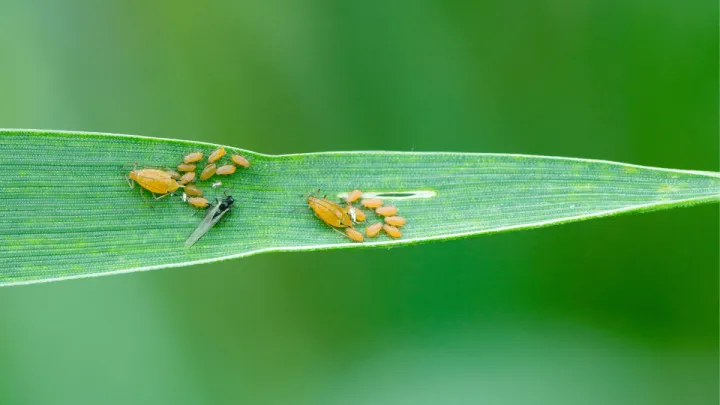
The English grain aphid (often referred to as Macrosiphum granarium or Sitobion avenae) is a significant pest of various cereal crops worldwide. The adults are relatively large, measuring between 2.5 and 3.5 mm in length.
Their bodies are typically elongated, with colors ranging from pale green to brownish-red. A key diagnostic feature is their long, dark-colored antennae and black siphunculi.
This species exhibits a complex life cycle, including both winged and wingless forms. The winged adults are responsible for long-distance migration and colonizing new fields during the growing season.
They reproduce through parthenogenesis throughout the spring and summer, which leads to exponential population growth when environmental conditions are favorable.
The overwintering stage typically occurs as eggs on winter cereals or various wild grasses, serving as the primary source of infestation for the following year.
What it damages
This aphid primarily attacks wheat, barley, oats, and rye. It has a high preference for succulent plant tissues, particularly during the stages of flag leaf development and grain filling.
By sucking the phloem sap, the aphids drain nutrients from the plant, causing physical weakening. This depletion significantly reduces the plant's capacity to fill the grains properly.
Severe infestations lead to reduced thousand-grain weight and overall yield loss. Furthermore, the aphids secrete honeydew, which promotes the growth of sooty mold.
They are also vectors for several important cereal viruses, such as Barley Yellow Dwarf Virus (BYDV), which can cause catastrophic yield losses if plants are infected early.
The combination of direct feeding damage and virus transmission makes this pest a critical concern for agricultural management in cereal-producing regions.
When it appears
The activity begins in early spring as temperatures rise, triggering the hatch of nymphs from overwintering eggs. These initial colonies grow rapidly.
Peak populations are usually observed during the late stages of crop development, specifically around the time of flowering and grain milky-dough stage.
High temperatures in mid-summer can slow down reproduction, but the population remains active as long as the host plants provide sufficient nutrients and moisture.
As the crops reach maturity and harden, the aphids migrate towards greener, late-sown fields or wild grasses to complete their seasonal cycle.
Regular field scouting is essential from stem elongation through to grain ripening to determine the infestation level and the necessity for control interventions.
Signs of infestation
The most obvious sign of infestation is the presence of aphid clusters on the stems and heads (ears) of the wheat plants, often visible to the naked eye.
Plants affected by heavy feeding may show yellowing or wilting, particularly the flag leaf, which is vital for providing sugars to the developing grain.
Honeydew accumulation makes the leaves sticky and shiny, eventually turning black due to the growth of sooty mold fungi, which inhibits photosynthesis.
Infested heads often appear shriveled or display incomplete grain set, significantly affecting the quality and quantity of the harvestable crop.
Yellowing patches within a field indicate significant colonization, and close inspection usually reveals the presence of both winged and wingless individuals.
Control measures
Effective management begins with cultural practices, such as controlling volunteer cereals and grassy weeds that act as refuges for aphids between crops.
Promoting natural enemies like ladybirds, hoverflies, and lacewings is a crucial biological control strategy that can keep aphid numbers below economic thresholds.
Economic threshold levels should be monitored closely; in many regions, the threshold is approximately 10–15 aphids per stem during the grain filling stage.
If thresholds are exceeded, targeted applications of systemic insecticides are used to control the population and prevent the spread of virus diseases.
Integrated Pest Management (IPM) should be prioritized, ensuring the timing of chemical control minimizes the impact on beneficial insects and pollinators.
Taxonomy
- Latin name
- Microsiphum granarium
- Order
- Hemiptera (bugs, aphids, leafhoppers)
- Family
- Aphididae
- EPPO code
- MICSGR
Discussion
No discussions yet — be the first.