
Mesembrina meridiana
Mesembrina meridiana
Description
How to identify
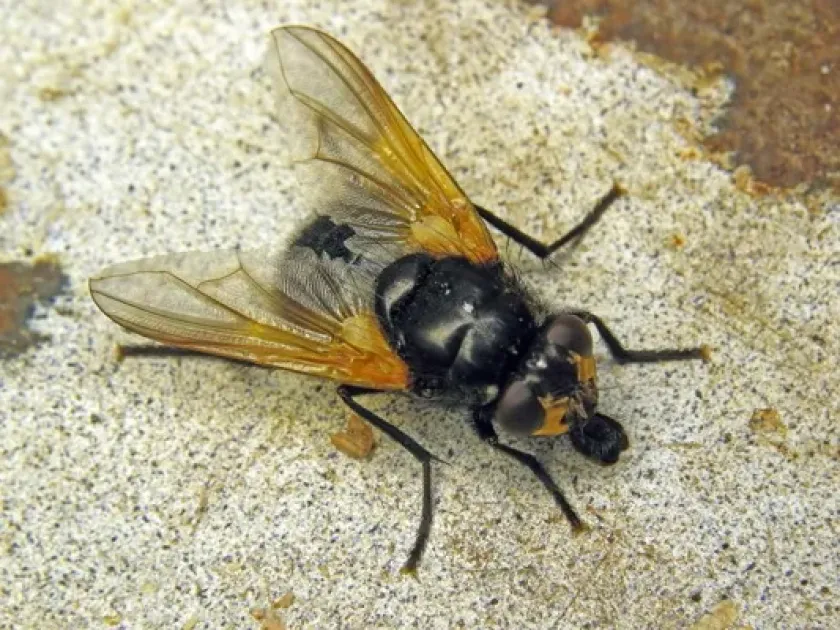
Mesembrina meridiana, commonly known as the noon fly, is a large species of fly belonging to the family Muscidae. It is easily recognized by its dense black hair and yellowish-orange bases of the wings and legs.
The fly typically measures between 10 to 14 millimeters in length. Its appearance is somewhat reminiscent of a bumblebee, which is a common mimicry trait in the insect world.
As a member of the order Diptera, it follows a complete metamorphosis life cycle. The larvae are coprophagous and develop in cattle dung, which makes the species abundant near pastures and dairy farms.
The name "noon fly" originates from its distinct behavior of sunning itself on leaves or warm surfaces during the hottest hours of the day.
Taxonomically, it is classified within the genus Mesembrina. Its robust appearance distinguishes it from common houseflies that are typically found in households.
What it damages
Mesembrina meridiana is not considered a crop pest. It does not feed on plant tissues, nor does it deposit eggs in the stems, fruits, or roots of cultivated plants.
The fly does not possess the mouthparts necessary for causing phytophagous damage. Consequently, it has no direct negative impact on crop yields or plant health.
Any potential interaction with crops is purely coincidental, as adult flies may land on vegetation to warm themselves or rest before resuming their search for breeding sites.
There are no documented instances of this species causing wilting, leaf perforation, or economic losses in grain or horticultural industries.
In agricultural settings, it is regarded as a harmless visitor rather than a pest that requires monitoring or management strategies targeting the crops themselves.
When it appears
The noon fly is most active during the summer months, typically reaching its peak population density between June and September when temperatures are favorable.
Adult flies exhibit a clear diurnal pattern, showing increased flight activity during the middle of the day, especially in sunny and warm weather conditions.
The developmental cycle of the larvae is dependent on the availability of organic matter, specifically cow dung, and optimal ambient temperatures for rapid growth.
As the season shifts toward autumn, adult numbers decrease, and the species prepares for winter survival, often sequestering in soil or organic debris.
The timing of the first emergence in spring is governed by soil warmth and the commencement of livestock grazing activities which provide essential substrate for reproduction.
Signs of infestation
The primary sign of the presence of Mesembrina meridiana is the visual sighting of large, bumblebee-like flies basking in the sun on leaves or fence posts near livestock areas.
The complete absence of plant tissue damage, such as galleries or necrotic lesions, is the most important diagnostic factor when evaluating potential pest presence in the field.
A loud, distinctive buzzing sound produced during flight is often the first indicator that these flies are present in significant numbers near a pasture or barn.
Accumulations of cattle manure serve as the primary indicator for the likelihood of this fly's presence, as it is a strictly required breeding environment for the larvae.
If insects are observed but there is no evidence of feeding damage on the crops, one should consider these as part of the natural farm ecosystem rather than harmful invaders.
Control measures
Since Mesembrina meridiana is not a crop pest, no chemical control measures or insecticide applications are required to protect plants from this species.
Effective management focuses on agricultural sanitation, particularly the timely removal or proper composting of livestock manure to prevent the breeding of larvae.
Maintaining clean pastures and surrounding agricultural infrastructure significantly reduces the attractiveness of the area for these flies.
In cases where their presence near farm buildings or livestock becomes a nuisance, physical methods such as fly screens or sticky traps are sufficient for local reduction.
Farmers should prioritize the protection of beneficial predatory insects rather than attempting to eradicate non-harmful species like the noon fly.
Taxonomy
- Latin name
- Mesembrina meridiana
- Order
- Diptera (flies)
- Family
- Muscidae
- EPPO code
- MESMME
Discussion
No discussions yet — be the first.