
Mesembrina
Mesembrina
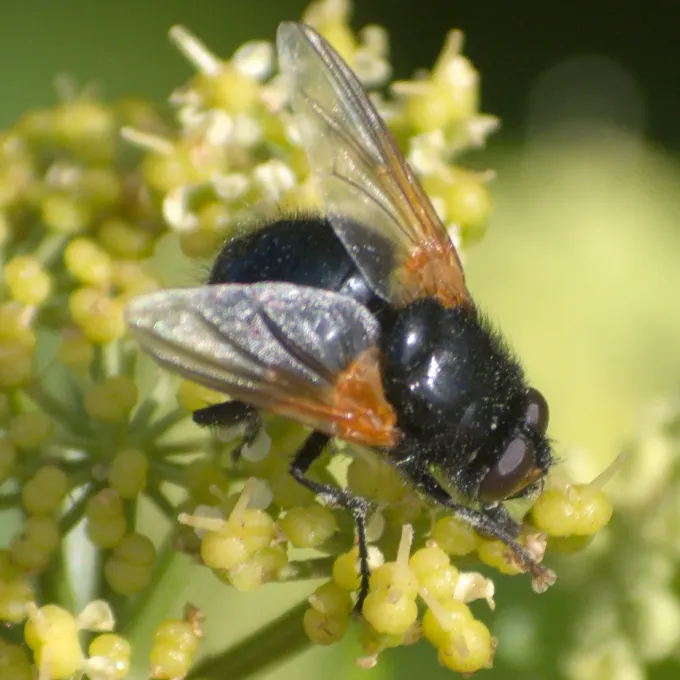
Description
How to identify
The genus Mesembrina, including the species Mesembrina meridiana, belongs to the family Muscidae of the order Diptera. Externally, the adults resemble common houseflies but are significantly larger, characterized by a metallic black body and yellowish fuzz on the thorax.
The adults possess robust mouthparts of the lapping-sucking type, perfectly adapted for feeding on organic matter. The larvae share typical morphology for Muscidae: they are legless, whitish, cylindrical, with a pointed anterior end and a truncated posterior.
A distinctive feature of the genus's biology is its strong dependence on dung and animal excrement. The adults are frequently found in open areas, pastures, and near livestock farms, where they locate suitable substrates for oviposition.
The life cycle of Mesembrina comprises four stages: egg, larva (three instars), pupa (enclosed in a puparium), and adult. Larval development occurs exclusively in organic-rich media, making these insects an important part of the decomposition process.
Temperature significantly impacts the rate of development for this species. During the warmer seasons, a complete generation cycle can be finished in just a few weeks, which facilitates rapid population growth in mid-summer.
What it damages
Mesembrina is not a direct agricultural pest in the sense of damaging plant foliage or crops. Instead, its impact is primarily associated with livestock health and animal husbandry management.
The main concern is the annoyance caused to grazing livestock. Mass gatherings of these flies cause stress to the animals, which negatively influences milk production and the weight gain of beef cattle.
Furthermore, Mesembrina serves as a mechanical vector for various pathogenic microorganisms. By frequenting excrement and subsequently landing on feeding troughs or the animals themselves, flies facilitate the spread of infections.
In specific greenhouse settings that utilize non-disinfected manure as fertilizer, Mesembrina populations can explode, leading to unfavorable sanitary conditions that complicate daily operations.
High concentrations of these insects inside farm structures can hinder worker productivity and potentially contaminate agricultural products with insect excreta.
Control measures
The control strategy for Mesembrina is based primarily on maintaining high sanitary standards in animal housing and manure storage facilities.
A highly effective method is the regular removal and transfer of manure to specialized composting areas, where thermal treatment occurs to eliminate fly eggs and larvae.
Chemical control includes the use of insecticidal baits or adhesive traps in livestock buildings, ensuring that toxic substances do not come into contact with animal feed.
To control adult populations in pastures, topical repellents are applied to livestock, which reduces stress levels and minimizes the risk of pathogen transmission.
Biological control measures involve the use of natural predators, such as hister beetles and dung beetles, which compete with fly larvae for the organic food source.
Taxonomy
- Latin name
- Mesembrina
- Order
- Diptera (flies)
- Family
- Muscidae
- EPPO code
- MESMSP
Discussion
No discussions yet — be the first.