
Lewin's honeyeater
Meliphaga lewinii
Description
How to identify
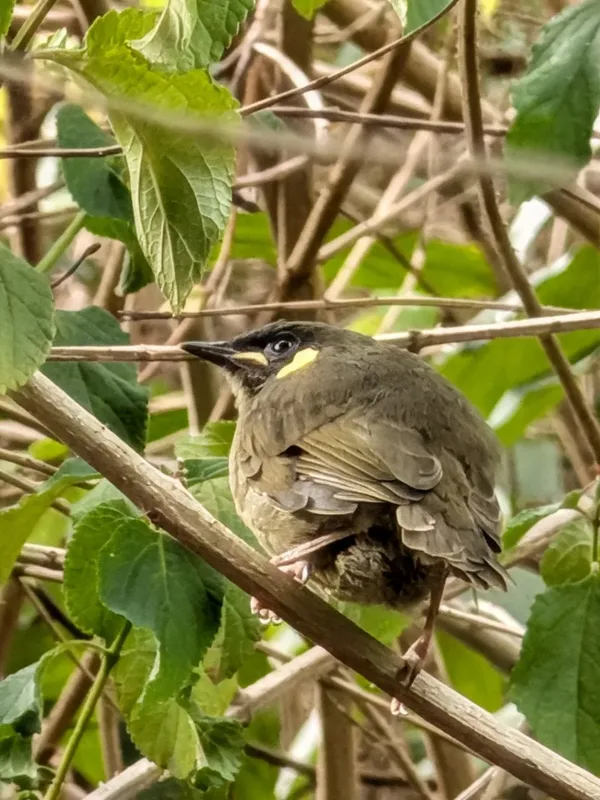
Lewin's honeyeater (Meliphaga lewinii) is a bird species belonging to the Meliphagidae family, easily recognizable by a bright yellow patch behind the ear-coverts.
These birds are medium-sized with olive-green plumage, which provides excellent camouflage among foliage, making them difficult to spot in orchards or vineyards.
They are highly territorial and vocal, often observed in groups, and their presence is usually announced by loud, machine-gun-like clicking calls that echo through the trees.
The beak is slightly decurved, perfectly evolved for reaching nectar, but also efficient at piercing the tough skins of fruits like grapes, berries, and stone fruits.
While the adults are well-defined, juveniles are often found alongside them, learning to exploit various food sources, including agricultural crops, which increases the impact of a local flock.
What it damages
Lewin's honeyeater is a significant agricultural pest, particularly during the ripening season of stone fruits, pome fruits, and grapes in various regions of Australia.
They cause damage by pecking into the fruit to feed on the sugary pulp, which leaves the produce compromised and susceptible to secondary infections by pathogens and rot.
Vineyards are particularly vulnerable; honeyeaters can strip entire clusters of grapes, often leaving only the stems or damaged, rotting berries that attract secondary insect pests like wasps.
Small fruits like raspberries and blueberries are also targets. A flock of honeyeaters can cause massive losses in a short timeframe if left uncontrolled, rendering the harvest unmarketable.
The economic impact is compounded by the fact that even slightly pecked fruit is culled during sorting, leading to reduced yield and higher labor costs in fruit management.
When it appears
The peak activity season aligns with the warm months of spring and summer, which is when the majority of fruit crops are in the ripening stage and most attractive to these birds.
Early spring may see them visiting orchards during the flowering period, where they occasionally damage young buds or blossoms while searching for nectar.
During the summer fruit harvest, their activity levels inside orchards increase dramatically as they seek out both high-sugar fruits and accessible water sources during hot, dry periods.
Early autumn often marks the end of their peak fruit-feeding behavior, although they may continue to linger if there are late-maturing varieties left on the trees.
Winter months generally show a decrease in orchard pressure, as the birds revert to their natural diet of insects and native flower nectar in surrounding bushland areas.
Signs of infestation
The most prominent sign of Lewin's honeyeater presence is the presence of shredded, pecked fruit, often hanging on the tree with portions of the flesh consumed.
Clusters of grapes showing missing berries, often with jagged, uneven skin edges, are a primary indicator of honeyeater damage in viticulture.
Acoustic evidence is very common; the distinct, sharp, repetitive chattering calls are a reliable indicator that a group of honeyeaters is feeding in the vicinity.
Accumulation of bird droppings on leaves and fruit clusters, along with debris like discarded skin fragments, is typically visible under feeding sites.
A sudden increase in fallen, partially eaten fruit beneath the canopy is a clear symptom that the orchard has been targeted by these avian pests.
Control measures
The gold standard for protecting crops from Lewin's honeyeater is the use of high-quality exclusion netting, which physically prevents birds from accessing the fruit.
Visual deterrents, including reflective tape, holographic eyes, or predator kites, can provide temporary relief but usually have limited long-term effectiveness due to the birds' intelligence.
Managing the orchard environment is crucial: removing nearby brush or thickets that serve as nesting sites can help reduce the local population density.
Harvesting fruits as soon as they reach maturity is a key practice, as overripe fruits are significantly more attractive to honeyeaters than firm, just-ripe produce.
- Utilize audio deterrent systems that broadcast natural predator alarm calls.
- Ensure irrigation systems do not create puddles that might attract birds for drinking.
- Encourage local raptor populations to establish themselves near the orchard.
Taxonomy
- Latin name
- Meliphaga lewinii
- Family
- Meliphagidae
- EPPO code
- MLPHLE
Discussion
No discussions yet — be the first.