
Black pecan aphid
Melanocallis caryaefoliae
Description
How to identify
The black pecan aphid, scientifically known as Melanocallis caryaefoliae, is a significant pest primarily affecting pecan and various species of walnut trees.
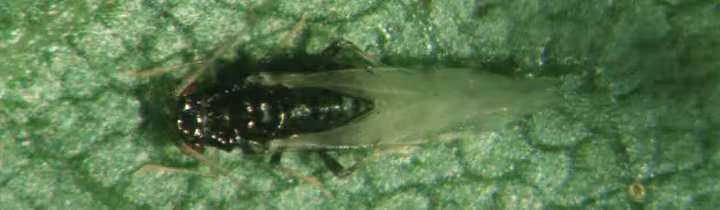
The adults are characterized by their small, dark, nearly black appearance. They are often found in colonies on the underside of leaves, which provides a protected micro-environment.
This aphid species has a complex life cycle, involving both wingless and winged forms. Winged adults are highly mobile, allowing them to spread rapidly throughout an orchard.
The overwintering stage consists of eggs laid by females in the crevices of the tree bark or near the leaf scars, ensuring the pest survives cold winter temperatures.
Identification can be confirmed by looking for small, dark clusters of aphids on the undersides of leaves, often accompanied by characteristic yellow spotting on the foliage.
What it damages
The primary damage caused by Melanocallis caryaefoliae is the withdrawal of phloem sap, which deprives the tree of essential nutrients and photosynthetic products.
Feeding by this aphid causes distinct bright yellow, angular spots to appear on the leaves. These spots eventually turn brown or necrotic as the tissue dies.
Severe infestations lead to premature defoliation, which severely stresses the tree and can lead to reduced nut quality and lower yields in the following seasons.
The aphids excrete a substance known as honeydew, which promotes the growth of sooty mold, blocking sunlight and further interfering with the tree's ability to produce energy.
In cases of heavy infestation, the tree's overall vigor decreases, making it more susceptible to environmental stressors and secondary infections.
When it appears
The life cycle begins in early spring when eggs hatch and the nymphs begin feeding on the newly developed leaves of the host tree.
Population levels usually increase throughout the summer months, with multiple overlapping generations occurring, especially during hot and dry weather conditions.
As the season progresses toward autumn, the aphids produce sexual forms that mate and lay eggs, which will remain on the tree through the winter until the following spring.
Monitoring should be most intensive from late spring through mid-summer, when the population density has the potential to reach economic threshold levels.
Weather patterns, particularly humidity and temperature extremes, directly affect the reproductive rate of the aphid colonies throughout the growing season.
Signs of infestation
The most visible sign of infestation is the presence of irregular, bright yellow angular spots appearing on the green foliage.
Sticky honeydew buildup on the leaf surfaces, branches, and even the ground beneath the tree is a clear indicator of aphid activity.
A darkening of the foliage caused by the growth of black sooty mold fungus is a secondary sign that often develops on heavily infested trees.
Premature yellowing and leaf drop in mid-summer are clear indicators that the trees are suffering from significant aphid pressure.
The presence of ant activity on the tree trunk is often a sign that they are protecting aphid colonies to harvest the sweet honeydew they produce.
Control measures
Effective management requires a combination of regular monitoring, biological control, and, when necessary, targeted chemical interventions.
Biological control agents, such as lady beetles, lacewing larvae, and parasitic wasps, play a vital role in suppressing aphid populations naturally.
Chemical control should be applied using selective insecticides that target aphids while minimizing impact on beneficial predatory insects in the orchard.
- Maintain tree vigor through proper irrigation and balanced fertilization practices.
- Regular pruning to improve air circulation and sunlight penetration throughout the tree canopy.
- Use of horticultural oils during the dormant season to reduce the overwintering egg population.
- Implement regular scouting to detect initial signs of aphid presence before populations explode.
- Avoid over-fertilization with nitrogen, which can create succulent growth favored by aphids.
In commercial orchards, growers should utilize economic thresholds to determine when chemical applications are necessary to prevent significant yield losses.
Taxonomy
- Latin name
- Melanocallis caryaefoliae
- Order
- Hemiptera (bugs, aphids, leafhoppers)
- Family
- Aphididae
- EPPO code
- TINCCA
Discussion
No discussions yet — be the first.