
Sugarcane aphid
Melanaphis
Description
How to identify
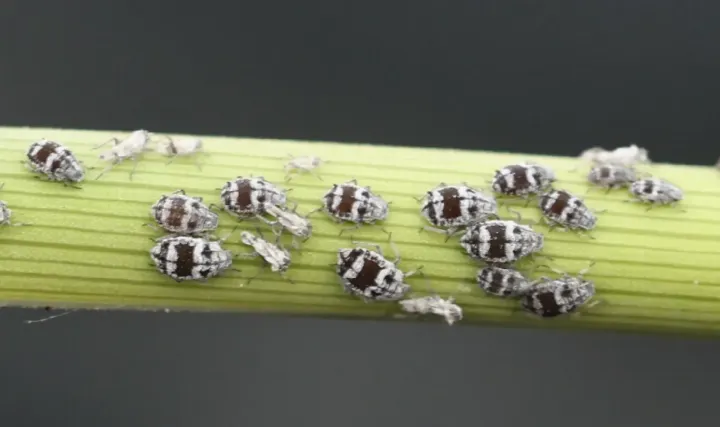
The sugarcane aphid, known by its scientific name Melanaphis sacchari, belongs to the family Aphididae within the order Hemiptera. Adult aphids are small insects, with coloration ranging from light yellow to light tan or dark brown, depending on their diet and the developmental stage of the colony.
These insects feature the typical aphid morphology: a soft body, a pair of cornicles on the posterior abdomen, and a piercing-sucking mouthpart. Winged forms enable the pest to disperse rapidly across fields, while wingless individuals focus on rapid reproduction within established colonies.
Identification can be challenging due to their ability to fluctuate in population density based on temperature and humidity. They typically cluster on the underside of leaves, forming dense colonies that are easily spotted during routine field inspections during hot weather.
The life cycle of Melanaphis sacchari involves both sexual and asexual (parthenogenetic) reproduction, where females give birth to live nymphs without fertilization. This allows the population to grow exponentially in a very short time, especially under favorable climatic conditions.
In warm climates, this pest can persist on weeds or volunteer crops, ensuring the continuity of generations. Its high adaptability makes it a significant threat to cereal production in regions with intensive monoculture or warm growing seasons.
What it damages
The primary host for Melanaphis sacchari is sorghum, including grain, sweet, and forage varieties. Additionally, the pest can infest corn, millet, sugarcane, and various wild grasses, which act as reservoirs for infection during the off-season.
The aphids feed on plant sap by piercing the leaf epidermis. This feeding causes severe plant stress, disrupts photosynthesis, and leads to significant reductions in both biomass and seed yield, impacting the overall harvest quality.
Beyond direct sap extraction, the sugarcane aphid excretes honeydew—a sticky, sugary substance. This honeydew serves as a substrate for the development of sooty mold, which covers leaves in a black layer, effectively blocking sunlight and further inhibiting the plant's metabolic processes.
This aphid is also an active vector for various plant viral diseases. Injecting saliva during feeding triggers phytotoxic reactions, characterized by red or brown necrotic spots on leaves, leaf curling, and premature tissue senescence.
During massive outbreaks, sorghum plants may wither completely or lose the ability to develop healthy panicles. This leads not only to yield loss but also to a decrease in silage quality, which is detrimental to livestock feeding operations.
When it appears
Peak activity of the sugarcane aphid occurs in the second half of the growing season when high temperatures and moderate humidity are established. During these periods, the life cycle of a single generation can be as short as 7 to 10 days.
Spring colonization of fields begins with the migration of winged females from overwintering sites. Optimal conditions for reproduction occur at temperatures between 25 and 30 degrees Celsius, where female fecundity reaches its maximum.
During the summer months, an exponential increase in pest numbers is typically observed, necessitating weekly field monitoring. It is crucial to detect colonies before they spread across the entire canopy, as control becomes significantly harder as population density rises.
As autumn approaches, with falling temperatures and shorter days, development slows down, and the insects prepare for overwintering. During this phase, destroying crop residues is vital to reduce the food source for the pest in the following season.
The intensity of the infestation is strongly correlated with local microclimatic conditions. Shaded areas or fields with poor water management are more prone to severe aphid outbreaks, making them high-risk zones for intensive scouting.
Signs of infestation
The first sign of infestation is the appearance of a sticky residue on the upper surface of leaves located below the aphid colonies. This stickiness is caused by honeydew dripping from higher parts of the plant.
Visually, the presence of the pest is confirmed by inspecting the underside of lower and middle leaves. One can see colonies of yellow-to-brown insects, often accompanied by ants that feed on the honeydew and protect the aphids from natural predators.
A characteristic symptom is leaf discoloration and the appearance of chlorotic spots at the site of feeding. Over time, these spots can darken to a rusty-red hue, which is often misdiagnosed as fungal disease or nutrient deficiency.
- Curling and deformation of young leaves.
- Black sooty mold deposits on leaf surfaces.
- Stunted growth and poor panicle development.
- Heavy ant traffic on plant stems.
- Premature yellowing and desiccation of lower leaves.
In advanced cases, plants appear sickly and stunted, and fields may develop a scorched appearance due to extensive tissue necrosis caused by the combination of fungal growth and the insect's salivary enzymes.
Control measures
The management strategy for the sugarcane aphid must be integrated, involving agronomical, biological, and chemical methods. Weed control is a top priority, as weeds serve as critical host bridges until the main crop emerges.
Agronomical practices include proper crop rotation and optimal planting dates. Healthy, well-fertilized crops are more resilient to aphid attacks, whereas water stress or excessive nitrogen application can make plants more attractive to the pest.
Biological control relies on protecting and encouraging natural enemies such as lady beetles, lacewings, hoverflies, and parasitic wasps. Insecticide applications should be selective to avoid harming these beneficial populations.
Chemical control is warranted when economic injury thresholds are exceeded. Systemic insecticides that penetrate plant tissues are preferred, as they provide longer-lasting protection against aphids that hide in sheltered leaf niches.
During application, ensuring thorough coverage of the leaf undersides is critical. The use of appropriate adjuvants can improve spray penetration and enhance the overall efficacy of the insecticide against the pest in its sheltered habitat.
Taxonomy
- Latin name
- Melanaphis
- Order
- Hemiptera (bugs, aphids, leafhoppers)
- Family
- Aphididae
- EPPO code
- MELHSP
Discussion
No discussions yet — be the first.