
Bean pod borer
Melanagromyza obtusa
Description
How to identify
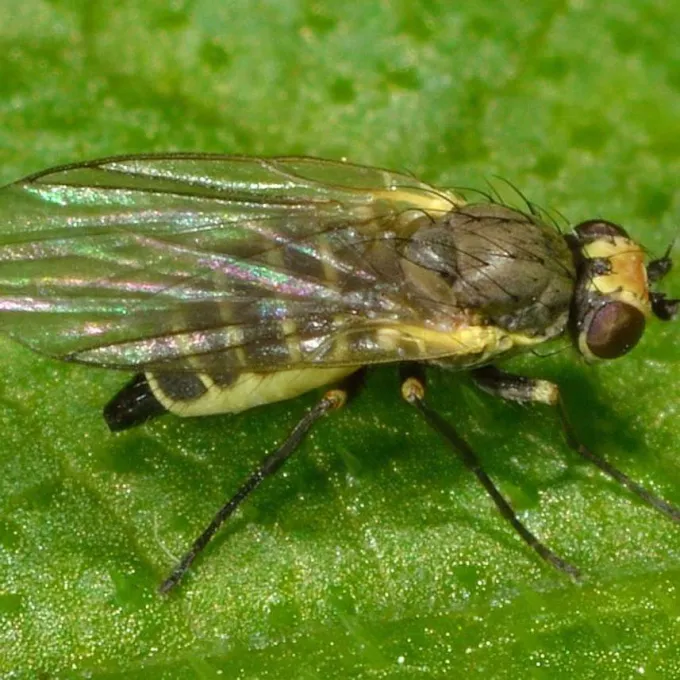
The bean pod borer (Melanagromyza obtusa) belongs to the order Diptera and the family Agromyzidae. The adult is a small, dark-colored fly characterized by a subtle metallic luster on its body.
The larva is cylindrical, legless, and cream-colored. This stage is the primary cause of agricultural damage, as larvae burrow into plant tissues immediately upon hatching.
The life cycle involves egg, larva, pupa, and adult stages. Favorable conditions include high humidity and warm temperatures, which facilitate rapid multiplication and overlapping generations.
Females deposit eggs directly into the walls of young pods or tender stems. This strategic placement ensures that larvae have immediate access to nutrients essential for their rapid development.
The development speed is highly temperature-dependent, with the entire cycle from egg to adult often taking between three to four weeks, enabling multiple generations per season.
What it damages
This pest primarily attacks grain legumes. It is particularly notorious for causing substantial damage to crops like pigeon peas (Cajanus cajan) and chickpeas in various tropical and subtropical regions.
Larvae feed internally on developing seeds, causing severe deformation and complete destruction of the grain, which leads to significant yield losses and lower quality of the harvest.
In addition to direct feeding damage, the entry points created by the larvae often become sites for secondary bacterial or fungal infections, leading to pod rot and reduced seed viability.
Under heavy infestation pressure, crop losses can reach catastrophic levels of up to 50-80% in susceptible varieties if no proper management measures are implemented.
The damage occurs during the crucial reproductive phase of the plant, preventing the accumulation of biomass in seeds and forcing the plant to divert energy to defense instead of growth.
Signs of infestation
The presence of the pest is indicated by minute, characteristic puncture marks on the surface of the pods, which are the sites where females inserted their ovipositor to lay eggs.
Upon opening the pods, one can observe the larvae feeding inside, with visible trails and galleries excavated within the grain tissues and pod walls.
External signs include dark, meandering lines or "mines" on the pod surface, representing the paths taken by larvae as they move through the pod tissues.
Severely infested plants may show stunted growth, yellowing, and premature senescence, as the internal damage interferes with the physiological processes of the developing seeds.
- Punctured pod surfaces from oviposition.
- Deformed, shriveled, or hollowed-out seeds.
- Visible internal larval galleries.
- Darkened tracks or "mines" on the pod exterior.
Control measures
Integrated Pest Management (IPM) is essential. Crop rotation is a primary cultural practice, as it prevents the continuous buildup of pest populations in fields where legumes are grown annually.
Deep plowing after harvest is highly recommended, as it buries and destroys pupae present in the soil, effectively reducing the overwintering population for the next crop cycle.
Chemical control focuses on the use of systemic insecticides during the peak of adult fly activity to prevent egg-laying, as larvae inside the pods are difficult to target.
Monitoring using yellow sticky traps or pheromone baits allows farmers to determine the economic threshold and apply insecticide treatments only when necessary, minimizing environmental impact.
Maintaining field sanitation and removing alternative legume host plants or weeds around the farm perimeter can significantly decrease the risk of infestation and migration.
Taxonomy
- Latin name
- Melanagromyza obtusa
- Order
- Diptera (flies)
- Family
- Agromyzidae
- EPPO code
- MEAGOP
Discussion
No discussions yet — be the first.