
Tsuga seed chalcid
Megastigmus tsugae
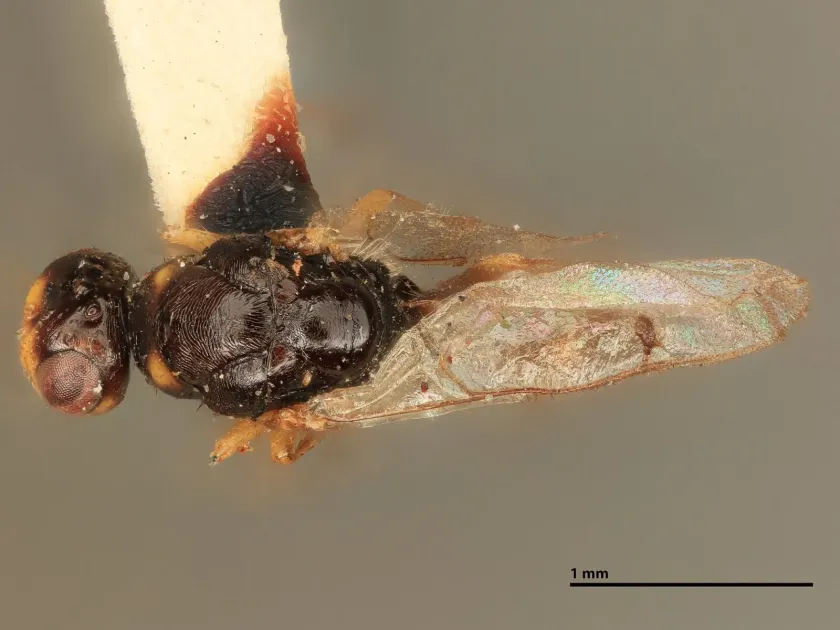
Description
How to identify
The Tsuga seed chalcid (Megastigmus tsugae) is a small hymenopteran insect belonging to the family Torymidae. These tiny parasitic wasps are highly specialized, targeting the seeds of hemlock (Tsuga) trees.
Adult insects are typically brownish or yellowish in color. Females possess a prominent ovipositor, an elongated structure used to penetrate the developing seed coat and deposit eggs deep within the seed tissues.
Larvae are legless, grub-like, and cream-colored. Their entire developmental stage is spent inside a single seed, where they consume the endosperm and embryo, remaining well-protected from external threats.
Because they spend their entire juvenile life hidden within the seed, they are notoriously difficult to detect by general nursery inspection until the damage is already significant.
This species is highly specific to its host plants, meaning its presence is strictly tied to the distribution of Tsuga stands, which is a key factor for forest pathologists monitoring their spread.
What it damages
The primary economic impact of this pest is the destruction of hemlock seeds, which is a significant problem for forest regeneration programs and nurseries seeking to propagate native hemlock species.
Larvae consume the interior of the seed, effectively killing the germ. A seed infested by a chalcid larva will appear normal from the outside but will be completely non-viable for germination.
Heavy infestations can lead to a drastic reduction in seed yield. In some cases, a large percentage of a seed lot may be rendered worthless, causing major financial losses for nursery managers.
The pest does not typically damage the foliage or woody parts of the tree, keeping the host looking healthy while silently destroying its potential for reproduction.
Indirect damage occurs when empty seed coats harbor secondary fungal pathogens, further reducing the overall health of the remaining seed collection after processing.
When it appears
The life cycle of the Tsuga seed chalcid is tightly synchronized with the host tree's cone development. Adults emerge during the spring when the cones are in the early stages of development.
Mating and oviposition occur shortly after emergence. Females carefully select developing cones and insert their ovipositor into the small seeds to deposit their eggs.
Once the egg hatches, the larva begins to feed on the endosperm throughout the summer and autumn. This period is critical, as the larva builds up energy reserves for overwintering.
The insect enters diapause as a larva within the seed. During the winter, the seeds (often still inside the cones on the ground or the tree) provide a stable environment for survival.
Pupation occurs in the following spring within the seed. The adult wasp eventually cuts a small, round exit hole to emerge, marking the completion of its life cycle.
Signs of infestation
The most diagnostic sign of infestation is the presence of small, circular exit holes, approximately 1 mm in diameter, found on the surface of the seeds or the cone scales.
When evaluating seed batches, infested seeds feel significantly lighter than healthy ones. They often break easily under light pressure, revealing a hollow interior.
Inspecting a cross-section of a suspect seed will reveal a hollowed-out cavity. If the insect is still inside, you may find the larva itself or dark frass pellets left behind.
Floating tests are a reliable method for detecting empty seeds: healthy seeds sink in water, while those damaged by the chalcid typically float due to their lack of internal mass.
In a nursery setting, the failure of seeds to germinate despite being stored under proper conditions is often the first real indicator of a latent seed chalcid problem.
Control measures
Effective control begins with strict phytosanitary measures. Avoiding the movement of infested cones or seeds between different geographical regions is essential to prevent the spread of the pest.
Fumigation of seed lots is the standard industrial method for neutralizing larvae within the seeds. This process ensures that the germinating potential is protected without harming the seed viability.
Collecting cones as early as possible in the season and storing them in insect-proof facilities helps prevent further infestation by adult wasps arriving from nearby areas.
Separating the light, hollow seeds from the healthy ones using gravity tables or wind-based cleaning systems can significantly increase the quality of the planting material.
- Use of pheromone traps for monitoring adult activity.
- Destruction of heavily infested cone material by burning.
- Regular seed viability testing through X-ray radiography.
Taxonomy
- Latin name
- Megastigmus tsugae
- Order
- Hymenoptera
- Family
- Torymidae
- EPPO code
- MEGSTS
Discussion
No discussions yet — be the first.