
Fir seed chalcid
Megastigmus suspectus
Description
How to identify
The fir seed chalcid (Megastigmus suspectus) is a small hymenopteran insect belonging to the family Torymidae. It is a specialized pest that targets the seeds of fir trees (Abies species).
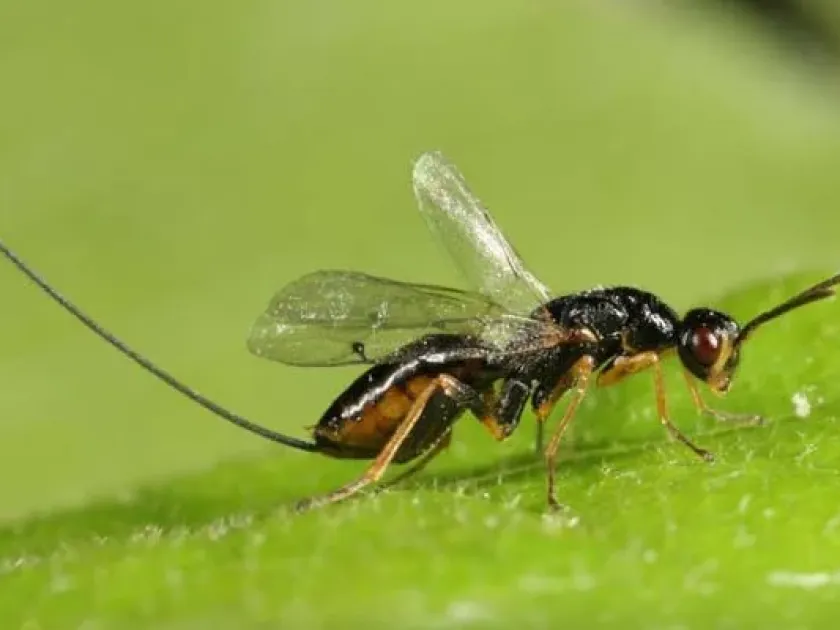
Adults are typically 3 to 5 mm long, with a slender body that is usually yellowish-brown or brown in color. They resemble small wasps and possess two pairs of clear, veined wings.
The female insect is equipped with a long ovipositor, which is used to insert eggs deep into the developing seeds within the fir cones during the early stages of cone growth.
Larvae are white, legless, and have a curved body shape. They develop entirely within the host seed, consuming the embryo and endosperm from the inside out.
Identification of the adult stage is most common during the spring months, coinciding with the flowering period of host trees.
What it damages
The primary economic impact of this species is the significant reduction in viable seed production, which can cause severe issues for nurseries and forest regeneration efforts.
Because the larvae feed internally on the seed, the damage remains hidden throughout the maturation of the cone. Often, the external appearance of the cone remains unaffected.
In high-infestation years, the fir seed chalcid can destroy nearly the entire seed crop, rendering the harvest practically worthless for professional cultivation.
This pest does not kill the host tree, but it severely limits the reproduction success of the fir forest, which is critical for natural biodiversity and timber management.
The damage is cumulative, and repeated infestations over several years can lead to a drastic decline in local seed stock quality.
When it appears
The lifecycle is generally univoltine, meaning one generation occurs per year. Adults emerge in the spring to mate and lay eggs on fresh, developing cones.
The egg is deposited inside the seed, and the larva hatches and feeds throughout the summer. As the seed matures, the larva remains inside, protected by the seed coat.
The insect overwinters as a mature larva inside the dormant seed. This allows it to survive harsh winter temperatures within the protective cone structure.
Pupation occurs in the following spring, just before the adults chew their way out of the seed coat, creating a small, characteristic emergence hole.
In some populations, a small percentage of individuals may remain in diapause for an extra year, acting as a natural buffer for the population during bad seasons.
Signs of infestation
The most reliable sign of an infestation is the presence of small, circular emergence holes in the seed coat, roughly 1 mm in diameter, found after the extraction process.
Infected seeds are typically much lighter than healthy ones, which is a useful trait during the cleaning process using air-separation equipment.
X-ray imaging (radiography) is the gold-standard method for detecting larvae within seeds without damaging them, allowing for accurate quality assessment of batches.
If an entire lot of seeds shows low germination rates without a clear external cause, dissection of a sample batch will usually reveal the presence of larvae.
Detection is difficult during field surveys because there is rarely any visible damage to the cone scales or external needles of the fir tree.
Control measures
Management focuses on prevention and rigorous seed inspection. Ensuring that seed sources are not from historically high-infestation areas is the first line of defense.
Prompt harvesting of cones is vital; gathering cones shortly after they mature can prevent some of the adult emergence and further spread of the pest.
Storage conditions that maintain the seeds in specific temperatures or moisture levels can sometimes limit the success rate of the developing larvae.
Biological control, including the protection of natural parasitoids (other small wasps that prey on the chalcid larvae), is encouraged in sustainable forest management.
- Implement strict sanitation by removing and burning infested cones.
- Use X-ray testing to identify and discard heavily infested seed lots.
- Maintain seed orchards with proper spacing to reduce pest mobility.
- Avoid moving potentially infested seeds between regions to prevent range expansion.
Taxonomy
- Latin name
- Megastigmus suspectus
- Order
- Hymenoptera
- Family
- Torymidae
- EPPO code
- MEGSSU
Discussion
No discussions yet — be the first.