
Douglas-fir seed chalcid
Megastigmus spermotrophus
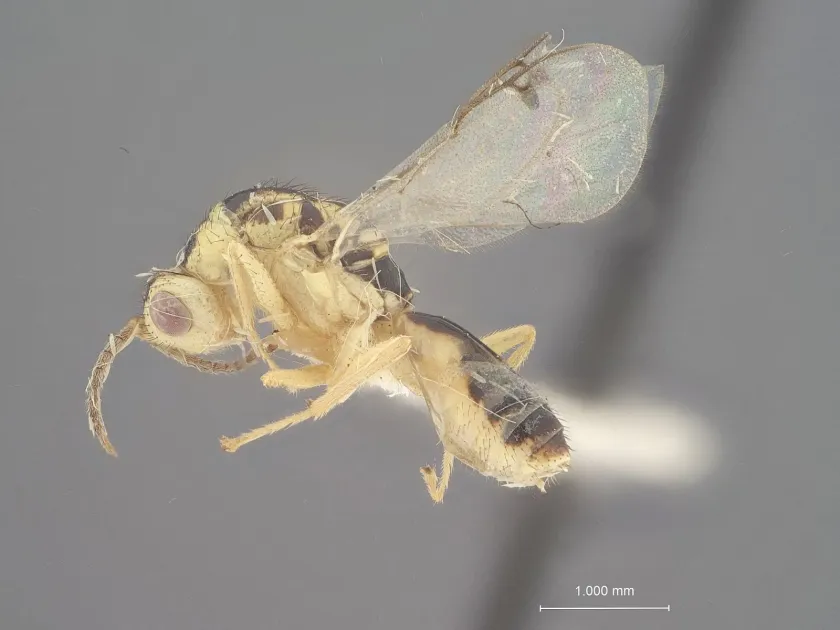
Description
How to identify
The Douglas-fir seed chalcid (Megastigmus spermotrophus) is a member of the Torymidae family within the Hymenoptera order. It is a small wasp, typically measuring between 3 to 5 millimeters in length.
Adult females are characterized by a long ovipositor, which they use to penetrate the scales of Douglas-fir cones and lay their eggs directly into the developing seeds.
The larvae are white or cream-colored, legless, and slightly curved. Their entire development occurs inside the seed, making the infestation invisible to the naked eye until the adult wasp emerges.
The lifecycle is generally univoltine, meaning one generation per year, though some individuals may undergo extended diapause and remain as larvae inside the seed for two years or more.
Identifying this pest in the field is difficult, as the internal feeding causes no immediate outward signs on the cones during the growing season.
What it damages
The primary host for this species is the Douglas-fir (Pseudotsuga menziesii). The larvae feed exclusively on the endosperm and embryo of the seed, effectively destroying it.
In high-infestation years, the Douglas-fir seed chalcid can consume a significant portion of the seed crop, sometimes resulting in losses exceeding 70-80 percent in commercial orchards.
Because the seed coat remains intact while the internal contents are consumed, infested seeds are indistinguishable from healthy ones until they are dissected or tested for density.
The damage is not just a loss of current seed yield but also a major obstacle for reforestation projects that rely on high-quality, viable seeds for propagation.
Furthermore, infested seeds have a lower specific gravity, which often leads to poor performance during sowing and lower germination rates in forest nurseries.
When it appears
Adult emergence typically occurs in the spring, coinciding with the flowering period of the Douglas-fir and the development of young, receptive cones.
Once mated, the female wasp begins the oviposition process, carefully inserting her long ovipositor through the cone scales to reach the developing ovules.
The larvae hatch and begin feeding during the summer months. By late autumn, they reach maturity and enter a period of dormancy, remaining inside the seed throughout the winter.
Wintering occurs within the seeds, which may remain in the cones on the trees or drop to the ground. This survival strategy protects the larvae from harsh environmental conditions.
As spring arrives, the larvae pupate inside the seed, and the adult wasps eventually chew their way out of the seed coat and cone scale to restart the cycle.
Signs of infestation
The most reliable sign of an established infestation is the presence of small, perfectly circular emergence holes, roughly 1 millimeter in diameter, on the surface of the cone scales.
Dissecting suspected seeds is a definitive method of identification. If infested, the seed will be hollow, often containing the larva, pupa, or cast skins of the pest.
A simple water floatation test can also reveal the infestation, as damaged, hollow seeds are significantly lighter and will float, whereas healthy, full seeds will sink.
- Circular emergence holes on cone scales.
- Hollow seeds when dissected.
- Presence of white larvae within the seed coat.
Control measures
Chemical control is challenging due to the short window of adult activity. Applications of insecticides must be precisely timed with the emergence of the adults to be effective.
Cultural practices, such as the prompt harvest of cones before the wasps emerge, are the most effective management tools for minimizing seed loss in commercial operations.
Seed processing plants often use cold storage or heat treatment protocols to kill any larvae hidden inside the seeds before they are distributed for planting.
Monitoring adult populations using color-coded sticky traps can help foresters predict the potential severity of the infestation and plan necessary interventions.
Quarantine measures and the inspection of seed lots help prevent the accidental spread of the Douglas-fir seed chalcid to uninfected nurseries or forest plantations.
Taxonomy
- Latin name
- Megastigmus spermotrophus
- Order
- Hymenoptera
- Family
- Torymidae
- EPPO code
- MEGSSR
Discussion
No discussions yet — be the first.